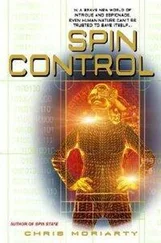
Chris Moriarty - Spin State
Здесь есть возможность читать онлайн «Chris Moriarty - Spin State» весь текст электронной книги совершенно бесплатно (целиком полную версию без сокращений). В некоторых случаях можно слушать аудио, скачать через торрент в формате fb2 и присутствует краткое содержание. Год выпуска: 2003, ISBN: 2003, Издательство: Bantam spectra, Жанр: Фантастика и фэнтези, на английском языке. Описание произведения, (предисловие) а так же отзывы посетителей доступны на портале библиотеки ЛибКат.
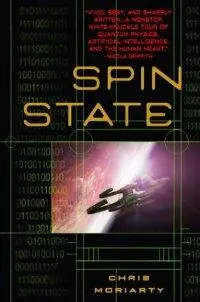
- Название:Spin State
- Автор:
- Издательство:Bantam spectra
- Жанр:
- Год:2003
- ISBN:978-0-553-38213-6
- Рейтинг книги:5 / 5. Голосов: 1
-
Избранное:Добавить в избранное
- Отзывы:
-
Ваша оценка:
Spin State: краткое содержание, описание и аннотация
Предлагаем к чтению аннотацию, описание, краткое содержание или предисловие (зависит от того, что написал сам автор книги «Spin State»). Если вы не нашли необходимую информацию о книге — напишите в комментариях, мы постараемся отыскать её.
UN Peacekeeper Major Catherine Li has made thirty-seven faster-than-light jumps in her lifetime—and has probably forgotten more than most people remember. But that’s what backup hard drives are for. And Li should know; she’s been hacking her memory for fifteen years in order to pass as human. But no memory upgrade can prepare Li for what she finds on Compson’s World: a mining colony she once called home and to which she is sent after a botched raid puts her on the bad side of the powers that be. A dead physicist who just happens to be her cloned twin. A missing dataset that could change the interstellar balance of power and turn a cold war hot. And a mining “accident” that is starting to look more and more like murder…
Suddenly Li is chasing a killer in an alien world miles underground where everyone has a secret. And one wrong turn in streamspace, one misstep in the dark alleys of blackmarket tech and interstellar espionage, one risky hookup with an AI could literally blow her mind.
Spin State — читать онлайн бесплатно полную книгу (весь текст) целиком
Ниже представлен текст книги, разбитый по страницам. Система сохранения места последней прочитанной страницы, позволяет с удобством читать онлайн бесплатно книгу «Spin State», без необходимости каждый раз заново искать на чём Вы остановились. Поставьте закладку, и сможете в любой момент перейти на страницу, на которой закончили чтение.
Интервал:
Закладка:
“No one’s stolen anything from me,” she said finally. “I sold it. And why, and when, and what for is none of your business.”
Korchow watched her over the rim of his teacup. When he spoke, his voice was cool and detached, and he looked up at the ceiling instead of at her. “I’ve been on five Trusteeships in the last eight years. And I’ve seen the same game, a sport I suppose, on all of them. A poor man’s sport, popular in the Trusteeships, but not at all known in the inner worlds. The enthusiasts breed male chickens—”
“Cocks,” Li said.
“Cocks, then. They breed them to kill each other. The fights are held at night and in secret; the sport is illegal on most worlds. Spectators arrive at the appointed place and hour, lay bets, drink various types of hard liquor. Then the handler of each bird takes it from its cage, attaches razor blades to its spurs, and sends it into the ring to peck and claw a fellow chicken to death.”
Korchow put down his teacup and leaned across the desk to pour Li another cup of tea. “Good tea, isn’t it?” he said.
“Yes.”
“I get it from a friend in New Ceylon. They appreciate the art of tea there. And the art of the deal. Ever been there?”
“No.”
“Mmm.” Korchow settled back in his chair, cup in hand. “Between tournaments the fighting cock lives in oriental luxury. He is a prince, a diva, a satrap. He knows nothing of the ordinary woes and sorrows of his species. But each pleasure we savor must be purchased with pain—a principle I am sure you appreciate, Major. And even the most spectacular fighting cock is, after all, a chicken.” He drew a taut index finger across his throat. “I wonder what those cocks would say about their lives if you could get inside the cage with them. I wonder if they’d tell you they chose this fate. That they’d sold their life, their death, and gotten a fair price for it.”
“I wouldn’t know,” Li said. “I’m not a chicken.”
“No you’re not.” Korchow smiled. “And I have a powerful presentiment that you’re about to tell me to get on with it and stop wasting your time.”
Li raised an eyebrow.
“I represent certain interested parties,” Korchow continued after a few beats.
“The Syndicates.”
“Let’s not name names just yet. In any case, at the time of Hannah Sharifi’s death, these parties were engaged in… ongoing negotiations. Their negotiations had reached a point at which the involved parties expected to receive specific items of information from Dr. Sharifi. That information was never received. The parties believe that you, as the UN officer investigating her death, are in a position to deliver it.”
“You want the datasets from Sharifi’s live field run.”
“Ah. The direct approach. How like you.”
“You can forget about it. I don’t have them.”
Korchow rocked back in his chair as if he were dodging a blow. “Now that is a most interesting statement. First, because we have assumed until this moment that you did in fact have them. Second, and correct me if I err, your answer suggests that if you were to acquire this information, you might not be absolutely opposed to sharing it.”
Li shrugged.
“I think,” said Korchow, “this is the juncture at which I am supposed to inform you that my… clients would be prepared to reward you liberally for your assistance. In money, or in ways that might, in the end, mean more to you than money.”
“Are we talking about chickens again?” Li said.
Korchow threw back his head and laughed. “Major,” he said, still laughing. “You more than live up to your reputation. No, we are not talking about chickens. We are talking about a level of remuneration that would allow you to, how shall I put this?… decide when and where and for whom you strap on the razor blades.”
“Or?”
“Or incorporation. What you would call political sanctuary. Into the Syndicate of your choice.”
“Christ, Korchow. I’ve seen the Syndicates. I’ve seen how you people live. Why the hell would I want that?”
“I’ll leave you to answer that question for yourself, Major.”
The bells on the shop door tinkled. Li turned just in time to see a new customer walk in. A tall man, dressed in ministerial gray. A diplomat or banker. Definitely not local.
“Mr. Lind!” Korchow beamed at the new arrival. “You’ve come back to look at the Heyerdal again? I’ll be at your disposal momentarily.” He pulled a knickknack off the shelf above his desk and began wrapping it in hand-printed rice paper. “I know you’ll enjoy this,” he told Li as he tied the package with a length of green ribbon. “It’s really quite an exceptional little piece. One of my personal favorites.” He smiled. “Consider it a symbol of my good intentions. And… other things.”
Li took the package without having actually seen what was in it, let herself be propelled to the counter, swiped her palm across the portable scanner Korchow held up. She wondered how he explained the absence of a credit implant to his clients. Probably faked allergies or religious objections.
“How can I reach you?” she asked.
Korchow smiled a bland, guiltless shopkeeper’s smile. “I’ll put you on the mailing list,” he said—and Li felt his hand in the small of her back, politely but firmly propelling her out into the street.
When she turned the corner, she stopped, looked back to make sure she couldn’t be seen from the shop, and unraveled the elaborately folded rice paper. Korchow had sold her a generation-ship-era figurine, molded in plastic. It had once been brightly colored, but the paint had flaked and faded, leaving the figure’s skin—or were those scales?—mottled.
It was a woman, or rather a caricature of one. Long hair cascaded over her bare shoulders, and her breasts were only hinted at. Instead of legs, she had a silver tail with fins and scales. A mermaid. Half one thing, half the other, at home in neither world.
Li felt the ridges of raised lettering on the base of the figurine. She turned it over and read MADE IN CHINA, in block letters, and, immediately below it, DISNEY ®.
She rewrapped the figurine carefully, returned it to the bag, and unfolded the credit slip Korchow had tucked into the wrapping.
“Son of a bitch!” she said when she read the figure at the bottom of the printout.
It was for four times her monthly salary. And it was a credit, not a debit. A transfer into an account Li had never opened, in a Freetown bank she had never heard of. It looked like Korchow had decided to pay in advance… and leave Li to do the explaining if anyone put the pieces together.
Zona Libre: 20 Mar 48.
Even shunted through an organic interface ,an Emergent as vast as Cohen left a wide wake in streamspace.
Li found him in the Zona Libre, at a back table in a place called the 5th Column. She had to flash ID to get past the bouncers, and when she finally convinced them to let her in, she thought at first she’d come to the wrong place. Then someone called her name, and she looked over and saw Roland’s coppery curls gleaming against the oxblood velvet of a long banquette that curved along the shadowy back wall.
“I need to talk to you,” she said, sliding onto the empty place beside him. “Now.”
He smiled—an open, uncomplicated smile that was a million light-years away from any look that had ever crossed Cohen’s face. “Sorry,” Roland said. “I’m just the hired help.”
“Where’s Cohen, then?”
“He stepped out for a moment. Drop him a line and let him know you’re here.”
“No, I’ll just wait.”
“Okay.” Roland shrugged. “He’ll figure it out soon enough. And he won’t be gone long anyway; dinner’s waiting.”
Читать дальшеИнтервал:
Закладка:
Похожие книги на «Spin State»
Представляем Вашему вниманию похожие книги на «Spin State» списком для выбора. Мы отобрали схожую по названию и смыслу литературу в надежде предоставить читателям больше вариантов отыскать новые, интересные, ещё непрочитанные произведения.


Обсуждение, отзывы о книге «Spin State» и просто собственные мнения читателей. Оставьте ваши комментарии, напишите, что Вы думаете о произведении, его смысле или главных героях. Укажите что конкретно понравилось, а что нет, и почему Вы так считаете.