Chris Moriarty - Spin State
Здесь есть возможность читать онлайн «Chris Moriarty - Spin State» весь текст электронной книги совершенно бесплатно (целиком полную версию без сокращений). В некоторых случаях можно слушать аудио, скачать через торрент в формате fb2 и присутствует краткое содержание. Год выпуска: 2003, ISBN: 2003, Издательство: Bantam spectra, Жанр: Фантастика и фэнтези, на английском языке. Описание произведения, (предисловие) а так же отзывы посетителей доступны на портале библиотеки ЛибКат.
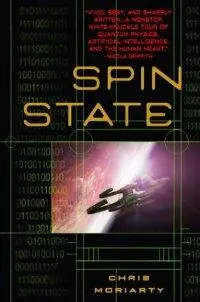
- Название:Spin State
- Автор:
- Издательство:Bantam spectra
- Жанр:
- Год:2003
- ISBN:978-0-553-38213-6
- Рейтинг книги:5 / 5. Голосов: 1
-
Избранное:Добавить в избранное
- Отзывы:
-
Ваша оценка:
Spin State: краткое содержание, описание и аннотация
Предлагаем к чтению аннотацию, описание, краткое содержание или предисловие (зависит от того, что написал сам автор книги «Spin State»). Если вы не нашли необходимую информацию о книге — напишите в комментариях, мы постараемся отыскать её.
UN Peacekeeper Major Catherine Li has made thirty-seven faster-than-light jumps in her lifetime—and has probably forgotten more than most people remember. But that’s what backup hard drives are for. And Li should know; she’s been hacking her memory for fifteen years in order to pass as human. But no memory upgrade can prepare Li for what she finds on Compson’s World: a mining colony she once called home and to which she is sent after a botched raid puts her on the bad side of the powers that be. A dead physicist who just happens to be her cloned twin. A missing dataset that could change the interstellar balance of power and turn a cold war hot. And a mining “accident” that is starting to look more and more like murder…
Suddenly Li is chasing a killer in an alien world miles underground where everyone has a secret. And one wrong turn in streamspace, one misstep in the dark alleys of blackmarket tech and interstellar espionage, one risky hookup with an AI could literally blow her mind.
Spin State — читать онлайн бесплатно полную книгу (весь текст) целиком
Ниже представлен текст книги, разбитый по страницам. Система сохранения места последней прочитанной страницы, позволяет с удобством читать онлайн бесплатно книгу «Spin State», без необходимости каждый раз заново искать на чём Вы остановились. Поставьте закладку, и сможете в любой момент перейти на страницу, на которой закончили чтение.
Интервал:
Закладка:
“I can imagine.”
“I imagine you can do more than imagine.”
“How well did you know Sharifi?” Li asked, brushing the implied question aside.
Ted smiled. “Not that well. She was my age, you know. The women who would have taught her are all long gone.”
“What did she visit for, then?”
“To talk to me.”
“About?”
“A new gift.”
“Look,” Li said. “I’m investigating Sharifi’s death, not your school. Can you just spare me the effort of dragging this out of you?”
The sister’s eyes widened slightly. “Can you just tell me what you want to know, then, and spare me the effort of guessing?”
“I want to know who killed her.”
“Oh.” Sister Ted pursed her lips and made a faint blowing sound. That was all the reaction Li’s news got from her. But then Li got the impression this was a woman who was used to bad news. “She seemed like her usual self. I’d only ever met her instream before that, of course.” She gestured to the ramshackle bulk of an old VR rig gathering dust in the corner of the office. “But she was adamant that she wanted to wrap this gift up in person.” She shifted in her chair, setting the old springs creaking. “If I’d thought anything like that was going on, I would have tried to help, Major. I liked her. And not just because she got our girls to college. She was the kind of person you just liked, somehow.” She grinned. “Well, the kind of person I liked. I imagine she pissed the hell out of most people.”
“What about the gift? Anything unusual there?”
Sister Ted twisted in her chair to reach a file drawer. “Have a look at it,” she said, handing a thick sheaf of paper to Li. “The digital original’s on file Ring-side.”
Li flipped through the document, her heart beating faster with every page she read. It was a will. A will that left everything Sharifi owned to St. Joseph’s School.
“Congratulations,” Li said. “You’re rich.”
“I know. I would have expected to feel better about it.”
Li handed the papers back, and Sister Ted set them on the desk, absently, as if she were thinking of something else. Or someone else.
There was a problem finding Korchow’s street. The cabbie kept circling through lunch-hour traffic, insisting that he knew the address, that the turn was in the next block, or the next one. Finally Li got out and walked.
She stumbled onto the shop abruptly, turning a blind corner into a narrow flagstoned alley and bumping up against a spotlit window full of old carpets and inlaid furniture. A gold-lettered sign readANTIQUITIES and below it, in dark red, she saw the same intricate lozenge design she had seen on Korchow’s card.
He sat at a small desk toward the back, in a carved laminate chair that was either an astronomically expensive generation-ship artifact or a very professional forgery. A tank silk raincoat and a stylish gas mask lay neatly across a nearby table, as if Korchow had just come in or was just leaving.
“Major,” he said. “What a surprise. I hope you didn’t have too much trouble finding me?”
“I did, actually. Pretty out-of-the-way place to run a business from. Must cut into your profits.”
Korchow smiled. “I have a certain reputation among discerning collectors. Can I get you something? Tea?”
He bustled through a curtained doorway into the back of the shop, and Li heard the clink of glass on china, the sound of running water. He returned with two covered teacups, an ornately carved glazed-iron teapot, and a sleek black box that he set carefully on the desk between them.
He served the tea, which was excellent. Then he picked up the box and handed it to her. “I thought you might like to see it,” he said. “You seemed quite put out by it the last time we met.”
She turned the device over, feeling the weight of it, trying unsuccessfully to scan it.
“Second button from the left,” Korchow said.
She pressed it. The box beeped discreetly. A bioluminescent display window began counting thousandths of seconds. Li’s security programs flashed a yellow alert on her retina and went dead as her internals cut out.
Korchow leaned across the desk and took back the box. “Some things are better kept private,” he said.
“What do you want from me?” Li asked.
“Nothing complicated. Just to do business. Business that could be to our mutual advantage.” He paused and fingered the controls of the jamming device.
“It’s working fine,” Li snapped. “And it’s giving me a headache. So just tell me what you want and get it over with.”
“I represent parties who are, shall we say, interested in recent events in the Anaconda mine. Particularly in the aspects of the explosion that your, er, office seems to be investigating.”
“You want information about Sharifi,” Li said.
“Among other things.” Korchow smiled. “I can see how difficult this is for you, Major. You’d rather halo-jump into enemy territory than sit over tea talking to a Syndicate spy. I understand better than you can imagine. But we are not always called to serve in the ways we prefer. This is the price of owing allegiance to a greater good.” Steam curled from his cup, veiling his narrow, intelligent face. “We’ve met before,” he said. “Do you remember? Or have they taken that from you?”
“I don’t know what you’re talking about.”
“I was with the Thirty-second on Gilead. I fought on Cale’s Hill.”
Li looked at him, her face stiff. She’d commanded that assault.
“You don’t remember me, I suppose. Corps files are so… unreliable. But I remember you. I remember with perfect clarity.” He unbuttoned the top two buttons of his shirt, pulled the cloth aside to show Li a chewed-up slash of scar tissue at the base of his neck. “I was sitting in the sun. The first warmth after a cold night. Drinking a cup of tea, of all things.”
An image of a thin, stubble-faced soldier flashed through Li’s mind. A spill of dark tea and darker blood runneling over boot-packed dirt.
She looked at the wound. The shooter had pulled high and left, missing the spine by a hair. “I remember,” she said finally. “There was a crosswind. I overcorrected.”
Korchow buttoned his shirt. “Do you remember what happened after that? Or have your psychiatric technicians deleted it?”
Li watched Korchow, her heart pounding.
“I was still conscious when you arrived,” he went on. “I remember that your captain’s insignia was ripped off another uniform and sewn on with mismatched thread. I remember your smile—quite a lovely one, by the way. I remember you talking to your lieutenants. They asked you what to do with the wounded. Do you recall what you told them?”
“I told them to shoot everyone still breathing.”
“Don’t think I blame you,” Korchow said. “Though I do owe my life to the fact that some of your soldiers had more… scruples than you did. Still, it was a moment of revelation. A conversion of sorts. Do you know what I thought as I looked up at you?”
Li stirred restlessly. “How the hell would I?”
“I thought, She’s one of us. She’s like us. She can’t help but be merciful. I saw your face, you see. And I thought you would spare us because of what you were. Because of who you were. When you ordered them to shoot us, I understood, finally and completely, what they had stolen from you.”
Li watched the hypnotic blinking of the status lights on the jamming device. She probed her memory, poking at the Gilead files, looking for the cracks, the places where the emotions welled up between the digitized data and gave the lie to the official story. They should never have sent us , she thought. And the thought that she could think that—that she already did think it—frightened her more than anything she remembered doing on Gilead.
Читать дальшеИнтервал:
Закладка:
Похожие книги на «Spin State»
Представляем Вашему вниманию похожие книги на «Spin State» списком для выбора. Мы отобрали схожую по названию и смыслу литературу в надежде предоставить читателям больше вариантов отыскать новые, интересные, ещё непрочитанные произведения.








Обсуждение, отзывы о книге «Spin State» и просто собственные мнения читателей. Оставьте ваши комментарии, напишите, что Вы думаете о произведении, его смысле или главных героях. Укажите что конкретно понравилось, а что нет, и почему Вы так считаете.