Chris Moriarty - Spin State
Здесь есть возможность читать онлайн «Chris Moriarty - Spin State» весь текст электронной книги совершенно бесплатно (целиком полную версию без сокращений). В некоторых случаях можно слушать аудио, скачать через торрент в формате fb2 и присутствует краткое содержание. Год выпуска: 2003, ISBN: 2003, Издательство: Bantam spectra, Жанр: Фантастика и фэнтези, на английском языке. Описание произведения, (предисловие) а так же отзывы посетителей доступны на портале библиотеки ЛибКат.
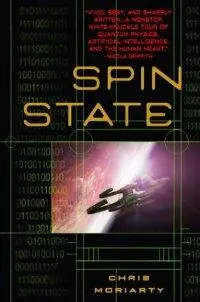
- Название:Spin State
- Автор:
- Издательство:Bantam spectra
- Жанр:
- Год:2003
- ISBN:978-0-553-38213-6
- Рейтинг книги:5 / 5. Голосов: 1
-
Избранное:Добавить в избранное
- Отзывы:
-
Ваша оценка:
Spin State: краткое содержание, описание и аннотация
Предлагаем к чтению аннотацию, описание, краткое содержание или предисловие (зависит от того, что написал сам автор книги «Spin State»). Если вы не нашли необходимую информацию о книге — напишите в комментариях, мы постараемся отыскать её.
UN Peacekeeper Major Catherine Li has made thirty-seven faster-than-light jumps in her lifetime—and has probably forgotten more than most people remember. But that’s what backup hard drives are for. And Li should know; she’s been hacking her memory for fifteen years in order to pass as human. But no memory upgrade can prepare Li for what she finds on Compson’s World: a mining colony she once called home and to which she is sent after a botched raid puts her on the bad side of the powers that be. A dead physicist who just happens to be her cloned twin. A missing dataset that could change the interstellar balance of power and turn a cold war hot. And a mining “accident” that is starting to look more and more like murder…
Suddenly Li is chasing a killer in an alien world miles underground where everyone has a secret. And one wrong turn in streamspace, one misstep in the dark alleys of blackmarket tech and interstellar espionage, one risky hookup with an AI could literally blow her mind.
Spin State — читать онлайн бесплатно полную книгу (весь текст) целиком
Ниже представлен текст книги, разбитый по страницам. Система сохранения места последней прочитанной страницы, позволяет с удобством читать онлайн бесплатно книгу «Spin State», без необходимости каждый раз заново искать на чём Вы остановились. Поставьте закладку, и сможете в любой момент перейти на страницу, на которой закончили чтение.
Интервал:
Закладка:
Nguyen sighed, picked up a fiche, scanned and signed it, and moved it to the other side of her desk.
“Well, that’s over with,” she said. “I hope it wasn’t more unpleasant than it had to be. I think you understand my reasons for raising the issue. Anything else?”
Li started to speak, then hesitated, weighing the risks of telling Nguyen about Korchow. “Yes,” she said. “I had a strange talk with someone the other day. I’m not sure how to proceed.”
Something sparked behind Nguyen’s dark eyes as Li told her about Korchow, and she had a sudden uncomfortable conviction that her meeting with Korchow was the real news Nguyen had been waiting to hear. Maybe even the real reason Nguyen had sent her to Compson’s in the first place. But that was crazy, of course. Even Nguyen didn’t control everything and everyone.
“What makes you think Korchow was in contact with Sharifi?” Nguyen asked.
Li downloaded an image of Korchow’s card and flashed it onto a shared substream. “I found this in her datebook.”
“Well,” Nguyen said, looking at it. “Maybe she was just buying antiques from him.”
“Sure she was.”
“How sure are you he’s Syndicate?”
“I’m not. But he had the look. And if he wasn’t Syndicate, he was doing everything he could to make me think he was.”
“So. Sharifi was talking to a Syndicate agent… about her work, we have to assume. And now the same agent wants to talk to you.”
“What do I do?” Li asked.
Nguyen’s lips thinned in a chilly smile. “You talk to him.”
Helena: 22:10:48.
Korchow’s address put him square in the center of Helena’s commercial district, a five-minute walk, air quality permitting, from the old colonial administration building. But Li had a first stop to make before she saw Korchow: St. Joseph’s Home for Girls. And unlike Korchow’s shop, St. Joe’s wasn’t in the nicer part of town.
Compson’s capital city predated the Bose-Einstein Rush. The elegantly dilapidated domes of the capitol building and governor’s mansion recalled the old home-rule days before the Bose-Einstein boom. The commercial zone’s masonry colonnades and office blocks reminded visitors that Helena had once been more than just a company town, Compson’s World more than a Trusteeship. Still, there was nothing quaint or old-fashioned about the slums Li’s cab rolled through on the long drive in from the spaceport. They were brand-name UN-wide standard-issue: market democracy in action, legislated by the General Assembly, bankrolled by the Interplanetary Monetary Fund.
Everywhere she looked, she saw the mines. The Anaconda was half a continent away, the next closest Bose-Einstein mine in the remote northern hemisphere, but even at that distance they stamped their mark on the city. Acid rain painted long sulfur-yellow streaks on the composite board walls of the housing projects. A permanent smog of coal dust hung in the air, fed by pea-coal fires in every kitchen. Blue-faced ex-miners shuffled along the sidewalks in the final stages of black-lung, come to the capital to live off their comp checks.
On the outskirts of the industrial zone the cab passed a long weedy stretch of open space. Goalposts leaned crookedly at either end of the field. They’d been white once, but the paint was peeling and streaked with rust. Someone, probably some local welfare group, had taken care of the grass; otherwise, it would long ago have lost its battle against the burning rain.
Eight players were scattered across the field, a few in uniform, the rest dressed in street clothes. As the car passed, one player broke upfield, running with the long sure stride of a born striker. The sun passed out of the clouds just as he took his shot, and a ray of sunlight stabbed across the field, silvering the striker’s legs, the taut arc of the goalie’s body as he leapt to intercept the shot.
Li shuddered and looked away, back into the half dark of the cab.
St. Joe’s sprawled in the shadow of the poorest projects. It had one permanent building—a drafty-looking parish church whose brick facade was overdue for pointing. The rest of the orphanage was housed in colonial-era modular units that weren’t much more than Quonset huts.
The sister who met Li at the door wore blue jeans, a flannel shirt, and a rawboned no-bullshit air that made Li wonder if she were ex-militia.
“So you’re the one who wants to know about Hannah,” she said. “What are you, half-XenoGen? That why you’re interested?”
“I’m the senior UN officer on-station,” Li said. “It’s my job to be interested.”
The sister narrowed her eyes at Li for a moment. “You’d better keep your cab,” she said. “You won’t find another one in this neighborhood.” She waved her into a long, dimly lit corridor. “Sorry for the lack of a welcoming committee, but everyone else has class now. You’ll have to make do with the principal.”
“Thanks, Sister…”
“Just Ted.” She grinned. “For Theresa. Class lets out in two minutes. We’d better beat a strategic retreat to my office.”
They walked back through the rat’s nest of tin-roofed buildings, down linoleum-floored hallways, past long racks of children’s winter coats and school bags. The smell of chalk and Magic Markers seeped out from under the classroom doors, along with the disciplined refrain and chorus of every Catholic-school class everywhere. As they passed one room, Li heard a voice that could only belong to a nun say, “You’re not as cute as you think you are,” provoking a quickly smothered wave of childish laughter.
The bell rang ten minutes to the hour, and a noisy, laughing, rambunctious flood of uniformed schoolgirls poured out into the corridors. Sister Ted waded through the flood with the decisive step of a woman who expected people to make way for her. And make way they did; for the next several minutes, Li shadowed her through an unrelenting barrage of Good morning, Sister Ted and Excuse me, Sister Ted and Hello, Sister Ted.
“You’ve got them well trained,” Li said.
The other woman turned a sharp unforgiving look on her. “We wouldn’t help them by cutting them any slack, Major. You can bet no one else ever will.”
“How many of your students are genetics?”
“Look around and take a guess.”
Li looked at the sea of young faces, so many of them the same two or three faces. “Two-thirds, I’d say.”
“Then you’d be right.”
“Any jobs for them when they get out of here?”
“Not unless they’re five times as good as any human who wants the job. And not unless they’re polite enough to not scare people.” The nun threw another of her sharp looks at Li. “I bet you learned how to keep your mouth shut early.”
“You’d bet right, then.” Li grinned. “I can’t walk into this place without the creeping feeling that Sister Vic is going to rise from the grave and ask me for my hall pass.”
That got a laugh.
“What can I tell you?” Sister Ted asked, when they were settled in the dilapidated relative peace of her office.
“What Sharifi was doing here two weeks ago for a start.”
“Making a donation. We have a lot of Ring-side donors.”
“Do all of them come here to visit personally?”
“Hannah was a former student. And she was extremely generous.”
Li couldn’t help glancing around the run-down office at that and thinking of the cheap buildings the school was housed in.
“She gave the things that counted,” Ted said. “Books. Food money. And she guaranteed every student college tuition at the best school she could get admitted to. Every student. Do you have any idea what that means to the girls we get here?”
Читать дальшеИнтервал:
Закладка:
Похожие книги на «Spin State»
Представляем Вашему вниманию похожие книги на «Spin State» списком для выбора. Мы отобрали схожую по названию и смыслу литературу в надежде предоставить читателям больше вариантов отыскать новые, интересные, ещё непрочитанные произведения.






Обсуждение, отзывы о книге «Spin State» и просто собственные мнения читателей. Оставьте ваши комментарии, напишите, что Вы думаете о произведении, его смысле или главных героях. Укажите что конкретно понравилось, а что нет, и почему Вы так считаете.