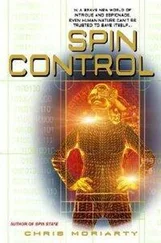
Chris Moriarty - Spin State
Здесь есть возможность читать онлайн «Chris Moriarty - Spin State» весь текст электронной книги совершенно бесплатно (целиком полную версию без сокращений). В некоторых случаях можно слушать аудио, скачать через торрент в формате fb2 и присутствует краткое содержание. Год выпуска: 2003, ISBN: 2003, Издательство: Bantam spectra, Жанр: Фантастика и фэнтези, на английском языке. Описание произведения, (предисловие) а так же отзывы посетителей доступны на портале библиотеки ЛибКат.
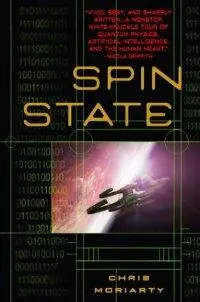
- Название:Spin State
- Автор:
- Издательство:Bantam spectra
- Жанр:
- Год:2003
- ISBN:978-0-553-38213-6
- Рейтинг книги:5 / 5. Голосов: 1
-
Избранное:Добавить в избранное
- Отзывы:
-
Ваша оценка:
Spin State: краткое содержание, описание и аннотация
Предлагаем к чтению аннотацию, описание, краткое содержание или предисловие (зависит от того, что написал сам автор книги «Spin State»). Если вы не нашли необходимую информацию о книге — напишите в комментариях, мы постараемся отыскать её.
UN Peacekeeper Major Catherine Li has made thirty-seven faster-than-light jumps in her lifetime—and has probably forgotten more than most people remember. But that’s what backup hard drives are for. And Li should know; she’s been hacking her memory for fifteen years in order to pass as human. But no memory upgrade can prepare Li for what she finds on Compson’s World: a mining colony she once called home and to which she is sent after a botched raid puts her on the bad side of the powers that be. A dead physicist who just happens to be her cloned twin. A missing dataset that could change the interstellar balance of power and turn a cold war hot. And a mining “accident” that is starting to look more and more like murder…
Suddenly Li is chasing a killer in an alien world miles underground where everyone has a secret. And one wrong turn in streamspace, one misstep in the dark alleys of blackmarket tech and interstellar espionage, one risky hookup with an AI could literally blow her mind.
Spin State — читать онлайн бесплатно полную книгу (весь текст) целиком
Ниже представлен текст книги, разбитый по страницам. Система сохранения места последней прочитанной страницы, позволяет с удобством читать онлайн бесплатно книгу «Spin State», без необходимости каждый раз заново искать на чём Вы остановились. Поставьте закладку, и сможете в любой момент перейти на страницу, на которой закончили чтение.
Интервал:
Закладка:
He smiled. “Would I say such a thing?”
“You just enjoy watching people make fools of themselves, don’t you?” She spoke jokingly, but she suddenly felt a prickling urge to pick a fight with him.
He leaned back, responding to the feeling behind her words rather than the words themselves. “I make a fool of myself ten times a minute,” he said. “Fifty times a minute when you’re in the room. It’s called being alive, Catherine.”
“Right. You’re just the average guy, going about your average life. Just with a few billion times the processing speed.”
“Something like that.”
She snorted. “And this is how you use it? Forgive me if I’m not impressed.”
He shrugged. “I can’t help wanting to be around people. It’s the way I’m written.”
“So change it. Change your code. I would. I’d get shut of Nguyen and Sharifi and all this pathetic bullshit in a second if I could.”
“You just say that because you know you can’t. Now stop fussing and listen to this song. It’s a good one.”
The singer was still onstage, finishing out a set with a bittersweet country song. It was a good song, the kind of song that could have been written yesterday or three hundred years ago. “She write that?” Li asked, nodding across the room toward the spotlit figure.
“It was written before I was born.”
She listened closer, caught a stray word or two. “What’s a Pontchartrain?”
“The Pontchartrain. It’s a lake on the Mississippi, that used to flow through New Orleans.”
“Before the floods, you mean.”
“Before that, even. The river—the whole Mississippi Delta actually—shifted. The U.S. Army Corps of Engineers spent, oh, a century dredging and channeling and building levees. Defiance of nature, on a megalomaniacal scale. People wrote books and printed articles and whole theses about it. The river finally had its way, of course. It jumped its banks right around the time the oceans really started rising. Shifted the delta halfway across the Gulf of Texas. I wish I could make you feel what it was to be in New Orleans, stranded in the middle of a man-made desert while the ice caps were melting and we were watching floods in New York and Paris on the news every night. It was… unforgettable.”
“I didn’t think Earth was ever wired for streamspace. They didn’t even have shunts back then, did they?”
“No. Just a kind of primitive version of VR. But it was enough. I have my own memories, and other people’s. Over time it becomes harder and harder to separate them. Which may not be all bad.” He smiled. “I’m probably the only person still alive who remembers driving across the Pontchartrain in a convertible.”
Li grinned. “With a beautiful blonde, no doubt.”
Cohen smiled back, but it was the sad-sweet smile of a man lost in an old memory. “With Hyacinthe’s widow. The first woman I ever fell in love with.”
Li waited, wanting to hear more but not comfortable pushing.
“I know,” he said, answering a question that hadn’t even occurred to her. “I suppose from a puritanical sort of perspective, you could say she was my mother.”
“Well, it’s not like you invented that particular complex.”
“It wasn’t like that, though. I am Hyacinthe, his very self, in ways that have nothing to do with being a child, or a student, or an invention. Besides.” Another sweet and solemn smile. “The heart is complicated, whether it’s made of flesh or circuitry. It doesn’t always love the way you think it should. Or the people you think it should.”
“You don’t have to confess to me, Cohen.”
“Well, I have this funny idea that you come closer to understanding me than anyone else does. And so far you haven’t made me do any rosaries.”
A sudden memory of bare knees on a cold church floor and a grown-up hand—her mother’s?—moving her child’s fingers over the glass beads. The smooth, dark Aves . The gleaming Paters . The cross dangling and tapping against the pew in front of her.
“And I understand you, I think,” Cohen was saying when she surfaced again. “Which is an accomplishment given that what you’ve actually told me about yourself would fit on the back of a matchbook. At first I thought you didn’t trust me. Then I decided you’re just secretive. Is it how you’re put together, or did someone teach you to push people off like that?”
Li shrugged, feeling awkward. “It’s jump fade as much as anything. I don’t remember much.” She paused. “And what I do remember usually makes me wish I’d forgotten more of it. What’s the point in dredging up old miseries?”
She looked up into the silence that followed to find Cohen watching her.
“Eyelash,” he said.
“What?”
“You have an eyelash.”
“Where?” Li dabbed at her eye, looking for it.
“Other eye. Here. Wait.”
He slid toward her along the curved bench and tilted her head back against the velvet cushions with one hand while the other feathered along her lower eyelid hunting for the stray lash. She smelled extra-vielle , felt Roland’s warm sweet breath on her cheek, saw the soft skin of his neck and the pulse beating beneath it.
“There,” Cohen said, and held the lash up on the end of a slender finger.
She opened her mouth to thank him, but the words died in her throat. The hand that had been on her chin brushed along her cheek and traced the faint line of the bundled filament that followed the muscle from the corner of her jaw down to the hollow between her clavicles.
“You look like you’ve lost weight, even in streamspace,” he said. “You look like you’re not sleeping enough.”
He caught her eye and held it. The hand on her neck felt warm as Ring-side sunlight, and it reminded her how long it had been since anyone but a medtech had touched her. A dark tide of desire tugged at her. Desire and a reckless loneliness and a hunger to believe in the person and the feelings that seemed so real sometimes.
Uh-oh , she thought.
She looked away and cleared her throat.
Cohen drew back, held up his index finger, her eyelash still on it. “Make a wish,” he said.
“I don’t believe in wishes. You make one.”
He closed his eyes and blew the lash up into the smoky air.
“That was quick,” Li said and smiled—or at least tried to. “I guess you know what you want.”
But he wasn’t looking at her. He had his watch off and was listening to it, his face turned away from her. He twisted the golden knob, put the watch to his ear, wound it again, shook it.
“I don’t know what’s wrong with the thing,” he said. “It’s been running slow for weeks. Damned annoying.”
“Cohen,” said a woman’s voice from somewhere above their heads. A slender brown pair of legs had stopped by their table, and Li looked up them into an amused smile and horn-rimmed glasses—and her own face behind them.
It wasn’t her face, though. It was the nameless teenager’s face she remembered looking at fifteen years ago in a Shantytown mirror. A XenoGen face on a thin young woman who would have stood exactly Li’s height if she hadn’t been wearing three-inch heels and a red slip of a dress that looked far more revealing now that she wasn’t onstage.
The singer gave Li a brief measuring look, then sat down and put a possessive arm around Cohen’s shoulders. “I thought I was going to have you all to myself tonight,” she said in a voice that left no doubt in Li’s mind about what Cohen had been doing eating uncharacteristically alone in this place.
Cohen flinched ever so slightly. “Sorry,” he said, looking at Li.
“Not at all.” Li stood up, straightening her uniform with numb fingers. “I was leaving anyway.”
Читать дальшеИнтервал:
Закладка:
Похожие книги на «Spin State»
Представляем Вашему вниманию похожие книги на «Spin State» списком для выбора. Мы отобрали схожую по названию и смыслу литературу в надежде предоставить читателям больше вариантов отыскать новые, интересные, ещё непрочитанные произведения.




Обсуждение, отзывы о книге «Spin State» и просто собственные мнения читателей. Оставьте ваши комментарии, напишите, что Вы думаете о произведении, его смысле или главных героях. Укажите что конкретно понравилось, а что нет, и почему Вы так считаете.