Chris Moriarty - Spin State
Здесь есть возможность читать онлайн «Chris Moriarty - Spin State» весь текст электронной книги совершенно бесплатно (целиком полную версию без сокращений). В некоторых случаях можно слушать аудио, скачать через торрент в формате fb2 и присутствует краткое содержание. Год выпуска: 2003, ISBN: 2003, Издательство: Bantam spectra, Жанр: Фантастика и фэнтези, на английском языке. Описание произведения, (предисловие) а так же отзывы посетителей доступны на портале библиотеки ЛибКат.
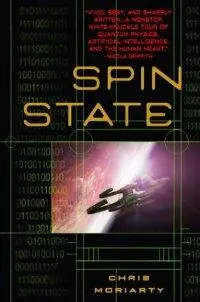
- Название:Spin State
- Автор:
- Издательство:Bantam spectra
- Жанр:
- Год:2003
- ISBN:978-0-553-38213-6
- Рейтинг книги:5 / 5. Голосов: 1
-
Избранное:Добавить в избранное
- Отзывы:
-
Ваша оценка:
Spin State: краткое содержание, описание и аннотация
Предлагаем к чтению аннотацию, описание, краткое содержание или предисловие (зависит от того, что написал сам автор книги «Spin State»). Если вы не нашли необходимую информацию о книге — напишите в комментариях, мы постараемся отыскать её.
UN Peacekeeper Major Catherine Li has made thirty-seven faster-than-light jumps in her lifetime—and has probably forgotten more than most people remember. But that’s what backup hard drives are for. And Li should know; she’s been hacking her memory for fifteen years in order to pass as human. But no memory upgrade can prepare Li for what she finds on Compson’s World: a mining colony she once called home and to which she is sent after a botched raid puts her on the bad side of the powers that be. A dead physicist who just happens to be her cloned twin. A missing dataset that could change the interstellar balance of power and turn a cold war hot. And a mining “accident” that is starting to look more and more like murder…
Suddenly Li is chasing a killer in an alien world miles underground where everyone has a secret. And one wrong turn in streamspace, one misstep in the dark alleys of blackmarket tech and interstellar espionage, one risky hookup with an AI could literally blow her mind.
Spin State — читать онлайн бесплатно полную книгу (весь текст) целиком
Ниже представлен текст книги, разбитый по страницам. Система сохранения места последней прочитанной страницы, позволяет с удобством читать онлайн бесплатно книгу «Spin State», без необходимости каждый раз заново искать на чём Вы остановились. Поставьте закладку, и сможете в любой момент перейти на страницу, на которой закончили чтение.
Интервал:
Закладка:
Bella was the wild card, of course. Did she know about Korchow? Was she working for him? What was there really between her and Haas? What had Voyt done to make her hate him so much? And what was the cold calculation Li had seen in her eyes? Grief over Sharifi, or something deeper, older, darker?
Something moved in the darkness.
Li’s eyes snapped open. Nothing.
Then she heard the faint but unmistakable sound of someone breathing. She slid a hand into her coverall and eased the Beretta out of its holster. She flicked the safety off, inching the lever back with agonizing slowness in order to muffle the dry little click of the catch snapping open.
“You’re not going to shoot me, Katie,” said a familiar voice.
A match flared. Li smelled sulfur, saw a monstrous shadow loom across the vault high above her. The shadow bent, shifted. A rusty pin squeaked, and a Davy lamp flared into life. “Hello,” Cartwright said from where he sat cross-legged on the gleaming floor. “So you heard them too, did you?”
“Heard who?” Li asked breathlessly.
“The saints, Katie. Her children.” He smiled. “Rejoice, for we know the hour and the day of Her Coming. It’s beginning.”
“Save the sermons for your sheep, Cartwright. It has nothing to do with me.”
Something drew her eyes into the inky shadows behind the priest. Some movement, so faint that she felt rather than saw it. But when the voice spoke out of the darkness she felt so little surprise that she realized she’d known Daahl would be here.
“If it has nothing to do with you,” he asked, “then why are you down here?”
“Just doing my job, that’s all.”
“There are a lot of people who are wondering just what that job is. A lot of people who’d like to know which side you’re on.”
She didn’t answer.
Cartwright began scratching at a patch of dry skin on his wrist, and something about the movement—the sound of fingernails on flesh, the dead skin flaking off and glittering in the lamplight—made her feel ill. He’s crazy , she thought. He always was crazy .
“Well, Katie,” Daahl asked, “don’t you have any answer at all for me?”
Li rubbed a clammy hand across her face.
“I’m going to show you something,” Daahl said. “I may regret showing it to you. A lot of people have told me I will, in fact. But I think you have a right to see it. I think you have a right to know what’s on the table here.”
Li saw the UNSC seal on the letter before he’d finished handing it to her. “This is a classified internal memo,” she said. “Where the hell are you getting this stuff?”
“Just read it.”
It took several reads for the sense of the thing to come through to her—and even then she wasn’t sure what the cautious, bureaucratically vague words really meant. Someone else had been sure though. Some other reader had been there before her, had scored through the critical lines with a strong confident hand:
In conclusion, the presence of live Bose-Einstein strata on Compson’s World is both an internal and external security threat. It is vital, both in relation to Syndicate industrial espionage activities and for reasons of political stability (vis-à-vis the IWW and other outside agitators) to transfer the production of transport and communications-grade condensate off the planet and into a controlled laboratory setting. This goal presents a compelling reason, in and of itself, for supporting Dr. Sharifi’s research.
“You understand what that means, don’t you?” Daahl asked. “They’re saying that the very presence of live crystal on-planet is a security risk. That as soon as they can manufacture it off-planet they’ll destroy the deposits that are left in the ground here.”
“This memo doesn’t say anything like that, Daahl.”
“Doesn’t it? Then what does that mean, ‘the presence of live strata is a security risk’?”
“It means nothing. Some paper pusher producing overblown verbiage for a departmental meeting. And anyway, you have no guarantee this thing is genuine.”
“My source was too good for it to be anything else.”
“If you want me to take that claim seriously, you’d better tell me who this ‘source’ was and let me make up my own mind.”
“You know, Katie. Think about it.”
Li stared at the sooty fiche, her mind spinning through the possibilities. Station security. Mine personnel. TechComm itself. But almost by definition no one cleared to see this kind of document could have come from a place like Compson’s World, let alone cared enough about it to risk their job and freedom for it.
“Who?” she asked, looking up to see Cartwright and Daahl both watching her. “Who was it?”
Daahl smiled. He took the memo back, pulling it from her fingers so gently that she hardly realized she’d let go of it, and folded it carefully away into his shirt pocket.
“Hannah,” he said. “Hannah Sharifi.”
AMC Station: 23.10.48.
Li woke to the sound of people running down the corridor outside, banging on its alloy walls hard enough to set them echoing: the universal spacer’s manual alarm system.
She rolled out of bed just as the station lit up her livewall and started talking to her. Her first thought was that there’d been a blowout, but as the calm automated voice droned on she realized it was calling all rescue and medical personnel to the shuttle bays. Whoever was in trouble, they were on the planet below.
She reached over to her cabin’s one chair and started pulling on the uniform she’d flung over it a few short hours ago. She was just lacing her boots up when the station put up a planet-side call for her.
Sharpe.
“You have medical training, don’t you?” he asked abruptly.
He was in his office at the hospital, and he looked as if he’d been hauled out of bed by the same crisis that had the stationers running for the shuttle bays. A mournful keening rose and fell on his end of the line like the Doppler-distorted navigational beacon of a drive ship pushing lightspeed.
“Just the usual,” she said. “CPR. Trauma response. My oracle has a combat med praxis it can load. What’s happened?”
“The Anaconda blew again.”
Suddenly Li recognized the wail coming over the line behind Sharpe’s voice for what it was: the pit whistle.
“How bad?” she asked.
“Pit 3’s gone. And 4’s burning. The above-ground foreman told me he’s got four hundred and twenty miners on the logs, all but seventy still underground. The closest doctor besides me is in Helena, three hours from here. More, if the weather doesn’t clear. If you can open a burn wrap and find a vein, I need you.”
Li stood up, realized she still had one boot left to lace, sat down again. “When’s the next open shuttle seat?”
“Gate 18. And hurry. They’re holding it for you.”
As the shuttle plunged toward the planet, the copilot scanned the surface channels for news of the fire.
No one they could raise had time to talk to them, but little by little they began to piece together the long slide through miscommunication and mischance to disaster.
The first step was the breakdown of the Pit 4 chippy lift. With a ten-meter-square lift floor that took up half the breadth of the main shaft, the chippy lift was the only way in and out of Pit 4 for every one of the miners who worked her two-hundred-odd cutting faces. With its chippy out of action, Pit 4 had to fall back on the double drum lift—a heavy-duty lift built to carry muck, ore, and waste rock, not miners. Eager to keep cutting, management stopped pulling waste up on the double drum and swapped in the eight-man emergency evac bucket.
That was the first link in the chain: four hundred miners underground with a lift that carried only eight men per trip instead of the chippy lift’s forty-eight.
Читать дальшеИнтервал:
Закладка:
Похожие книги на «Spin State»
Представляем Вашему вниманию похожие книги на «Spin State» списком для выбора. Мы отобрали схожую по названию и смыслу литературу в надежде предоставить читателям больше вариантов отыскать новые, интересные, ещё непрочитанные произведения.






Обсуждение, отзывы о книге «Spin State» и просто собственные мнения читателей. Оставьте ваши комментарии, напишите, что Вы думаете о произведении, его смысле или главных героях. Укажите что конкретно понравилось, а что нет, и почему Вы так считаете.