Chris Moriarty - Spin State
Здесь есть возможность читать онлайн «Chris Moriarty - Spin State» весь текст электронной книги совершенно бесплатно (целиком полную версию без сокращений). В некоторых случаях можно слушать аудио, скачать через торрент в формате fb2 и присутствует краткое содержание. Год выпуска: 2003, ISBN: 2003, Издательство: Bantam spectra, Жанр: Фантастика и фэнтези, на английском языке. Описание произведения, (предисловие) а так же отзывы посетителей доступны на портале библиотеки ЛибКат.
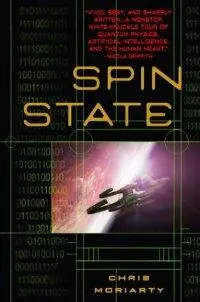
- Название:Spin State
- Автор:
- Издательство:Bantam spectra
- Жанр:
- Год:2003
- ISBN:978-0-553-38213-6
- Рейтинг книги:5 / 5. Голосов: 1
-
Избранное:Добавить в избранное
- Отзывы:
-
Ваша оценка:
Spin State: краткое содержание, описание и аннотация
Предлагаем к чтению аннотацию, описание, краткое содержание или предисловие (зависит от того, что написал сам автор книги «Spin State»). Если вы не нашли необходимую информацию о книге — напишите в комментариях, мы постараемся отыскать её.
UN Peacekeeper Major Catherine Li has made thirty-seven faster-than-light jumps in her lifetime—and has probably forgotten more than most people remember. But that’s what backup hard drives are for. And Li should know; she’s been hacking her memory for fifteen years in order to pass as human. But no memory upgrade can prepare Li for what she finds on Compson’s World: a mining colony she once called home and to which she is sent after a botched raid puts her on the bad side of the powers that be. A dead physicist who just happens to be her cloned twin. A missing dataset that could change the interstellar balance of power and turn a cold war hot. And a mining “accident” that is starting to look more and more like murder…
Suddenly Li is chasing a killer in an alien world miles underground where everyone has a secret. And one wrong turn in streamspace, one misstep in the dark alleys of blackmarket tech and interstellar espionage, one risky hookup with an AI could literally blow her mind.
Spin State — читать онлайн бесплатно полную книгу (весь текст) целиком
Ниже представлен текст книги, разбитый по страницам. Система сохранения места последней прочитанной страницы, позволяет с удобством читать онлайн бесплатно книгу «Spin State», без необходимости каждый раз заново искать на чём Вы остановились. Поставьте закладку, и сможете в любой момент перейти на страницу, на которой закончили чтение.
Интервал:
Закладка:
The first shift foreman then made a decision that, only a week ago, would have been the right one. He consulted the airflow maps and rerouted Pit 4 evac through Pit 5’s main shaft, two and a quarter miles southeast of the Pit 4 headframe. What he didn’t know—couldn’t know—was that the maps he was looking at were four days out of date because of a glitch in the AMC data system. And two days ago, a work crew had closed off the 642 crosscut to Pit 5 in an attempt to fix the ventilation problems that had contributed to the last fire.
Haas knew about the closures, of course. He would have known the maps were out of date, would have been able to put the pieces together and turn things around if he’d been there. But Haas was at a Mine Safety Commission hearing in Helena. And with Haas gone, no single person on-site was in a position to see what was coming.
And that was the second link in the chain: an entire shift sent downshaft with evac instructions that dead-ended thirty-two hundred meters underground in front of two locked-down steel ventilation louvers.
Meanwhile, Pit 4’s double drum lift was still being used to haul miners—and all the coal, waste rock, and condensates those miners were hacking out of the ground had to go somewhere. The miners began routing their carts through the 531 crosscut to Pit 3’s still-operable double drum lift. Coal and waste carts began piling up in Pit 3’s central gangway, directly under the main air intake, whose Vulcan fan pumped forty-two hundred cubic meters of air per minute through the entire active workings of Pits 3 and 4.
That underground traffic jam was the third link in the chain. That, and a simple physical fact: coal is a rock that burns.
At 3A.M. a flash fire flickered through the 4100 level of the Trinidad, almost six kilometers from the Pit 3 headframe as the crow flies. The fire crew suited up and went down, but they couldn’t find a point of origin—and though they shut down the nearby brattices, air was still coming in from somewhere. They called up to the Pit 3 fanhouse to report the fire. The fan operator checked his maps, saw that the fire was on Pit 3’s main ventilation circuit, logged the time, and flipped the safety shutoff on his fan, cutting all forced-air ventilation to Pits 3 and 4.
On any other day, the shutoff would have been the right thing to do. It would have given the fire crew additional time to find the flash fire’s source, and it would have stopped the big fans from pumping suffocating smoke through the rest of the mine until they got the crystals under control.
But today wasn’t any other day. Today there was a freight-train-sized traffic jam of coal and refuse carts lined up down the length of the 3100 gangway just below the intake shaft.
As long as the fans were running, the fresh air flowed through the gangway fast enough to catch the highly flammable coal dust rising off the carts and blow it out the Pit 4 outtake before it could stagnate and become volatile. When the fans shut off, however, the dust began to thicken in the unventilated gangway and climb toward ignition temperature. All that was missing now was a spark. A spark, and fresh air to feed the fire the spark would start.
At 3:42A.M. by the clock in the Pit 3 fanhouse, the fire crew called up top to report that the fire in the Trinidad was out.
At 3:47 the above-ground foreman ordered the fans back on.
At 3:49 the Anaconda crossed the line that every mine crosses sooner or later: the line where only the dead know what really happened.
All the living knew was that at ten to four a shock wave rippled through the coalfield, breaking windows and knocking people off their feet in the streets of Shantytown. People ran out of bars and flophouses, still half-asleep, and saw lightning over the coalfield, followed by a black billowing thunderhead of smoke that could only mean one thing: the mine was burning.
As the rescuers started pulling up the maps and putting the pieces together, they faced a critical situation. Over six hundred miners had gone into Pits 3 and 4 at the start of first shift. Seventy-odd miners, many of them badly injured, were huddled in Pit 4’s 3400 loading bay waiting for the spreading smoke to catch up with them. Hundreds more were scattered through the long miles of unventilated drifts and gangways that were rapidly filling with smoke. And the only way in or out of the mine was Pit 4’s excruciatingly slow emergency cage.
Now it was a simple matter of mathematics. The cage’s eight-man capacity meant that eight rescuers could go down each trip and send eight injured miners back up to the surface in their place. Nothing anyone did now could change that—any more than it could stop the fire ripping through the drifts and galleys.
But even with the disaster staring them in the face, Li couldn’t help wondering about the now-forgotten flash fire down in the Trinidad that had started it all.
They set down on the Pit 9 helipad, over six kilometers from the fire. Even so, they made their final descent through a solid curtain of smoke, and the touchdown, when it came, was as sudden as stepping off an unexpected stair flat-footed.
Li spotted Sharpe in the lee of the breakerhouse, surrounded by a half dozen still-unloaded trucks of medical equipment. She grabbed the strap of the medic’s kit he flung at her and followed him.
She counted almost eighty injured miners lying on stretchers lined up in haphazard rows around the trucks. One of Sharpe’s interns was moving down the rows already, tagging them. Green for mildly wounded victims whose treatment could wait until the first crush was over. Red for urgent cases. White for hopeless ones. There was a lot of white out there already—and the rescuers wouldn’t gain access to the immediate area of the explosion for hours, possibly even days.
“At least it looks like they’re getting them up fast,” Li said.
Sharpe gave her a grim tight-mouthed look. “They’ve only brought two loads up so far. The rest of these are above-ground injuries.”
“Oh God.”
“Haven’t you been listening to the pit priests, Major? We’re out of God’s jurisdiction.”
Li lost track of time after that. The underground cases came in slowly at first. Then the rescuers started rappelling down the Pit 4 shaft and hauling the injured up by hand. Within minutes, the triage unit was overwhelmed. Li’s oracle loaded its med praxis, and she sank into a long dark automatic tunnel of bending, cutting, injecting, bandaging.
At some point, the stretchers got short. Rescue crews started raiding the lines of wounded, checking for white tags, then pulses, pulling stretchers out from under the already dead.
“Hey!” Li shouted when a young miner dumped a white-tagged burn victim off a stretcher near her.
“No time,” the rescuer said. He sounded young, and furious. On the ground between them, the burn victim woke briefly, called out someone’s name, and died. “Christ Almighty, I thought he was dead already,” the rescuer said, then turned aside and vomited.
Li watched him for a moment, then wiped her face on her sleeve and went back to work.
“Hey!” someone said behind her, she wasn’t sure how much later. She felt the weight of a hand on her shoulder and turned to see Ramirez, barely recognizable under a mask of caked coal dust, blood, diesel oil.
“We could use you downstairs,” he said.
Li looked around for Sharpe and saw him talking to the newly arrived Helena medics. “How shorthanded are you?” she asked.
“What we’re short of is equipment. Rebreathers, mainly. Can’t recharge the ones we have fast enough to keep up with the rescue teams.” He hesitated, then went on, speaking quickly. “And the mine blew on the graveyard shift.”
Читать дальшеИнтервал:
Закладка:
Похожие книги на «Spin State»
Представляем Вашему вниманию похожие книги на «Spin State» списком для выбора. Мы отобрали схожую по названию и смыслу литературу в надежде предоставить читателям больше вариантов отыскать новые, интересные, ещё непрочитанные произведения.




Обсуждение, отзывы о книге «Spin State» и просто собственные мнения читателей. Оставьте ваши комментарии, напишите, что Вы думаете о произведении, его смысле или главных героях. Укажите что конкретно понравилось, а что нет, и почему Вы так считаете.