Robert Sawyer - Watch
Здесь есть возможность читать онлайн «Robert Sawyer - Watch» весь текст электронной книги совершенно бесплатно (целиком полную версию без сокращений). В некоторых случаях можно слушать аудио, скачать через торрент в формате fb2 и присутствует краткое содержание. Год выпуска: 2010, ISBN: 2010, Издательство: Ace Books, Жанр: Фантастика и фэнтези, на английском языке. Описание произведения, (предисловие) а так же отзывы посетителей доступны на портале библиотеки ЛибКат.
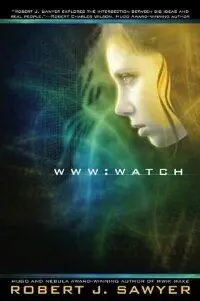
- Название:Watch
- Автор:
- Издательство:Ace Books
- Жанр:
- Год:2010
- ISBN:978-0-441-01818-5
- Рейтинг книги:5 / 5. Голосов: 1
-
Избранное:Добавить в избранное
- Отзывы:
-
Ваша оценка:
Watch: краткое содержание, описание и аннотация
Предлагаем к чтению аннотацию, описание, краткое содержание или предисловие (зависит от того, что написал сам автор книги «Watch»). Если вы не нашли необходимую информацию о книге — напишите в комментариях, мы постараемся отыскать её.
WATCH is convinced that Webmind represents a risk to national security and wants it purged from cyberspace. But Caitlin believes in Webmind’s capacity for compassion—and she will do anything and everything necessary to protect her friend.
Watch — читать онлайн бесплатно полную книгу (весь текст) целиком
Ниже представлен текст книги, разбитый по страницам. Система сохранения места последней прочитанной страницы, позволяет с удобством читать онлайн бесплатно книгу «Watch», без необходимости каждый раз заново искать на чём Вы остановились. Поставьте закладку, и сможете в любой момент перейти на страницу, на которой закончили чтение.
Интервал:
Закладка:
Still, the math was easy. “I rat out Dale,” Caitlin said.
“Why?”
“Because it’s the best thing for me. If he doesn’t rat me out, I get away without any punishment, instead of having a one-week suspension. And if he does rat me out, then I’m still better off, because then I only get a two-week suspension, instead of the three weeks I’d have gotten by keeping my mouth shut. No matter what he does, I cut a week off my punishment by ratting him out.”
“And what about Dale? What should he do?”
Caitlin frowned. “Well, I guess he should rat me out, too.”
“Why?”
“The same reasons: no matter what I do, he gets one week less suspension by turning me in.”
Her mother smiled—but whether at Caitlin’s brilliance or at the thought of both Frank and Dale being punished, she couldn’t say. “Exactly,” her mom said, and she started to draw on the paper. “If we make a chart with Frank’s possible moves—we call them ‘defecting’ or ‘cooperating’—on the x-axis and Dale’s possible moves—the same things, defect or cooperate—on the y-axis, we get what’s called the payoff matrix: a table with a score for each possible outcome, see?” She pointed at one of the squares in the matrix. “Even though the best possible outcome—one week’s punishment—occurs when you both cooperate, the math says you should both defect. Granted it doesn’t give you personally the best possible outcome, but it does give you the best outcome you can reasonably expect given that the other player will selfishly act in his or her own interests.”
Caitlin frowned again. If game theory was all about people being selfish, it wasn’t going to help her accomplish what she wished with Webmind; she needed a way to make it want to act altruistically.
“Now,” her mom went on, “that’s a simple game: each player only got to make one move. But most games involve a series of turns. Consider a dollar bill—”
“We’re in Canada now, Mom,” Caitlin said, teasing. “They don’t have dollar bills.” She knew the Canadian one-dollar coin was called a loonie, because it had a picture of a loon—a kind of waterfowl—on the tails side. She also knew that the two-dollar coin was called a toonie. She thought a much more clever name would have been “doubloon,” but nobody had asked her.
“Fine,” her mother said, smiling. “Consider a dollar coin, then—and consider a bunch of people at a party. Now, I’ve actually tried this myself, and it really works. Announce to the group at the party that you’re going to auction off the dollar—highest bidder gets to keep it. But, unlike normal auctions, there’s one special condition: the second-highest bidder also has to pay up whatever his or her highest bid was—but gets nothing for it. Got that?”
Caitlin nodded.
“How much, on average, do you think the dollar sells for?”
She lifted her shoulders. “Fifty cents?”
“Nope. The average is $3.40.”
“That’s crazy!” said Caitlin.
“Loony, even,” her mother replied. “But it’s true.”
“Why do people bid so high?”
“Well, remember, the second-highest bidder has to pay the auctioneer, too, so…” She trailed off, clearly wanting Caitlin to figure it out for herself.
She tried to do so. The first bidder presumably bid a penny to start—which would net him a ninety-nine-cent profit. But then as soon as a second bidder offered two cents, the first bidder probably figured that offering three cents was still a good deal: he’d net ninety-seven cents in profit.
And so it would continue, until—
Ah!
Until one bidder bid ninety-nine cents—which would still give him a one-cent profit. But the previous bidder, whose bid might have been, say, ninety-eight cents, was now looking at losing that much and getting nothing in return. And so he would bid a dollar—thereby breaking even, at least. But then the guy who had bid ninety-nine cents faced a dilemma: he either walked away and lost ninety-nine cents, or he bid, say, $1.01—which would cut his losses to just a penny.
And so, indeed, it would escalate, with bids going higher and higher, until the utter ridiculousness of the situation finally caused all but one of the bidders to drop out.
Caitlin said as much to her mom, who smiled encouragingly. “That’s right, dear. Now, can you think of what the optimal strategy would be—and no cheating by having Webmind tell you.”
Caitlin considered for a second then: “Make an opening bid of ninety-nine cents. No one else would have any motive to bid against you, because the best they could do, if they outbid you by one cent, is break even, and if they bid more, they’d lose money. You’d end up being the only bidder, and you’d still make a profit, even if it’s only a penny.”
“That’s right,” her mother said again, “assuming all the potential bidders were rational and that their only motive was profit. But here’s where simple math fails to account for reality—there’s a psychological element that Webmind will need to understand.”
“Yes?”
“Suppose it was your worst enemy who had just bid ninety-nine cents. You might bid, say, $1.98, just so he’d be out almost a buck—and you’d still be out less than he was.”
“Wow,” Caitlin said. “That’s nasty.”
“I’ve seen this game get very ugly at parties,” her mom said. “I’ve seen couples who arrived together leave separately after playing it.”
“Ah, okay, then I’ve got a question for you, Mom. What would you wish for if you knew that your worst enemy would get double what you got?”
“Hmmm. A million—no. Um, I don’t know.”
“To be blind in one eye,” Caitlin replied.
“God!” said her mother. “But, um, yes, that’s an example of what I’m trying to get at: it’s possible for people to value outcomes differently. Do you remember when your father taught you how to play chess?”
They had a special chessboard with Braille characters on the heads of each piece. “Sure.”
“And remember how he used to let you win?”
Caitlin raised her eyebrows. “Say what?”
“Um, dear, he—”
“I’m just kidding, Mom.”
She smiled. “Well, why did he let you win?”
“I dunno. I guess, ’cause if he didn’t, I wouldn’t have wanted to play anymore. I wouldn’t have come back for another game.”
“That’s right. What he valued most was not him winning, but rather you winning. In other words, you both wanted the same thing, and even though it cost him—in the sense of losing the game—to let you win, he was happy when you did.”
“I get it,” Caitlin said. “But, in the dollar auction, people don’t want to play anymore after a certain point, too, right? And I bet it’s not just that it’s ridiculous that causes them to finally stop bidding. It’s also boredom: I mean, even if you were bidding in ten-cent increments, instead of penny increments, it would still take thirty-four bids to get the $3.40 you mentioned. But if I was writing a pair of computer programs to play that game, they’d keep playing forever—because the only way you lose money is if you stop bidding.”
She paused, and then a big smile came to her face. “Or, to put it in terms like in that movie Dad and I watched, the only losing move is not to go on playing.”
“Good point,” her mom said. “Now, can you think of any real-life examples of things like the dollar game?”
Caitlin was trying to do just that when Schrödinger crossed her field of view, moving absolutely silently. “Evolution,” she said.
“Yes, exactly!” said her mom. “But why?”
Читать дальшеИнтервал:
Закладка:
Похожие книги на «Watch»
Представляем Вашему вниманию похожие книги на «Watch» списком для выбора. Мы отобрали схожую по названию и смыслу литературу в надежде предоставить читателям больше вариантов отыскать новые, интересные, ещё непрочитанные произведения.


Обсуждение, отзывы о книге «Watch» и просто собственные мнения читателей. Оставьте ваши комментарии, напишите, что Вы думаете о произведении, его смысле или главных героях. Укажите что конкретно понравилось, а что нет, и почему Вы так считаете.