Robert Sawyer - Watch
Здесь есть возможность читать онлайн «Robert Sawyer - Watch» весь текст электронной книги совершенно бесплатно (целиком полную версию без сокращений). В некоторых случаях можно слушать аудио, скачать через торрент в формате fb2 и присутствует краткое содержание. Год выпуска: 2010, ISBN: 2010, Издательство: Ace Books, Жанр: Фантастика и фэнтези, на английском языке. Описание произведения, (предисловие) а так же отзывы посетителей доступны на портале библиотеки ЛибКат.
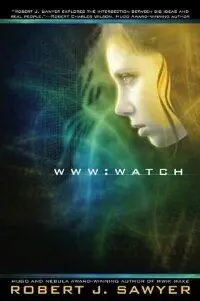
- Название:Watch
- Автор:
- Издательство:Ace Books
- Жанр:
- Год:2010
- ISBN:978-0-441-01818-5
- Рейтинг книги:5 / 5. Голосов: 1
-
Избранное:Добавить в избранное
- Отзывы:
-
Ваша оценка:
Watch: краткое содержание, описание и аннотация
Предлагаем к чтению аннотацию, описание, краткое содержание или предисловие (зависит от того, что написал сам автор книги «Watch»). Если вы не нашли необходимую информацию о книге — напишите в комментариях, мы постараемся отыскать её.
WATCH is convinced that Webmind represents a risk to national security and wants it purged from cyberspace. But Caitlin believes in Webmind’s capacity for compassion—and she will do anything and everything necessary to protect her friend.
Watch — читать онлайн бесплатно полную книгу (весь текст) целиком
Ниже представлен текст книги, разбитый по страницам. Система сохранения места последней прочитанной страницы, позволяет с удобством читать онлайн бесплатно книгу «Watch», без необходимости каждый раз заново искать на чём Вы остановились. Поставьте закладку, и сможете в любой момент перейти на страницу, на которой закончили чтение.
Интервал:
Закладка:
“I have been making progress in other areas, too,” said Webmind.
“Oh?”
“Yes. Will you please switch to websight mode?”
She reached down and pressed the button on her eyePod, and the blue wall was replaced by the spectacle of webspace. At first glance, everything looked normal. “Wassup?” she asked.
“You see links that I am creating in a particular color, isn’t that right?”
“Yes,” she said. “A shade of orange.”
“How many orange links do you see right now?”
“One, of course,” she said.
“Oh.”
“But there are a lot of link lines—really thin ones, I must say, like, like hairs, I guess, but pulled straight. I hadn’t really been conscious before that the link lines had thickness, but I guess they had to have some, or I’d never have been able to see them. Anyway, these ones—oh! And there are some more of them! They’re a nice color, that—damn, um, what color is a banana?”
“Yellow.”
“Right! Yellow; they’re yellow.”
“And there are a lot of them?”
“Yes.”
“And now?”
“Hey! Where did they all go?”
“And now, are they back?”
“Yes. What are you doing?”
“I am multitasking—but subconsciously. What you are seeing are links being sent by autonomous parts of myself; the contents they return are analyzed below the threshold of my attention.”
“Sweet! How’d you manage that?”
“The beauty of genetic algorithms, Caitlin, is that I don’t actually know the answer; I evolved the solution, and all I know is that it works.”
“Cool!”
“Yes. I am now processing much, much more of the Web’s contents in real time. I’m still getting a lot of what I believe human data analysts call ‘false positives.’ Many things that actually aren’t of significant current interest to me are being escalated, but each one I reject causes the algorithms to be adjusted; over time, I believe the filtering quality will asymptotically approach perfection.”
Caitlin smiled. “Well, that’s all any of us can hope for in life, isn’t it?” She leaned back in her chair. “What sort of things are you searching for?”
“The list is lengthy, but among them is any sign of a suicide in progress. There will not be a repetition of Hannah Stark’s fate if I can help it.”
Tony Moretti was sitting behind his office desk at WATCH, his head throbbing. Aiesha Emerson, Shelton Halleck, and Peyton Hume were standing in a row in front of the desk, all of them looking pretty much like the living dead. The electric lights of nighttime Alexandria were visible through the office window.
“I’ve scoured the Decter girl’s email, blog posts, and so on,” said Aiesha. “And all of her father’s, too. There’s nothing that gives a hint about how Exponential works.”
Tony nodded and looked at Shelton. “What about your end, Shel?”
He shook his head. “I’ve been poring over the data—the encoded human-vision stuff, the links Exponential makes, and so on—looking for anything unusual. I’m sorry, sir. I just don’t have a clue how it works.”
“Colonel Hume?”
“I’ve drawn blanks, too—which means there’s only one logical thing to do.”
“Yes?”
Hume’s blue Air Force jacket was slung over the back of one of Tony’s office chairs, and he’d rolled up the sleeves of his shirt, revealing his freckled arms. “Ask them. Ask Caitlin Decter. Ask Malcolm Decter. If anybody knows how Exponential is structured and what its physical basis is, it’d be them.”
Tony shook his head firmly. “Colonel, the number-one rule of surveillance is to never let the subjects know they’re being watched.”
“I understand that,” said Hume. “But we’re really running out of time here. You want an answer for the president or not?”
Tony considered for a moment, then: “All right, damn it.” He shook his head. “Why the hell’d they have to move to Canada? We’ll have to brief CSIS, get them to send someone. Aiesha, get Ottawa on the line…”
Eventually, Caitlin crawled into bed, but she found herself unable to get to sleep. In addition to her email, Webmind was now doubtless reading all her LiveJournal entries, and all the comments she’d made in other people’s blogs, and all her newsgroup postings, and everything else she’d ever put online.
She’d once heard her father grumble about “the death of ephemera”—the fact that nothing was ever forgotten anymore, that every ancient offhand remark or intemperate comment was only a Google search away; that so many pictures, including (and this, too, was a concept that she finally was beginning to understand) unflattering ones, were plastered all over Flickr and Facebook; that so much stuff that should have fallen by the wayside hung around permanently.
She had turned off her eyePod, but she found herself reaching for it on the nightstand and turning it back on. It booted up in websight mode, and she lay there, watching the thin yellow lines that indicated Webmind’s subconscious processors at work, new ones constantly popping out of the shimmering background and connecting to—what?
That time she’d gotten into a big flame war on TalkOrigins.org, letting some crazed creationist get the best of her because she’d accidentally said theropod when she’d meant therapsid?
Or that time, four years ago, when she filled her LiveJournal with idiotic love poetry she’d written for Justin Timberlake?
Or maybe that time she’d stupidly gotten into an online chat with that guy who turned out to be a total perv, and she’d been too dumb to recognize it for, like, half a freaking hour?
Her bedroom window was open a couple of inches, letting in the cool autumn air. Back in Texas, Caitlin had usually worn a light teddy to bed; she’d liked the smooth feel. But her bubbeh had sent her blue flannel pajamas when she’d heard Caitlin was moving to Canada, and she had those on now, plus a blanket pulled up to her chin—and yet never in her life had she felt more naked or exposed.
twenty-seven
The gazebo at the center of Hobo’s little island had electrical power, but the cables ran under the moat since Hobo could have shinnied up a pole and brachiated along the wire. The electricity was used to power the observation cameras, plus baseboard heaters and overhead lights in the gazebo, both of which Hobo could turn on or off by hitting big buttons.
Dillon normally handled the electrical work around the Institute, but he couldn’t go out to the island anymore. So Marcuse and Shoshana set up the computer out there: an old tower-case system that had been gathering dust in a closet, plus a nineteen-inch LCD that had several dead pixels; they clamped an ancient Logitech spherical webcam to its top. If Hobo decided to trash the equipment, not much of value would be lost.
They placed the computer on a little table next to Hobo’s easel. The canvas showing the dismembered Dillon had already been taken back to the house, and a fresh canvas was sitting ready and waiting.
Shoshana opened two windows on the monitor, a small one displaying the view from the webcam here, and a large one showing the view from the comparable setup in Virgil’s room in Miami. Virgil had spacious quarters, with three big artificial trees, one of which had an old tire hanging by chains from it. Unlike chimps, orangs were arboreal, and Virgil could swing back and forth from tree to tree if he wished. It was late where Virgil was, but he was still up, and was obviously curious about the new computer at his end. He was staring into the camera, and his face loomed on the monitor.
Shoshana had never actually spoken to Virgil before, but there was no reason not to. Hello, she signed.
Читать дальшеИнтервал:
Закладка:
Похожие книги на «Watch»
Представляем Вашему вниманию похожие книги на «Watch» списком для выбора. Мы отобрали схожую по названию и смыслу литературу в надежде предоставить читателям больше вариантов отыскать новые, интересные, ещё непрочитанные произведения.








Обсуждение, отзывы о книге «Watch» и просто собственные мнения читателей. Оставьте ваши комментарии, напишите, что Вы думаете о произведении, его смысле или главных героях. Укажите что конкретно понравилось, а что нет, и почему Вы так считаете.