Robert Sawyer - Watch
Здесь есть возможность читать онлайн «Robert Sawyer - Watch» весь текст электронной книги совершенно бесплатно (целиком полную версию без сокращений). В некоторых случаях можно слушать аудио, скачать через торрент в формате fb2 и присутствует краткое содержание. Год выпуска: 2010, ISBN: 2010, Издательство: Ace Books, Жанр: Фантастика и фэнтези, на английском языке. Описание произведения, (предисловие) а так же отзывы посетителей доступны на портале библиотеки ЛибКат.
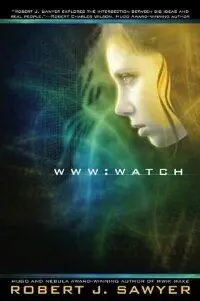
- Название:Watch
- Автор:
- Издательство:Ace Books
- Жанр:
- Год:2010
- ISBN:978-0-441-01818-5
- Рейтинг книги:5 / 5. Голосов: 1
-
Избранное:Добавить в избранное
- Отзывы:
-
Ваша оценка:
Watch: краткое содержание, описание и аннотация
Предлагаем к чтению аннотацию, описание, краткое содержание или предисловие (зависит от того, что написал сам автор книги «Watch»). Если вы не нашли необходимую информацию о книге — напишите в комментариях, мы постараемся отыскать её.
WATCH is convinced that Webmind represents a risk to national security and wants it purged from cyberspace. But Caitlin believes in Webmind’s capacity for compassion—and she will do anything and everything necessary to protect her friend.
Watch — читать онлайн бесплатно полную книгу (весь текст) целиком
Ниже представлен текст книги, разбитый по страницам. Система сохранения места последней прочитанной страницы, позволяет с удобством читать онлайн бесплатно книгу «Watch», без необходимости каждый раз заново искать на чём Вы остановились. Поставьте закладку, и сможете в любой момент перейти на страницу, на которой закончили чтение.
Интервал:
Закладка:
So, hell, she wouldn’t even be here if her mother had been too shy to make the first move—and the second, and the third, and…
“Um,” she said, and “ah,” and then, disappointing herself with the quality of her rhetoric, she let loose with another “um.” Online she was fearless—she was Calculass! But here, in the real world, she was just Caitlin, and sometimes, especially when having to deal with people stuff, she felt more like her father’s daughter than her mother’s. She took a deep breath and tried to summon the strength of her alter ego. Then she looked down at her sandwich, and, when she forced the words out they came in a rush, without any pauses: “So would you like to go out sometime?”
Caitlin, of course, counted the seconds.
One. Two. Three.
She resisted the urge to look up him, afraid of the expression she might see.
Four. Five. Six.
“You want to go out with me?” he said, at last, sounding stunned.
She did lift her gaze. “Yes, silly.”
“I, uh, I thought you were going with Trevor. I, um, I mean, didn’t he take you to the dance?”
“Were you there?”
“Me?” He seemed astounded at the suggestion. “No.”
“Trevor’s a jerk,” she said. “And, no, I’m not going out with him. So, how ’bout it? Wanna go out sometime?”
“Well,” he said, and “um,” and, at last, “yes.”
“Great,” said Caitlin. She paused, waiting for him to make a suggestion, but when he didn’t she said, “There’s an awesome series of free public lectures at the Perimeter Institute. Have you ever been to any of those?”
“No. I’ve tried. The tickets are impossible to get. They go like that.” He snapped his fingers as he spoke the final word.
“I’ve got an in. My dad is on the lecture committee there.”
“Your dad works at PI?”
“Uh-huh. He studies quantum gravity.”
“Cool!”
Caitlin smiled. Who’d have thought her dad would turn out to be cool?
Suddenly, Braille dots flowed in front of her eyes. If I may be so bold, Caitlin, you should inquire about what he hopes to do after high school.
Caitlin wanted to ask what the hell Webmind was doing, but there was no way to do so with Matt right there. Still, it did seem like a good way to keep the conversation going, so she posed the suggested question.
“I’m going to do computer science.”
Ask him where.
“Where?”
“Here,” he said. “There’s nowhere better than the University of Waterloo.”
“Really? I’ve always had my heart set on MIT.”
“Well,” said Matt, “you should check out what’s here, too.”
Ask him what his favorite color is.
Caitlin couldn’t stand it anymore. “What are you doing?” she said into the air.
I read all of Project Gutenberg, Webmind replied at once, including the play Cyrano de Bergerac. I thought I’d lend a hand.
“Sorry,” said Matt. “I, um, I always eat my sandwich that way.”
Caitlin had too little experience with watching people eat to be able to identify whatever Matt had done that was unusual. “Ah,” she said, and smiled at him. “That’s okay. It’s cute.”
twenty-five
Caitlin had heard her mom use the phrase “nonzero-sum” from time to time. She knew it was a term from her mother’s field of expertise, game theory. Webmind had already read everything on Wikipedia about game theory, but that didn’t mean he actually understood what “nonzero-sum” meant. Nor, if she was really honest with herself, did Caitlin, and yet this notion of nonzero-sum games was stuck in her mind: win-win situations in which everything could be made better.
Her mother had been having her own conversations with Webmind all day long while Caitlin was at school. Once Caitlin got home and had checked her email and so forth, she went across the hall to her mother’s office and told her about that poor Australian girl who had committed suicide, and about how she’d told Webmind that he should intervene in nonzero-sum situations.
Her mom looked horrified. “It just… just watched her kill herself? It didn’t try to stop her?”
“He, Mom. He didn’t know what to do, what to think. We need him to understand what to do the next time, and not just with teen suicides, but in any nonzero-sum situations. Can you help us?”
Her mother’s face moved through several expressions but then settled on one that Caitlin had seen before: the take-charge, supermotherscan-do-everything face. “Yes, I’ll help it—help him —learn to help the rest of us. That’s something I definitely want in on.”
“Thanks,” replied Caitlin. “But, I mean, I know— we know—what nonzero-sum is; we get that. But there must be a lot more to game theory than just that.”
“Oh… a bit,” said her mother. Caitlin realized she was still coming to grips with the magnitude—the importance—of what she was about to do.
“So, could you explain it to us? I remember hearing you say once that game theory really isn’t just about mathematics, but about human psychology.”
“That’s right,” her mother said. “In fact, the hottest branch of game theory right now is called ‘behavioral game theory.’ ”
“Well, Webmind certainly needs to understand human behavior better.”
So everyone keeps saying, Webmind sent to her eye.
“Okay,” said her mom. “Let’s go downstairs.”
Her mother got a clipboard, some pens, and some paper, and the two of them went to the dining room, which had a big table. There was normally one chair on each side of the table, but Caitlin’s mom moved hers to be next to Caitlin’s.
“Webmind is listening, right?” asked her mom.
The word Yes flashed in Caitlin’s vision, and she repeated it.
“Okay,” her mom said. “Do you know what the prisoner’s dilemma is?”
Caitlin thought, How to pick up the soap in the shower? But what she said was, “No.”
Her mother seemed to consider for a moment, then: “Okay, let’s do it like this: say you and Bashira both get in trouble at school. Say Principal Auerbach has said that he thinks you guys have hacked into the school’s computer and changed your grades—just like in WarGames, right? And he talks to each of you separately. He says to you, ‘Okay, look, Caitlin, I admit I haven’t got enough evidence to actually prove you did this, but I can suspend each of you for a week just because, well, because I’m the principal.’ ”
Caitlin nodded, and her mother went on. “But the principal’s real interest is in making sure this never happens again, so he adds that if you’ll say Bashira did it and explain how it was done, you get off scot-free—no suspension at all—and he’ll suspend Bashira for three weeks. Oh, except for this: if you say Bashira did it, and Bashira says you did—that is, if you each blame the other—then you’ll both get suspended for two weeks. Got that? You can end up with no suspension, one week’s worth, two weeks’ worth, or three weeks’ worth. And you know he’s going to make the same offer in private to Bashira. What do you do?”
Caitlin didn’t hesitate. “I clam up; I don’t say a word.”
“But if Bashira fingers you, you’ll get three weeks of suspension.”
“But she won’t,” Caitlin said firmly.
Her mother seemed to consider this. “Okay, okay, let’s say it’s not you and Bashira for the moment. Let’s say it’s just two random guys—um, Frank and Dale. What should you do if you’re Frank?”
Caitlin suppressed a smile. Frank was the name of her mother’s first husband, who had come and gone long before she’d been born, and Dale, she knew, was the former head of the Economics Department at the University of Houston—someone her mother had famously not gotten along with. Picking truly random people was as hard as generating really random numbers, it seemed.
Читать дальшеИнтервал:
Закладка:
Похожие книги на «Watch»
Представляем Вашему вниманию похожие книги на «Watch» списком для выбора. Мы отобрали схожую по названию и смыслу литературу в надежде предоставить читателям больше вариантов отыскать новые, интересные, ещё непрочитанные произведения.






Обсуждение, отзывы о книге «Watch» и просто собственные мнения читателей. Оставьте ваши комментарии, напишите, что Вы думаете о произведении, его смысле или главных героях. Укажите что конкретно понравилось, а что нет, и почему Вы так считаете.