Robert Sawyer - Watch
Здесь есть возможность читать онлайн «Robert Sawyer - Watch» весь текст электронной книги совершенно бесплатно (целиком полную версию без сокращений). В некоторых случаях можно слушать аудио, скачать через торрент в формате fb2 и присутствует краткое содержание. Год выпуска: 2010, ISBN: 2010, Издательство: Ace Books, Жанр: Фантастика и фэнтези, на английском языке. Описание произведения, (предисловие) а так же отзывы посетителей доступны на портале библиотеки ЛибКат.
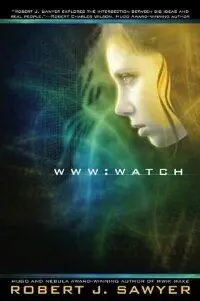
- Название:Watch
- Автор:
- Издательство:Ace Books
- Жанр:
- Год:2010
- ISBN:978-0-441-01818-5
- Рейтинг книги:5 / 5. Голосов: 1
-
Избранное:Добавить в избранное
- Отзывы:
-
Ваша оценка:
Watch: краткое содержание, описание и аннотация
Предлагаем к чтению аннотацию, описание, краткое содержание или предисловие (зависит от того, что написал сам автор книги «Watch»). Если вы не нашли необходимую информацию о книге — напишите в комментариях, мы постараемся отыскать её.
WATCH is convinced that Webmind represents a risk to national security and wants it purged from cyberspace. But Caitlin believes in Webmind’s capacity for compassion—and she will do anything and everything necessary to protect her friend.
Watch — читать онлайн бесплатно полную книгу (весь текст) целиком
Ниже представлен текст книги, разбитый по страницам. Система сохранения места последней прочитанной страницы, позволяет с удобством читать онлайн бесплатно книгу «Watch», без необходимости каждый раз заново искать на чём Вы остановились. Поставьте закладку, и сможете в любой момент перейти на страницу, на которой закончили чтение.
Интервал:
Закладка:
And, although they were facing almost certain destruction at the hands of V’Ger, a vast artificial intelligence, Kirk knew his friend well enough to say, in reference to the tears, “Not for us?”
Spock replied, with infinite sadness. “No, Captain, not for us. For V’Ger. I weep for V’Ger as I would for a brother. As I was when I came aboard, so is V’Ger now.” When Spock had come aboard, he’d been trying to purge all remaining emotion—the legacy of his human mother—to become, like V’Ger, like Deep Blue, a creature of pure logic, the Vulcan ideal. Two heritages, two paths. A choice to be made.
And, by the end of the film, he’d made his choice, embracing his human, emotional half, so that in the final scene, when Scotty announced to him, in that wonderful accent of his, that, “We can have you back on Vulcan in four days, Mr. Spock,” Spock had replied, “Unnecessary, Engineer. My business on Vulcan is concluded.”
“What did you think?” Caitlin asked into the air as the ending credits played over the stirring music.
Braille characters flashed across her vision: I’m a doctor, not a film critic. She laughed, and Webmind went on. It was interesting when Spock said, “Each of us, at some time in our lives, turns to someone—a father, a brother, a god—and asks, ‘Why am I here? What was I meant to be? ’ ” Most uncharacteristically, Webmind paused, then added: He was right. We all must find our place in the world.
On Tuesday morning, Caitlin’s mother drove her to school, and Caitlin headed up to math class. Webmind knew that she couldn’t really talk to him at school; still, he occasionally sent text to her, commenting on things they were seeing. Only the sounds of the school were new to him; he’d been watching when Caitlin had last attended classes four days ago.
Caitlin’s seat was right next to Bashira’s, and Bash gave her a big smile when she entered. Caitlin was nervous because Trevor was in that class, too, but he didn’t arrive until just as “O Canada” was starting to play.
Caitlin had known the Canadian anthem before moving there—you couldn’t be a hockey fan without hearing it from time to time—but she didn’t really like it: too sexist, with its line about “all thy sons’ command”; too, well, provincial for a country of immigrants such as her and Bashira, with its line about “our home and native land”; and too religious, with the line about “God keep our land.”
Once the anthem was over, Trevor made a show during the morning announcements of arranging his textbook and notebook on his desk, avoiding her gaze.
Is that the Hoser? Webmind asked.
Caitlin nodded—which, she knew, made the view Webmind was seeing go up and down.
She’d hoped for something more interesting than rote memorization of trigonometric identities, which is what they’d done the last time she’d been in class, but today’s subject was only slightly better. And so she found herself looking around the classroom, and seeing—really seeing—some of her classmates for the first time.
She spent a fair bit of time staring at Sunshine Bowen. Caitlin understood the whole big-boobs-equals-hot thing, at least in the minds of most teenage boys, but as for the rest of it, she just didn’t get what all the fuss was about. Oh, the long hair was nice, sure, and its color was… distinctive. And, yes, her clothes seemed to show more skin than just about anyone else in the room was exposing.
Sunshine had her textbook propped up in front of her on her desk— but, after a moment, Caitlin realized it wasn’t because she was reading it but rather because she was using it to shield what she was doing from the teacher’s eyes… something with her thumbs, and—
Oh! She was texting on her cell phone! Caitlin had heard about that, but had never seen it—but, hey, it now seemed downright primitive compared to having words beamed right into your eye.
“Mr. Heidegger?” asked a thin boy sitting in front of Sunshine. Caitlin recognized the voice at once: it was Matt, whom she’d noticed repeatedly in the past because he often asked good questions, and clearly was a math geek himself.
The teacher, who was also thin and had a close-cropped beard, said, “Yes, Matt?”
Matt did not disappoint: he proceeded to ask a very intelligent question about what Mr. H had written on the blackboard. Matt’s voice was breathy, and it cracked now and then as he spoke. The Hoser snorted at one point when it did so, but Caitlin thought it was endearing.
“That’s really beyond the scope of what we’re trying to do today,” Mr. Heidegger said, “but if—”
Caitlin surprised herself by piping up with, “I’ll explain it to him.”
Matt turned around and looked at her, and—
She’d read the phrase often enough in books, and although she’d yet to see a deer, or a picture of one, she imagined that was what was meant by “a deer caught in the headlights.”
Mr. H nodded and pointed to the back of the room, where there were some empty desks. “Go back there,” he said, “where you won’t disturb anyone else.”
Caitlin got up, and, after a second, Matt did, too. He was white—in fact, quite white; “pale” was the appropriate term, Caitlin supposed. And he had a… unique face, unlike any she’d seen yet. But he smiled a lot, and Caitlin liked that.
They kept their voices down, and talked about what Mr. Heidegger had written on the board.
And about how to solve problems involving right triangles using the primary trigonometric ratios and the Pythagorean theorem.
And about how to solve problems involving acute triangles using the sine law and the cosine law.
And then they started talking about hockey; Caitlin loved the game because of the player statistics, which she found much more interesting than those associated with baseball. Matt liked talking about hockey stats, too—although, being a local boy, he was a Leafs fan.
Caitlin found herself smiling, and—
And then the bell rang.
“Don’t forget,” said Mr. H. “Do all the problems on pages forty-eight and forty-nine for tomorrow.”
Caitlin had an electronic version of the textbook on her notebook computer, which she could easily read with her Braille display, but—
“Um, I have a hard time reading printed text,” she said to Matt. “Would you—maybe at lunch? Could you go over the problems with me?”
That deer-in-the-headlights look again. She felt her heart pounding as she waited for the response.
It was suddenly noisy. The other students were getting up, banging their chairs against their desks, and starting to file out—but the door was at the far end of the room, near the blackboard, and so they’d have a few moments of privacy before the next class started pouring in.
“Um, sure,” Matt said. “It’s a—” But then he stopped himself and started over, “I mean, I’ll see you in the cafeteria.”
Which would have been a perfect place to end their conversation, Caitlin thought—but they both had to walk up to the front of the room and out the door, and then head off to their next class, which, now that she thought about it, was English—and Matt was in that class with her, too. So they walked there without saying anything else, but she, at least, was grinning.
twenty-three
Barbara Decter called her upstairs study her “office,” but Malcolm Decter referred to his, on the first floor opposite the laundry room, as his “den,” a term his father had used for a similar room in his childhood home back in Philadelphia. He had delayed going in to PI this morning, waiting until his wife and daughter had headed out for the drive to school—after which Barb was going to pick up some much-needed groceries. He wasn’t alone in his den, though. Schrödinger was stretched out—in his superstring configuration, as Malcolm called it—on the black leather couch. On the wall above the couch was a framed printout of a quotation from Captain Kirk, in forty-two-point Helvetica:
Читать дальшеИнтервал:
Закладка:
Похожие книги на «Watch»
Представляем Вашему вниманию похожие книги на «Watch» списком для выбора. Мы отобрали схожую по названию и смыслу литературу в надежде предоставить читателям больше вариантов отыскать новые, интересные, ещё непрочитанные произведения.








Обсуждение, отзывы о книге «Watch» и просто собственные мнения читателей. Оставьте ваши комментарии, напишите, что Вы думаете о произведении, его смысле или главных героях. Укажите что конкретно понравилось, а что нет, и почему Вы так считаете.