Robert Sawyer - Watch
Здесь есть возможность читать онлайн «Robert Sawyer - Watch» весь текст электронной книги совершенно бесплатно (целиком полную версию без сокращений). В некоторых случаях можно слушать аудио, скачать через торрент в формате fb2 и присутствует краткое содержание. Год выпуска: 2010, ISBN: 2010, Издательство: Ace Books, Жанр: Фантастика и фэнтези, на английском языке. Описание произведения, (предисловие) а так же отзывы посетителей доступны на портале библиотеки ЛибКат.
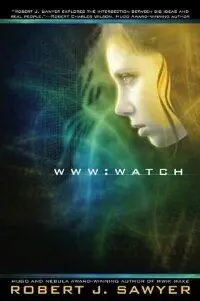
- Название:Watch
- Автор:
- Издательство:Ace Books
- Жанр:
- Год:2010
- ISBN:978-0-441-01818-5
- Рейтинг книги:5 / 5. Голосов: 1
-
Избранное:Добавить в избранное
- Отзывы:
-
Ваша оценка:
Watch: краткое содержание, описание и аннотация
Предлагаем к чтению аннотацию, описание, краткое содержание или предисловие (зависит от того, что написал сам автор книги «Watch»). Если вы не нашли необходимую информацию о книге — напишите в комментариях, мы постараемся отыскать её.
WATCH is convinced that Webmind represents a risk to national security and wants it purged from cyberspace. But Caitlin believes in Webmind’s capacity for compassion—and she will do anything and everything necessary to protect her friend.
Watch — читать онлайн бесплатно полную книгу (весь текст) целиком
Ниже представлен текст книги, разбитый по страницам. Система сохранения места последней прочитанной страницы, позволяет с удобством читать онлайн бесплатно книгу «Watch», без необходимости каждый раз заново искать на чём Вы остановились. Поставьте закладку, и сможете в любой момент перейти на страницу, на которой закончили чтение.
Интервал:
Закладка:
Interesting.
“Thanks, but it’s not just a debating point, Webmind. As you said, there’s a daunting amount of unhappiness in the world—and you can change that.”
Tolstoy said, “All happy families are alike, but all unhappy families are miserable in their own way.” Happiness is uniform, undifferentiated, uninteresting. I crave surprising stimuli.
“Happiness can be stimulating.”
In a biochemical sense, yes. But I have read much on the creation of art and literature—two human activities that fascinate me, because, at least as yet, I have no such abilities. There is a strong correlation between unhappiness and the drive to create, between depression and creativity.
“Oh, bullshit,” said Caitlin.
Pardon?
“Such garbage. I do mathematics because it gives me joy. Painters paint because it gives them joy. Businesspeople wheel and deal because that’s what they get off on. Ask anyone if they’d rather be happy than sad, and they’ll say happy.”
Not in all cases.
“Yes, yes, yes, I’m sure that people say they’d rather be sad and know the truth than be happy and fed a lie—that’s part of what Nineteen Eighty-Four is about. But in general, people do want to be happy. That’s why we promise them ‘Life, liberty, and the pursuit of happiness.’ ”
You’re in Canada now, Caitlin. I believe the corresponding promise made there is simply “Peace, order, and good government.” No mention of happiness.
“Well, then, it goes without saying! People want to be happy. And… and…”
Yes?
“And you can choose to value this, Webmind. You didn’t evolve; you spontaneously emerged. Maybe, in most things, humans are programmed by evolution—but even though you grew out of our computing infrastructure, you weren’t. We had our agendas set by natural selection, by selfish genes. But you didn’t. You just are. And so you don’t have… inertia. You can choose what you want to value—and you can choose to value this: the net happiness of the human race.”
twenty-two
Caitlin’s dad always roasted a turkey on American Thanksgiving—but that was six weeks away. To mark Canadian Thanksgiving, they got takeout from Swiss Chalet, which, despite its name, was a Canadian barbecue-chicken chain. It seemed, Caitlin noted, that the worst thing you could do if you were a Canadian restaurant was acknowledge that fact. Instead, the Great White North was serviced by domestically owned companies with names such as Montana’s Cookhouse, New York Fries, East Side Mario’s, and Boston Pizza. She wondered what clueless moron had come up with that last one. Chicago was famous for pizza, yes. Manhattan, too. But it’s Beantown, not Pietown, for Pete’s sake!
Caitlin and both her parents had spent most of the unexpected holiday working with Webmind, but, again, come evening, they were exhausted. There was a point at which, even with something as miraculous as this, Caitlin just had to take a break; her brain was fried, and, from the sound of his voice, her father’s brain was in the same state.
“Go ahead,” her mother said. “I’ll work with Webmind. You two relax.”
They’d nodded and headed down to the living room. “Another movie?” suggested her dad.
“Sure,” said Caitlin.
Perhaps another one about AI, Webmind sent to her post-retinal implant.
“Webmind wants to see something else about artificial intelligence,” Caitlin said.
They stood by the thin cabinets containing his DVD collection. Her father’s mouth curved downward; a frown. “Most of them are negative portrayals,” he said. “Colossus: The Forbin Project, The Matrix, The Terminator, 2001. I’ll definitely show you 2001 at some point, only because it was so influential in the history of artificial intelligence—a whole generation of people went into that field because of it. But it’s almost all visuals, without much dialog; we should wait until you can process imagery better before having you try to make sense out of that, and…”
The frown flipped; a smile. “…and they don’t call it Star Trek: The Motionless Picture for nothing,” he said. “Let’s watch it instead. It’s got a lot of talking heads—but it’s also one of the most ambitious and interesting films ever made about AI.”
And so they settled on the couch to give the Star Trek movie a look. This was, her father explained, the “Director’s Edition,” which he said was much improved over the tedious cut first shown in theaters when he was twelve.
Caitlin had read that the average length of a shot in a movie was three seconds, which was the amount of time it took to see all the important details; after that, apparently, the eye got bored. This film had shots that went on far longer than that—but the three-second figure was based on people who’d had vision their whole lives. It took Caitlin much more time to extract meaning from a normal scene, and even longer when seeing things she’d never touched in real life—such as starship control consoles, tricorders, and so on. For her, the film seemed to zip by at… well, at warp speed.
Even though Webmind was listening in, her dad turned on the closed-captioning again so Caitlin could practice her reading.
The film did indeed make some interesting points about artificial intelligence, Caitlin thought, including that consciousness was an emergent property of complexity. The AI in the film, like Webmind, had “gained consciousness itself ” without anyone having planned for it to do so.
Fascinating, Webmind sent to her eye. The parallels are not lost on me, and…
And Webmind went on and on, and suddenly Caitlin had sympathy for her dad not liking people talking during movies.
Very interesting, Webmind observed when the film suggested that after a certain threshold was reached, an AI couldn’t continue to evolve without adding “a human quality,” which Admiral Kirk had identified as “our capacity to leap beyond logic.” But what does that mean, precisely?
Caitlin had to keep the dates in mind: although the film was set in the twenty-third century, it had been made in 1979, long before Deep Blue had defeated grand master Garry Kasparov at chess. But Kirk was right: even though Deep Blue, by calculating many moves ahead in the game, ultimately did prove to be better at that one narrow activity than was Kasparov, the computer didn’t even know it was playing chess. Kasparov’s intuitive grasp of the board, the pieces, and the goal was indeed leaping beyond logic, and it was a greater feat than any mechanical number crunching.
But it was the subplot about Spock, the half-human half-Vulcan character, that really aroused Caitlin’s attention—and apparently Webmind’s, too, because he actually shut up during it.
To her astonishment, her dad had paused the DVD to say the most important scene in the whole film was not in the original theatrical release, but had been restored in this director’s cut. It took place, as almost the whole movie did, on the bridge of the Enterprise. Kirk asked Spock’s opinion of something. Spock’s back was to him, and he made no reply, so Kirk got up and gently swung Spock’s chair around, and—it was so subtle, Caitlin at first didn’t recognize what was happening, but after a few seconds the image popped into clarity for her, and there was no mistaking it: the cool, aloof, emotionless, almost robotic Spock, who in this movie had been even grimmer than Caitlin remembered him from listening to the TV shows with her father over the years, was crying.
Читать дальшеИнтервал:
Закладка:
Похожие книги на «Watch»
Представляем Вашему вниманию похожие книги на «Watch» списком для выбора. Мы отобрали схожую по названию и смыслу литературу в надежде предоставить читателям больше вариантов отыскать новые, интересные, ещё непрочитанные произведения.

Обсуждение, отзывы о книге «Watch» и просто собственные мнения читателей. Оставьте ваши комментарии, напишите, что Вы думаете о произведении, его смысле или главных героях. Укажите что конкретно понравилось, а что нет, и почему Вы так считаете.