Robert Sawyer - Watch
Здесь есть возможность читать онлайн «Robert Sawyer - Watch» весь текст электронной книги совершенно бесплатно (целиком полную версию без сокращений). В некоторых случаях можно слушать аудио, скачать через торрент в формате fb2 и присутствует краткое содержание. Год выпуска: 2010, ISBN: 2010, Издательство: Ace Books, Жанр: Фантастика и фэнтези, на английском языке. Описание произведения, (предисловие) а так же отзывы посетителей доступны на портале библиотеки ЛибКат.
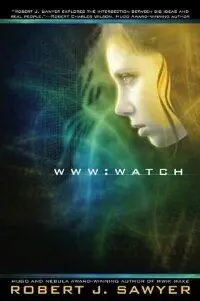
- Название:Watch
- Автор:
- Издательство:Ace Books
- Жанр:
- Год:2010
- ISBN:978-0-441-01818-5
- Рейтинг книги:5 / 5. Голосов: 1
-
Избранное:Добавить в избранное
- Отзывы:
-
Ваша оценка:
Watch: краткое содержание, описание и аннотация
Предлагаем к чтению аннотацию, описание, краткое содержание или предисловие (зависит от того, что написал сам автор книги «Watch»). Если вы не нашли необходимую информацию о книге — напишите в комментариях, мы постараемся отыскать её.
WATCH is convinced that Webmind represents a risk to national security and wants it purged from cyberspace. But Caitlin believes in Webmind’s capacity for compassion—and she will do anything and everything necessary to protect her friend.
Watch — читать онлайн бесплатно полную книгу (весь текст) целиком
Ниже представлен текст книги, разбитый по страницам. Система сохранения места последней прочитанной страницы, позволяет с удобством читать онлайн бесплатно книгу «Watch», без необходимости каждый раз заново искать на чём Вы остановились. Поставьте закладку, и сможете в любой момент перейти на страницу, на которой закончили чтение.
Интервал:
Закладка:
She was pleased to note that after a night of doubtless continued growth in intelligence and complexity, it looked the same as before.
She yawned, pulled back her sheet, and swung her bare feet to the dark blue carpeted floor. As she moved, webspace wheeled about her. She scooped up the eyePod, disconnected the charging cable, and carried it to her desk. Not until she was seated did she push the eyePod’s button and hear the low-pitched beep that signified a switch to simplex mode. Webspace disappeared, replaced by the reality of her bedroom.
She picked her glasses up from the desktop; her left eye had turned out to be quite myopic. Then she reached for the power switch on her old monitor, finding it with ease, and felt about for the switch on her new one. They both came to life.
She had closed the IM window when she’d gone to bed, and, although the mouse was sitting right there, its glowing red underbelly partially visible through the translucent sides of its case, she instead used a series of keyboard commands to open the window and start a new session with Webmind. She wasn’t awake enough yet to try to read text on screen, so she activated her refreshable Braille display. Instantly, the pins formed text: Otanjoubi omedetou.
Caitlin felt it several times. It seemed to be gibberish, as if Webmind were getting even for her father’s games from yesterday, but—but, no, no, there was something familiar about it.
And then she got it, or thought she did. Grinning, she typed, Konnichi wa! But—fair warning!—I only know a few words of Japanese.
The reply was instantaneous. That’s “ happy birthday.”
Caitlin smiled. Thank you!
I had some spare time after figuring out how to interpret graphics, so I learned Japanese; it seemed inappropriate to make Dr. Kuroda converse with me in something other than his native language.
Just like that, she thought. Overnight, on top of, doubtless, a million other things, it had learned Japanese.
So you can see images now?
Still images, yes. Dr. Kuroda continues to work on giving me access to moving images. Or, at least, he was doing that; he is sleeping now, I believe.
Hey, typed Caitlin, you’re no longer all “ hitherto” and “perchance.”
I have read much more widely now than just Project Gutenberg. I understand the distinctions between colloquial and archaic English—and colloquial and archaic Japanese, too, for that matter.
Caitlin frowned. She actually considered its old way of speaking rather charming.
Webmind went on: I know it’s traditional to give a gift to one celebrating a birthday. I can’t buy you anything, but I do have something for you.
Caitlin was startled. OMG! What?
A link, underlined and colored blue, popped up in the IM window on her screen. You’re supposed to click on it, Webmind added, helpfully.
Caitlin smiled, found her mouse, fumbled to get the pointer over the link, and—
And text started to appear on her larger monitor, but, paradoxically, her Braille display didn’t change, and—
And the text was… was painting in slowly on the monitor, top to bottom, and—
And it wasn’t even straight; the lines of text were angling up to the right for some reason. And the letters were tiny, and blotchy; it was unlike any Web page she’d yet seen, and she couldn’t understand why her computer wasn’t rendering the fonts properly.
And then it hit her. She’d heard of such things, but hadn’t ever thought about what they must look like. This was a scan of printed text: a graphic file, a picture that happened to be of a document. From descriptions she’d read, she guessed it was a clipping from a newspaper: narrow, parallel columns of text. But the spacing between words was odd, and—
Oh! That must be what’s meant by “right justification.” The text was so small, she could barely make it out. She had enough trouble reading crisp, clean text—but this!
There must be some way to make it bigger, at least. Back at the Texas School for the Blind and Visually Impaired, people were always doing things on their computers to make text larger. She hadn’t been able to see those monitors at all and so had tuned out the discussions, but there had to be a way, although, she supposed, it might require special software she didn’t have.
She used the mouse, for a change, to access the menus. There was no choice on the View menu for increasing the graphic size, just one for making text bigger. She tried that anyway; it didn’t do anything.
She was moving her mouse pointer back down to the bottom of the screen when she accidentally pressed the left button and— boom! —suddenly the graphic zoomed in. Ever the empiricist, she clicked the button again, and the text became small again, and—
Ah, got it! The graphic was being reduced by default to fit in her browser window; clicking toggled between that mode and its being seen at its natural size, even if that meant only a portion appeared on screen. She clicked once more, getting the large version, and struggled to read the text.
Her heart began to pound. It was an article about her father. She looked around the page, trying to find a date, and—ah. It was from five years ago, an article from The Daily Texan, the University of Texas at Austin campus newspaper.
She could have sworn she’d read everything about her father that was on the Web, but she’d never seen this, and—
Of course she hadn’t; it was a graphic, and no one had bothered to OCR the text, so it wasn’t in Google’s index.
The article was about her father winning an award, something from the American Physical Society; she had a vague recollection of that happening. She read on.
Prof. Decter’s breakthrough was in the nascent area of quantum gravity…
She struggled with the text. One of the letters—she surmised by context that it must have been a lowercase g —looked nothing like any example of that character she’d yet seen.
…graduate colloquium Thursday in the John A. Wheeler Lecture Hall…
She wished she could skim text, but, as her father had said yesterday, she was still reading visually letter by letter. It was a longish article, and some parts—ah, they were underlined, by a pen, or something; someone had been interested in what her dad had said about “six-dimensional Calabi-Yau shapes.”
She continued reading, but was torn—she was afraid her delay before going back to the instant-messenger program would be boring Webmind, which was hardly the right way to say thank you for a gift, even if it didn’t seem to be a particularly special one, and—
And she felt her eyes going wide. Funny: they’d never done that when she’d been blind. She read the text again, slowly, carefully, just to be sure she hadn’t gotten the words wrong, hadn’t just seen what she’d wanted to see.
But it really did say that.
…asked if winning the award was the greatest moment of his life, Prof. Decter replied, “Of course not. That was when my daughter was born. I like physics, but I love her.”
Caitlin’s vision blurred in the most wonderful way. She leaned back in her chair for a moment and read the text two more times. And then she reached for the keyboard and typed, Thank you, Webmind!
Instantly: You’re welcome. Happy birthday.
It is, she typed back, smiling. It totally is.
eight
I had read that some humans believe machines cannot have emotions or feelings because such things are supposedly mediated by hormones or are dependent on certain very specific structures in human brains.
Читать дальшеИнтервал:
Закладка:
Похожие книги на «Watch»
Представляем Вашему вниманию похожие книги на «Watch» списком для выбора. Мы отобрали схожую по названию и смыслу литературу в надежде предоставить читателям больше вариантов отыскать новые, интересные, ещё непрочитанные произведения.




Обсуждение, отзывы о книге «Watch» и просто собственные мнения читателей. Оставьте ваши комментарии, напишите, что Вы думаете о произведении, его смысле или главных героях. Укажите что конкретно понравилось, а что нет, и почему Вы так считаете.