Robert Sawyer - Watch
Здесь есть возможность читать онлайн «Robert Sawyer - Watch» весь текст электронной книги совершенно бесплатно (целиком полную версию без сокращений). В некоторых случаях можно слушать аудио, скачать через торрент в формате fb2 и присутствует краткое содержание. Год выпуска: 2010, ISBN: 2010, Издательство: Ace Books, Жанр: Фантастика и фэнтези, на английском языке. Описание произведения, (предисловие) а так же отзывы посетителей доступны на портале библиотеки ЛибКат.
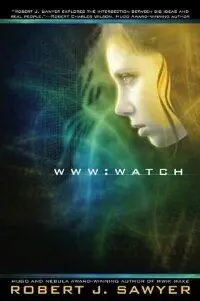
- Название:Watch
- Автор:
- Издательство:Ace Books
- Жанр:
- Год:2010
- ISBN:978-0-441-01818-5
- Рейтинг книги:5 / 5. Голосов: 1
-
Избранное:Добавить в избранное
- Отзывы:
-
Ваша оценка:
Watch: краткое содержание, описание и аннотация
Предлагаем к чтению аннотацию, описание, краткое содержание или предисловие (зависит от того, что написал сам автор книги «Watch»). Если вы не нашли необходимую информацию о книге — напишите в комментариях, мы постараемся отыскать её.
WATCH is convinced that Webmind represents a risk to national security and wants it purged from cyberspace. But Caitlin believes in Webmind’s capacity for compassion—and she will do anything and everything necessary to protect her friend.
Watch — читать онлайн бесплатно полную книгу (весь текст) целиком
Ниже представлен текст книги, разбитый по страницам. Система сохранения места последней прочитанной страницы, позволяет с удобством читать онлайн бесплатно книгу «Watch», без необходимости каждый раз заново искать на чём Вы остановились. Поставьте закладку, и сможете в любой момент перейти на страницу, на которой закончили чтение.
Интервал:
Закладка:
“Awesome?” suggested Caitlin.
“Exactly!”
“So you’re in contact?” Caitlin asked.
“Yes, I—oh! It has a funny way of talking, doesn’t it? Anyway, yes, we’re in contact. Incredible!”
“Okay, good,” she said. She took off her glasses and used the heels of her hands to rub her eyes—the one that could see and the one that couldn’t. “Look, we’re dying here,” she said. “It’s way after midnight. Can we leave this in your hands? We’ve got to get some shut-eye.”
six
There were interstices in my work with Dr. Kuroda—protracted lacunae while I waited for his text replies or for him to direct me to link to another bit of code he had written.
In those gaps I sought to learn more about Caitlin, about this human who had reached down and helped draw me up out of the darkness.
There was no Wikipedia entry on her, meaning, I supposed, that she was not—yet!—noteworthy. And—
Ah, wait—wait! Yes, there was no entry on her, but there was one on her father, Malcolm Decter… and Wikipedia saved not just the current version of its entries, but all previous versions, as well. Although there was no mention of Caitlin in the current draft, a previous iteration had contained this: “Has one daughter, Caitlin Doreen, blind since birth, who lives with him; it’s been speculated that Decter’s decline in peer-reviewed publications in recent years has been because of the excessive demands on his time required to care for a disabled child.”
That had been removed thirteen days ago. The change log gave only an IP address, not a user name. The IP address was the one for the Decter household; the change could have been made (among other possibilities) by Caitlin, her parents, or that other man—Dr. Kuroda, I now knew—that I had often seen there.
The deletion might have been made because Caitlin had ceased to be blind.
But…
But it seemed more likely that this text was cut because someone—presumably Caitlin herself—didn’t like what it said.
But I was merely inferring that. It was possible to more directly study Caitlin—and so I did.
In short order, I read everything she’d ever put publicly online: every blog post, every comment to someone else’s blog, every Amazon.com review she’d written. But—
Hmm.
There was much she had written that I could not access. Her Yahoo mail account contained all the messages she had received, and all the messages she had sent, but access was secured by a password.
A nettlesome situation; I’d have to do something about it.
LiveJournal:The Calculass Zone
Title:Changing of the Guard
Date:Saturday 6 October, 00:55 EST
Mood:Astonished
Location:Waterloo
Music:Lee Amodeo, “Nightfall”
I got a feeling I’m going to be pretty scarce for the next little while, folks. Things they be a-happenin’. It’s all good—miraculous, even—but gotta keep it on the DL. Suffice it to say that I told my parents something el mucho grande tonight, and they didn’t freak. Hope other people take it as well as they did…
Even though she was exhausted, Caitlin updated her LiveJournal, skimmed her friends’ LJs, updated her Facebook page (where she changed her status to “Caitlin thinks it’s better to give than to receive”), and then checked her email. There was a message from Bashira with the subject, “One for the math genius.”
When she’d been younger, Caitlin had liked the sort of mathematical puzzles that sometimes circulated through email: they’d made her feel smart. These days, though, they mostly bored her. It was rare for one to present much of a challenge to her, but the one in Bashira’s message did. It was related to an old game show, apparently, something called Let’s Make a Deal that had starred a guy named Monty Hall. In it, contestants are asked to pick one of three doors. Behind one of them is a new car, and behind each of the others is a goat—meaning the odds are one in three that the contestant is going to win the car.
The host knows which door has the car behind it and, after the contestant picks a door, Monty opens one of the unchosen ones and reveals that it was hiding a goat. He then asks the player, “Do you want to switch to the other unopened door?”
Bashira asked: Is it to the contestant’s advantage to switch?
Of course not, thought Caitlin. It didn’t make any difference if you switched or not; one remaining door had a car behind it and the other had a goat, and the odds were now fifty-fifty that you’d picked the right door.
Except that that’s not what the article Bashira had forwarded said. It contended that your chances of winning the car are much better if you switch.
And that, Caitlin was sure, was just plain wrong. She figured someone else must have written up a refutation to this puzzle before, so she googled. It took her a few minutes to find what she was looking for; the appropriate search terms turned out to be “Monty Hall problem,” and—
What the hell?
“…When the problem and the solution appeared in Parade, ten thousand readers, including nearly a thousand Ph.D.s, wrote to the magazine claiming the published solution was wrong. Said one professor, ‘You blew it! Let me explain: If one door is shown to be a loser, that information changes the probability of either remaining choice—neither of which has any reason to be more likely—to 1/2. As a professional mathematician, I’m very concerned with the general public’s lack of mathematical skills. Please help by confessing your error and, in the future, being more careful.’ ”
The person who had written the disputed answer was somebody called Marilyn vos Savant, who apparently had the highest IQ on record. But Caitlin didn’t care how high the lady’s IQ was. She agreed with the people who said she’d blown it; she had to be wrong.
And, as Caitlin liked to say, she was an empiricist at heart. The easiest way to prove to Bashira that vos Savant was wrong, it seemed to her, would be by writing a little computer program that would simulate a lot of runs of the game. And, even though she was exhausted, she was also pumped from her conversations with Webmind; a little programming would be just the thing to let her relax. She only needed fifteen minutes to whip up something to do the trick, and—
Holy crap.
It took just seconds to run a thousand trials, and the results were clear. If you switched doors when offered the opportunity to do so, your chance of winning the car was about twice as good as it was when you kept the door you’d originally chosen.
But that just didn’t make sense. Nothing had changed! The host was always going to reveal a door that had a goat behind it, and there was always going to be another door that hid a goat, too.
She decided to do some more googling—and was pleased to find that Paul Erdös hadn’t believed the published solution until he’d watched hundreds of computer-simulated runs, too.
Erdös had been one of the twentieth century’s leading mathematicians, and he’d co-authored a great many papers. The “Erdös number” was named after him: if you had collaborated with Erdös yourself, your Erdös number was 1; if you had collaborated with someone who had directly collaborated with Erdös, your number was 2, and so on. Caitlin’s father had an Erdös number of 4, she knew—which was quite impressive, given that her dad was a physicist and not a mathematician.
How could she—let alone someone like Erdös?—have been wrong? It was obvious that switching doors should make no difference!
Читать дальшеИнтервал:
Закладка:
Похожие книги на «Watch»
Представляем Вашему вниманию похожие книги на «Watch» списком для выбора. Мы отобрали схожую по названию и смыслу литературу в надежде предоставить читателям больше вариантов отыскать новые, интересные, ещё непрочитанные произведения.




Обсуждение, отзывы о книге «Watch» и просто собственные мнения читателей. Оставьте ваши комментарии, напишите, что Вы думаете о произведении, его смысле или главных героях. Укажите что конкретно понравилось, а что нет, и почему Вы так считаете.