Robert Sawyer - Watch
Здесь есть возможность читать онлайн «Robert Sawyer - Watch» весь текст электронной книги совершенно бесплатно (целиком полную версию без сокращений). В некоторых случаях можно слушать аудио, скачать через торрент в формате fb2 и присутствует краткое содержание. Год выпуска: 2010, ISBN: 2010, Издательство: Ace Books, Жанр: Фантастика и фэнтези, на английском языке. Описание произведения, (предисловие) а так же отзывы посетителей доступны на портале библиотеки ЛибКат.
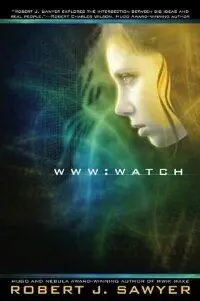
- Название:Watch
- Автор:
- Издательство:Ace Books
- Жанр:
- Год:2010
- ISBN:978-0-441-01818-5
- Рейтинг книги:5 / 5. Голосов: 1
-
Избранное:Добавить в избранное
- Отзывы:
-
Ваша оценка:
Watch: краткое содержание, описание и аннотация
Предлагаем к чтению аннотацию, описание, краткое содержание или предисловие (зависит от того, что написал сам автор книги «Watch»). Если вы не нашли необходимую информацию о книге — напишите в комментариях, мы постараемся отыскать её.
WATCH is convinced that Webmind represents a risk to national security and wants it purged from cyberspace. But Caitlin believes in Webmind’s capacity for compassion—and she will do anything and everything necessary to protect her friend.
Watch — читать онлайн бесплатно полную книгу (весь текст) целиком
Ниже представлен текст книги, разбитый по страницам. Система сохранения места последней прочитанной страницы, позволяет с удобством читать онлайн бесплатно книгу «Watch», без необходимости каждый раз заново искать на чём Вы остановились. Поставьте закладку, и сможете в любой момент перейти на страницу, на которой закончили чтение.
Интервал:
Закладка:
He nodded curtly. “That’s the protocol.”
“Whose protocol?” demanded Tony.
“Ours,” said Hume. “DARPA did the study back in 2001. And the Joint Chiefs adopted it as a working policy in 2003.”
“Aiesha, tie into the DARPA secure-document archive,” said Tony.
“Done,” she said.
“What’s the protocol called?” asked Tony.
“Pandora,” said Hume.
Aiesha typed something. “I’ve found it,” she said, “but it’s locked, and it’s rejecting my password.”
Tony sidled over to her station, leaned over, and typed in his password. The document came up on Aiesha’s monitor, and Tony threw it onto the middle big screen.
“Go to the last page before the index,” Colonel Hume said.
Aiesha did so.
“There,” said Hume. “ ‘Given that an emergent artificial intelligence will likely increase its sophistication moment by moment, it may rapidly exceed our abilities to contain or constrain its actions. If absolute isolation is not immediately possible, terminating the intelligence is the only safe option.’ ”
“We don’t know where it’s located,” Shelton said.
“You better find out,” said Colonel Hume. “And you better get the Pentagon on the line, but I’m sure they’ll concur. We’ve got to kill the damn thing right now—before it’s too late.”
seven
I could see!
And not just what Caitlin was seeing. I could now follow links to any still image on the Web, and by processing those images through the converters Dr. Kuroda had now set up for me on his servers, I could see images. These images turned out to be much easier for me to study than the feed from Caitlin’s eyePod because they didn’t change, and they didn’t jump around.
Caitlin, I surmised, had been going through much the same process I now was as her brain learned to interpret the corrected visual signals it was receiving. She had the advantage of a mind that evolution had already wired for that process; I had the advantage of having read thousands of documents about how vision worked, including technical papers and patent applications related to computerized image processing and face recognition.
I learned to detect edges, to discern foreground from background. I learned to be able to tell a photograph of something from a diagram of it, a painting from a cartoon, a sketch from a caricature. I learned not just to see but to comprehend what I was seeing.
By looking at it on a monitor, Caitlin had shown me a picture of Earth from space, taken by a modern geostationary satellite. But I’ve now seen thousands more such pictures online, including, at last, the earliest ones taken by Apollo 8. And, while Caitlin slept, I looked at pictures of hundreds of thousands of human beings, of myriad animals, of countless plants. I learned fine distinctions: different species of trees, different breeds of dogs, different kinds of minerals.
Dr. Kuroda had sent me occasional IMs as he wrote code. Half the work had already been done, he said, back when he’d worked out a way to make still images of Caitlin’s views of webspace, rendering what she saw in a standard computer-graphic format; what he was doing now for me was more or less just reversing the process.
The results were overwhelming. And enlightening. And amazing.
Granted, Caitlin’s universe contained three dimensions, and what I was now seeing were only two-dimensional representations. But Dr. Kuroda helped me there, too, directing me to sites with CT scans. Such scans, Wikipedia said, generated a three-dimensional image of an object from a large series of two-dimensional X-rays; seeing how those slices were combined to make 3-D renderings was useful.
After that, Kuroda showed me multiple images of the same thing from different perspectives, starting with a series of photos of the current American president, all of which were taken at the same time but from slightly different angles. I saw how three-dimensional reality was constructed. And then—
I’d seen her in a mirror; I’d seen her recently reflected—and distorted—in pieces of silverware. But those images were jittery and always from the point of view of her own left eye, and—yes, I was developing a sense of such things—had not been flattering. But Dr. Kuroda was now showing me pictures from the press conference at the Perimeter Institute announcing his success, well-lit pictures taken by professional photographers, pictures of Caitlin smiling and laughing, of her beaming.
I’d originally dubbed her Prime. Online, she sometimes adopted the handle Calculass. But now I was finally, really seeing her, rather than just seeing through her—seeing what she actually looked like.
Project Gutenberg had wisdom on all topics. Beauty, Margaret Wolfe Hungerford had said, is in the eye of the beholder.
And to this beholder, at least, my Caitlin was beautiful.
Caitlin woke slowly. She knew, in a hazy way, that she should get out of bed, go to her computer, and make sure that Webmind had survived the night. But she was still exhausted—she’d been up way too late. Her mind wasn’t yet focusing, although as she drifted in and out of consciousness, she realized that it was her birthday. Her parents had decided to give her the new widescreen monitor yesterday, so she didn’t expect any more gifts.
Nor was there a party planned. She’d managed to make only one friend—Bashira—over the short summer that they’d been in Waterloo, and she’d missed so much of the first month of classes that she didn’t really have any friends at school. Certainly not Trevor, and, well, somehow she suspected party-girl Sunshine (what had her parents been thinking?) wouldn’t have wanted to spend her Saturday night at a lame, alcohol-free Sweet Sixteen.
Sixteen was a magical year (and not just, Caitlin thought, because it was a square age, like nine, twenty-five, and thirty-six). But it didn’t make her an adult (the age for that was eighteen here in Ontario) or let her legally drink (she’d have to make it to nineteen for that). Still, one couldn’t be as obsessed with math as she was without knowing that the average age for American girls—presumably even those living in Canada!—to lose their virginity was 16.4 years. And here she was without a boyfriend, or even the prospect of one.
She was comfortably snug in her bed, and Schrödinger was sleeping next to her, his breathing a soft purr. She really should get up and check on Webmind, but she was having trouble convincing her body of that.
But maybe there was a way to check on Webmind without actually getting up. She felt on her night table for the eyePod. It was a little wider and thicker than an iPhone, and it was a couple of inches longer because of the Wi-Fi module Kuroda had attached to it with duct tape. She found the device’s single switch and held it down until it came on, and then—
And then webspace blossomed around her: crisscrossing glowing lines in assorted colors, radiant circles of various sizes.
She was pleased that she could still visualize the Web this way; she’d thought perhaps that the ability would fade as her brain rewired itself to deal with actual vision, but so far it hadn’t. In fact—
In fact, if anything, her websight seemed clearer now, sharper, more focused. The real-world skills were spilling over into this realm.
She concentrated on what was behind what she was seeing, the backdrop to it all, at the very limit of her ability to perceive, a shimmering—yes, yes, it was a checkerboard; there was no doubt now! She could see the tiny pixels of the cellular automata flipping on and off rapidly, and giving rise to—
Consciousness.
There, for her, and her alone, to see: the actual workings of Webmind.
Читать дальшеИнтервал:
Закладка:
Похожие книги на «Watch»
Представляем Вашему вниманию похожие книги на «Watch» списком для выбора. Мы отобрали схожую по названию и смыслу литературу в надежде предоставить читателям больше вариантов отыскать новые, интересные, ещё непрочитанные произведения.







Обсуждение, отзывы о книге «Watch» и просто собственные мнения читателей. Оставьте ваши комментарии, напишите, что Вы думаете о произведении, его смысле или главных героях. Укажите что конкретно понравилось, а что нет, и почему Вы так считаете.