Robert Sawyer - Watch
Здесь есть возможность читать онлайн «Robert Sawyer - Watch» весь текст электронной книги совершенно бесплатно (целиком полную версию без сокращений). В некоторых случаях можно слушать аудио, скачать через торрент в формате fb2 и присутствует краткое содержание. Год выпуска: 2010, ISBN: 2010, Издательство: Ace Books, Жанр: Фантастика и фэнтези, на английском языке. Описание произведения, (предисловие) а так же отзывы посетителей доступны на портале библиотеки ЛибКат.
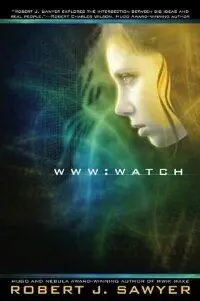
- Название:Watch
- Автор:
- Издательство:Ace Books
- Жанр:
- Год:2010
- ISBN:978-0-441-01818-5
- Рейтинг книги:5 / 5. Голосов: 1
-
Избранное:Добавить в избранное
- Отзывы:
-
Ваша оценка:
Watch: краткое содержание, описание и аннотация
Предлагаем к чтению аннотацию, описание, краткое содержание или предисловие (зависит от того, что написал сам автор книги «Watch»). Если вы не нашли необходимую информацию о книге — напишите в комментариях, мы постараемся отыскать её.
WATCH is convinced that Webmind represents a risk to national security and wants it purged from cyberspace. But Caitlin believes in Webmind’s capacity for compassion—and she will do anything and everything necessary to protect her friend.
Watch — читать онлайн бесплатно полную книгу (весь текст) целиком
Ниже представлен текст книги, разбитый по страницам. Система сохранения места последней прочитанной страницы, позволяет с удобством читать онлайн бесплатно книгу «Watch», без необходимости каждый раз заново искать на чём Вы остановились. Поставьте закладку, и сможете в любой момент перейти на страницу, на которой закончили чтение.
Интервал:
Закладка:
Caitlin read on and found a quote from a Harvard professor, who, in conceding at last that vos Savant had been right all along, said, “Our brains are just not wired to do probability problems very well.”
She supposed that was true. Back on the African savanna, those who mistook every bit of movement in the grass for a hungry lion were more likely to survive than those who dismissed each movement as nothing to worry about. If you always assume that it’s a lion, and nine times out of ten you’re wrong, at least you’re still alive. If you always assume that it’s not a lion, and nine times out of ten you’re right—you end up dead. It was a fascinating and somewhat disturbing notion: that humans had been hardwired through genetics to get certain kinds of mathematical problems wrong—that evolution could actually program people to be incorrect about things.
Caitlin felt her watch, and, astonished at how late it had become, quickly got ready for bed. She plugged her eyePod into the charging cable and deactivated the device, shutting off her vision; she had trouble sleeping if there was any visual stimulation.
But although she was suddenly blind again, she could still hear perfectly well—in fact, she heard better than most people did. And, in this new house, she had little trouble making out what her parents were saying when they were talking in their bedroom.
Her mother’s voice: “Malcolm?”
No audible reply from her father, but he must have somehow indicated that he was listening, because her mother went on: “Are we doing the right thing—about Webmind, I mean?”
Again, no audible reply, but after a moment, her mother spoke: “It’s like—I don’t know—it’s like we’ve made first contact with an alien lifeform.”
“We have, in a way,” her father said.
“I just don’t feel competent to decide what we should do,” her mom said. “And—and we should be studying this, and getting others to study it, too.”
Caitlin shifted in her bed.
“There’s no shortage of computing experts in this town,” her father replied.
“I’m not even sure that it’s a computing issue,” her mom said. “Maybe bring some of the people at the Balsillie on board? I mean, the implications of this are gigantic.”
Research in Motion—the company that made BlackBerrys—had two founders: Mike Lazaridis and Jim Balsillie. The former had endowed the Perimeter Institute, and the latter, looking for a different way to make his mark, had endowed an international-affairs think tank here in Waterloo.
“I don’t disagree,” said Malcolm. “But the problem may take care of itself.”
“How do you mean?”
“Even with teams of programmers working on it, most early versions of software crash. How stable can an AI be that emerged accidentally? It might well be gone by morning…”
That was the last she heard from her parents that night. Caitlin finally drifted off to a fitful sleep. Her dreams were still entirely auditory; she woke with a start in the middle of one in which a baby’s cry had suddenly been silenced.
“Where’s that bloody AI expert?” demanded Tony Moretti.
“I’m told he’s in the building now,” Shelton Halleck said, putting a hand over his phone’s mouthpiece. “He should be—”
The door opened at the back of the WATCH mission-control room, and a broad-shouldered, redheaded man entered, wearing a full-bird Air Force colonel’s service-dress uniform; he was accompanied by a security guard. A WATCH visitor’s badge was clipped to his chest beneath an impressive row of decorations.
Tony had skimmed the man’s dossier: Peyton Hume, forty-nine years old; born in St. Paul, Minnesota; Ph.D. from MIT, where he’d studied under Marvin Minsky; twenty years in the Air Force; specialist in military expert systems.
“Thank you for coming in, Colonel Hume,” Tony said. He nodded at the security guard and waited for the man to leave, then: “We’ve got something interesting here. We think we’ve uncovered an AI.”
Hume’s blue eyes narrowed. “The term ‘artificial intelligence’ is bandied about a lot. What precisely do you mean?”
“I mean,” said Tony, “a computer that thinks.”
“Here in the States?”
“We’re not sure where it is,” said Shel from his workstation. “But it’s talking to someone in Waterloo, Canada.”
“Well,” said Hume, “they do a lot of good computing work up there, but not much of it is AI.”
“Show him the transcripts,” Tony said to Aiesha. And then, to Hume: “ ‘Calculass’ is a teenage girl.”
Aiesha pressed some keys, and the transcript came up on the right-hand big screen.
“Jesus,” said Hume. “That’s a teenage girl administering the Turing tests?”
“We think it’s her father, Malcolm Decter,” said Shel.
“The physicist?” replied Hume, orange eyebrows climbing his high, freckled forehead. He made an impressed frown.
The closest analysts were watching them intently; the others had their heads bent down, busily monitoring possible threats.
“So, have we got a problem here?” asked Tony.
“Well, it’s not an AI,” said Hume. “Not in the sense Turing meant.”
“But the tests…” said Tony.
“Exactly,” said the colonel. “It failed the tests.” He looked at Shel, then back at Tony. “When Alan Turing proposed this sort of test in 1950, the idea was that you asked something a series of natural-language questions, and if you couldn’t tell by the responses that the thing you were conversing with was a computer, then it was, by definition, an artificial intelligence—it was a machine that responded the way a human does. But Professor Decter here has very neatly proven the opposite: that whatever they’re talking to is just a computer.”
“But it’s behaving as though it’s conscious,” said Tony.
“Because it can carry on a conversation? It’s an intriguing chatbot, I’ll give you that, but…”
“Forgive me, sir, but are you sure?” Tony said. “You’re sure there’s no threat here?”
“A machine can’t be conscious, Mr. Moretti. It has no internal life at all. Whether it’s a cash register figuring out how much tax to add to a bill, or”—he gestured at a screen—“ that, a simulation of natural-language conversation, all any computer does is addition and subtraction.”
“What if it’s not a simulation,” said Shel, getting up from his chair and walking over to join them.
“Pardon?” said Hume.
“What if it’s not a simulation—not a program?”
“How do you mean?” asked Hume.
“I mean we can’t trace it. It’s not that it’s anonymized—rather, it simply doesn’t source from any specific computer.”
“So you think it’s—what? Emergent?”
Shel crossed his arms in front of his chest, the snake tattoo facing out. “That’s exactly what I think, sir. I think it’s an emergent consciousness that’s arisen out of the infrastructure of the World Wide Web.”
Hume looked back at the screen, his blue eyes tracking left and right as he reread the transcripts.
“Well?” said Tony. “Is that possible?”
The colonel frowned. “Maybe. That’s a different kettle of fish. If it’s emergent, then— hmmm.”
“What?” said Tony.
“Well, if it spontaneously emerged, if it’s not programmed, then who the hell knows how it works. Computers do math, and that’s all, but if it’s something other than a computer—if it’s, Christ, if it’s a mind, then…”
“Then what?”
“You’ve got to shut it down,” Hume said.
“Are you sure?”
Читать дальшеИнтервал:
Закладка:
Похожие книги на «Watch»
Представляем Вашему вниманию похожие книги на «Watch» списком для выбора. Мы отобрали схожую по названию и смыслу литературу в надежде предоставить читателям больше вариантов отыскать новые, интересные, ещё непрочитанные произведения.


Обсуждение, отзывы о книге «Watch» и просто собственные мнения читателей. Оставьте ваши комментарии, напишите, что Вы думаете о произведении, его смысле или главных героях. Укажите что конкретно понравилось, а что нет, и почему Вы так считаете.