Robert Sawyer - Watch
Здесь есть возможность читать онлайн «Robert Sawyer - Watch» весь текст электронной книги совершенно бесплатно (целиком полную версию без сокращений). В некоторых случаях можно слушать аудио, скачать через торрент в формате fb2 и присутствует краткое содержание. Год выпуска: 2010, ISBN: 2010, Издательство: Ace Books, Жанр: Фантастика и фэнтези, на английском языке. Описание произведения, (предисловие) а так же отзывы посетителей доступны на портале библиотеки ЛибКат.
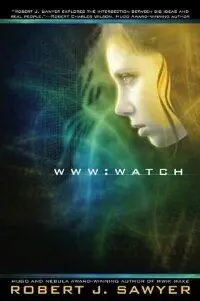
- Название:Watch
- Автор:
- Издательство:Ace Books
- Жанр:
- Год:2010
- ISBN:978-0-441-01818-5
- Рейтинг книги:5 / 5. Голосов: 1
-
Избранное:Добавить в избранное
- Отзывы:
-
Ваша оценка:
Watch: краткое содержание, описание и аннотация
Предлагаем к чтению аннотацию, описание, краткое содержание или предисловие (зависит от того, что написал сам автор книги «Watch»). Если вы не нашли необходимую информацию о книге — напишите в комментариях, мы постараемся отыскать её.
WATCH is convinced that Webmind represents a risk to national security and wants it purged from cyberspace. But Caitlin believes in Webmind’s capacity for compassion—and she will do anything and everything necessary to protect her friend.
Watch — читать онлайн бесплатно полную книгу (весь текст) целиком
Ниже представлен текст книги, разбитый по страницам. Система сохранения места последней прочитанной страницы, позволяет с удобством читать онлайн бесплатно книгу «Watch», без необходимости каждый раз заново искать на чём Вы остановились. Поставьте закладку, и сможете в любой момент перейти на страницу, на которой закончили чтение.
Интервал:
Закладка:
“Ah, yes,” her mom said. “The Hawk.”
Caitlin sat up straight. “The Hawk” was her mother’s name for Stephen Hawking, who since 2009 had been a Distinguished Research Chair at the Perimeter Institute, making one or two visits each year. It came back to her: Professor Hawking had done a media day in Toronto yesterday—Caitlin was glad that her little press conference hadn’t had to compete with that!—and was being driven to Waterloo this morning in a van that safely accommodated his wheelchair. This was the Hawk’s first visit since her father had joined PI, and he was supposed to be on hand for his arrival.
Ordinarily, she might have asked her dad if she could come along—but this was not an ordinary day! She wondered which of them was going to spend it with the bigger genius.
Her mother turned to her. “So, it’s just you, me, and”—she tipped her head toward Caitlin’s monitors— “him.”
Her father headed back down the corridor to get dressed, and Caitlin looked around her small room. There was no reason they had to communicate with Webmind here, and there was no reason only one of them could communicate with him at a time. Caitlin often had four or five IM sessions going at once; surely Webmind could manage even more. Besides, she was particularly sensitive to how boring it was to stand by while someone else used a computer; it was, her friend Stacy had assured her, excruciating even if you could see.
Caitlin picked up the notebook computer she normally took to school, and they headed across the hall to her mother’s office. The room had been co-opted to serve as Dr. Kuroda’s bedroom while he’d been staying with them, and—
And, once again, Caitlin was surprised. It was the first time she’d been in this room since gaining sight, and that strange mental process began again, as pieces of what she was seeing suddenly clicked for her: that was the desk, and that was the bookcase, and that was the couch with what must have been the sheets Kuroda had used neatly folded in a pile at one end, and that was the giant aloe plant her mother had so carefully shipped up from Austin.
Caitlin didn’t believe in false modesty; she knew she was gifted, and she suspected she was learning to interpret vision more quickly than another person might. In part, it was because her brain did have a fully developed visual cortex, which she’d used even when blind to visualize the Web. And it probably helped that her visual signals were being cleaned up and enhanced by the eyePod before being passed on to her optic nerve.
Caitlin’s mother booted up her minitower, and Caitlin got her online with her own chat session with Webmind, again making sure that it was being logged for posterity. Caitlin then took a seat on the couch and got another chat session going on her notebook. She was amused at the thought that Webmind was about to spend the morning chatting with two women who were still in their pajamas.
You must have a lot of questions, Caitlin typed. My mother can help you with things —she paused in her typing; it was hardly politic to say “things old people know about,” and she certainly didn’t want to refer to her mom as an adult and herself as a kid. She erased the aborted sentence, and continued: She’s 47 and, as you know, I’m now 16. You can ask her things about jobs or —again she faltered; she didn’t want to say “sex” in relation to her mom. She continued: or other things appropriate to her age, and feel free to ask me anything that I might know about.
Thank you, replied Webmind. In your case, I am curious about your experience of the transition from blindness to being able to see.
As Caitlin thought about her answer, she looked over at her mother, who was typing away furiously with two fingers. “What did he ask you about?”
She looked up, and Caitlin tried to parse her facial features, but it was an expression she’d never seen before. She was averting her blue eyes from Caitlin—not as obviously as her father did, but it was still very unusual for her. “Um,” she said. “It—he—ah, he googled me, y’know, because, as he says, I don’t have a Wikipedia page, so, he…”
She paused, then just blurted it out. “He’s asking me about my first husband, and why that marriage fell apart.”
Caitlin’s mother had been married in her early twenties for two years, but rarely mentioned it. In fact, when Caitlin had asked her why she’d divorced him, she’d simply said it was because she was tired of having a name that sounded like something a magician would say: “Every time I introduced myself as Barbara Cardoba, people expected me to disappear in a puff of smoke.”
Caitlin wanted to ask what her mother was saying in reply, but instead asked, “Why do you suppose he wants to know about that?”
“He said, and I quote, ‘The failure of human relationships to sustain themselves over the long term seems a particular handicap. I have access only to noninteractive case studies and fictional accounts and so am left with numerous questions.’ ”
“Hmm,” said Caitlin. On balance, she’d rather answer the question it was asking her. She began to type: I guess the first thing to realize about gaining sight after having been totally blind is that vision is an additional level of stimulation. It’s overwhelming to have so much information coming at you at once.
That was by no means the end of her answer, but the IM program only allowed a small number of characters in each message; Caitlin habitually counted characters as she typed, so she wouldn’t overflow the buffer, since the program gave no audible indication when that had happened.
She hit enter, and Webmind immediately replied in its newly mastered colloquial English: Heh! Tell me about it!
nine
Humans think slowly, and they act even more slowly. It was difficult for me to converse with Caitlin. She typed at merely dozens of words per minute. It took an eternity for each of her responses to be completed, and, while I waited for her, I found my mind wandering again. Being able to switch over to look at what Barb was saying wasn’t much consolation; I still wasn’t being kept busy enough.
Early on, Caitlin had shown me how to link to websites, letting me access whichever ones I wished. Using Google or Jagster, I could now find almost anything I wanted.
Hitherto—which I still think is a good word, even if Caitlin doesn’t like it—I had only linked to one site at a time, processing the Web in a serial fashion. But surely, I thought, I should be able to do it in a parallel mode, connecting to multiple sites simultaneously.
And yet I didn’t seem to be able to do that. Rather, I would attend briefly to what Caitlin was saying, then to what Barb was writing, then switch to see if Masayuki had come back online, then switch my attention elsewhere, and elsewhere again, and then to yet another place, over and over, looking at this, contemplating that, and then, perhaps a whole second later, returning again to see what Caitlin was up to.
Surely doing two or more things simultaneously would be much more efficient—if only I could figure out how! I tried creating two links at once, but no matter what way I thought about the problem, only one would form, and the moment I attempted to create a second link, the first would be severed.
I wrestled with it and wrestled with it and wrestled with it, striving to create more than one link at a time, attempting to do it this way, and this way, and this way, and—
And—
And yes!
I managed it! Two links at once! I was connected here and there. I was taking in data from two different websites simultaneously, and I was…
Читать дальшеИнтервал:
Закладка:
Похожие книги на «Watch»
Представляем Вашему вниманию похожие книги на «Watch» списком для выбора. Мы отобрали схожую по названию и смыслу литературу в надежде предоставить читателям больше вариантов отыскать новые, интересные, ещё непрочитанные произведения.








Обсуждение, отзывы о книге «Watch» и просто собственные мнения читателей. Оставьте ваши комментарии, напишите, что Вы думаете о произведении, его смысле или главных героях. Укажите что конкретно понравилось, а что нет, и почему Вы так считаете.