Connie Willis - Fire Watch
Здесь есть возможность читать онлайн «Connie Willis - Fire Watch» весь текст электронной книги совершенно бесплатно (целиком полную версию без сокращений). В некоторых случаях можно слушать аудио, скачать через торрент в формате fb2 и присутствует краткое содержание. Город: New York, Год выпуска: 1998, ISBN: 1998, Издательство: Bantam Spectra, Жанр: Фантастика и фэнтези, на английском языке. Описание произведения, (предисловие) а так же отзывы посетителей доступны на портале библиотеки ЛибКат.
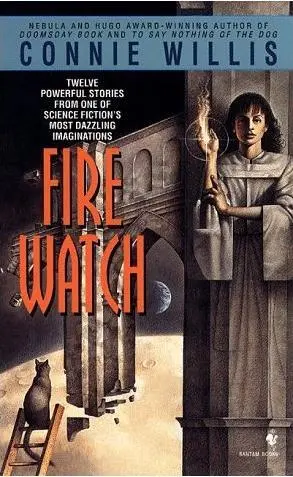
- Название:Fire Watch
- Автор:
- Издательство:Bantam Spectra
- Жанр:
- Год:1998
- Город:New York
- ISBN:978-0-307-57342-1
- Рейтинг книги:4 / 5. Голосов: 1
-
Избранное:Добавить в избранное
- Отзывы:
-
Ваша оценка:
Fire Watch: краткое содержание, описание и аннотация
Предлагаем к чтению аннотацию, описание, краткое содержание или предисловие (зависит от того, что написал сам автор книги «Fire Watch»). Если вы не нашли необходимую информацию о книге — напишите в комментариях, мы постараемся отыскать её.
In “Service for the Burial of the Dead,” a young woman mourning her lover comes upon a surprising funeral guest.
Biblical prophecies turn out to have unexpected meanings as the End Times approach in “Lost and Found.”
The dangers of ordering merchandise from the back pages of pulp magazines become apparent in “Mail-Order Clone.”
In “Blued Moon,” a young man uncovers a scientific property of coincidence—and falls in love.
As a tourist attraction, a total eclipse draws an even wider audience than (almost) anyone realizes in “And Come from Miles Around.”
In “Samaritan,” an enthusiastic young assistant pastor plunges the entire church hierarchy into a firestorm of controversy when she brings forward an orangutan to be baptized.
Parental abuse is all the rage in an institute of higher learning—for those who have no parents… and for those who have no children, in “All My Darling Daughters.”
Fire Watch — читать онлайн бесплатно полную книгу (весь текст) целиком
Ниже представлен текст книги, разбитый по страницам. Система сохранения места последней прочитанной страницы, позволяет с удобством читать онлайн бесплатно книгу «Fire Watch», без необходимости каждый раз заново искать на чём Вы остановились. Поставьте закладку, и сможете в любой момент перейти на страницу, на которой закончили чтение.
Интервал:
Закладка:
They brought him back about noon the next day. Reverend Hoyt saw the van again, and shortly afterward Natalie brought the young man to his office. She was dressed all in white, a childishly full surplice over a white robe. She looked like an angel in a Sunday school program. Pentecost must be over and Trinity begun. She was still subdued, more than the situation of having her friends argue for her would seem to merit. Reverend Hoyt wondered how often this same young man came for Esau.
“I thought you would like to know how things are going down at the Center, sir,” the young man said briskly “Esau passed his physical, though there is some question of whether he might need glasses. He has a slight case of astigmatism. Otherwise he is in excellent physical condition for a male of his age. His attitude toward the breeding program has also improved markedly in the past few months. Male orangs become rather solitary, neurotic beings as they mature, sometimes becoming very depressed. Esau was not, up until a few months ago, willing to breed at all. Now he participates regularly and has impregnated one female.
“What I came to say, sir, is that we feel Esau’s job and the friends he has made here have made him a much happier and better adjusted ape than he was before. You are to be congratulated. We would hate to see anything interfere with the emotional well-being he has achieved so far.”
This is the best argument of all, Reverend Hoyt thought. A happy ape is a breeding ape. A baptized ape is a happy ape. Therefore…
“I understand,” he said, looking at the young man. “I have been reading about orangutans, but I have questions. If you could give me some time this afternoon, I would appreciate it.”
The young man glanced at his watch. Natalie looked uncomfortable. “Perhaps after the news conference. That lasts until…” He turned to Natalie. “Is it four o'clock, Reverend Abreu?”
She tried to smile. “Yes, four. We should be going. Reverend Hoyt, if you’d like to come—”
“I believe the bishop is coming later this afternoon, thank you.” The young man took Natalie’s arm. “After the press conference,” Reverend Hoyt continued, “please have Esau put the ladder away. Tell him he does not need to use it.”
“But—”
“Thank you, Reverend Abreu.”
Natalie and her young man went to their press conference. He closed all the books he had checked out from the library and stacked them on the end of his desk. Then he put his head in his hands and tried to think.
“Where’s Esau?” the bishop said when she came in.
“In the sanctuary, I suppose. He’s supposed to be putting the webbing on the inside of the window.”
“I didn’t see him.”
“Maybe Natalie took him with her to her press conference.”
She sat down. “What have you decided?”
“I don’t know. Yesterday I managed to convince myself he was one of the lower animals. This morning at three I woke from a dream in which he was made a saint. I am no closer to knowing what to do than I have ever been.”
“Have you thought, as my archbishop would say, who cannot forget his Baptist upbringing, about what our dear Lord would do?”
“You mean, ‘Who is my neighbor? And Jesus answering said, A certain man went down from Jerusalem to Jericho and fell among thieves.’ Esau said that, you know. When I asked him if he knew that God loved him he spelled out the word Samaritan.”
“I wonder,” Moira said thoughtfully “Did he mean the good Samaritan or—”
“The odd thing about it was that Natalie’d apparently taught him some kind of shorthand sign for good Samaritan, but he wouldn’t use it. He kept spelling the word out, letter by letter.”
“How is it that thou, being a Jew, askest drink of me, which am a woman of Samaria?”
“What?”
“John 4. That’s what the Samaritan woman said to Jesus at the well.”
“You know, one of the first apes they raised with human parents used to have to do this test where she sorted through a pile of pictures and separated the humans from the apes. She could do it perfectly, except for one mistake. She always put her own picture in the human pile.” He stood up and went and stood at the doors. “I have thought all along that the reason he wanted to be baptized was because he didn’t know he wasn’t human. But he knows. He knows.”
“Yes,” said the bishop. “I think he does.”
They walked together as far as the sanctuary. “I didn’t want to ride my bicycle today,” she said. “The reporters recognize it. What is that noise?”
It was a peculiar sound, a sort of heavy wheezing. Esau was sitting on the floor by one of the pews, his chest and head leaning on the seat. He was making the noise.
“Will,” Moira said. “The ladder’s down. I think he fell.”
He whirled. The ladder lay full-length along the middle aisle. The plastic webbing was draped like fish net over the front pews. He knelt by Esau, forgetting to sign. “Are you all right?”
Esau looked up at him. His eyes were clouded. There was blood and saliva under his nose and on his chin. “Go get Natalie,” Reverend Hoyt said.
Natalie was in the door, looking like a childish angel. The young man from Cheyenne Mountain was with her. Her face went as white as her surplice. “Go call the doctor,” she whispered to him, and was instantly on her knees by Esau. “Esau, are you all right? Is he sick?”
Reverend Hoyt did not know how to tell her. “I’m afraid he fell, Natalie.”
“Off the ladder,” she said immediately. “He fell off the ladder.”
“Do you think we should lay him down, get his feet up?” Moira asked. “He must be in shock.”
Reverend Hoyt lifted Esau’s lip a little. The gums were grayish blue. Esau gave a little cough and spewed out a stream of frothy blood onto his chest.
“Oh,” Natalie sobbed and put her hand over her mouth.
“I think he can breathe better in this position,” Reverend Hoyt said. Moira got a blanket from somewhere. Reverend Hoyt put it over him, tucking it in at his shoulders. Natalie wiped his mouth and nose with the tail of her surplice. They waited for the doctor.
The doctor was a tall man with owlish glasses. Reverend Hoyt didn’t know him. He eased Esau onto his back on the floor and jammed the velvet pew cushion under his feet to prop them up. He looked at Esau’s gums, as Reverend Hoyt had done, and took his pulse. He worked slowly and methodically to set up the intravenous equipment and shave a space on Esau’s arm. It had a calming effect on Natalie. She leaned back on her heels, and some of the color came back to her cheeks. Reverend Hoyt could see that there was almost no blood pressure. When the doctor inserted the needle and attached it to the plastic tube of sugar water, no blood backed up into the tube.
The doctor examined Esau gently having Natalie sign questions to him. He did not answer. His breathing eased a little, but blood bubbled out of his nose. “We’ve got a peritoneal hernia here,” the doctor said. “The organs have been pushed up into the rib cage and aren’t giving the lungs enough space. He must have struck something when he fell.” The corner of the pew. “He’s very shocky. How long ago did this happen?”
“Before I came,” Moira said, standing to the side. “I didn’t see the ladder when I came.” She collected herself. “Before three.”
“We’ll take him in as soon as we get a little bit more fluid in him.” He turned to the young man. “Did you call the ambulance?”
The young man nodded. Esau coughed again. The blood was bright red and full of bubbles. The doctor said, “He’s bleeding into the lungs.” He adjusted the intravenous equipment slowly. “If you will all leave for just a few moments, I’ll try to see if I can get him some additional air space in the lungs.”
Читать дальшеИнтервал:
Закладка:
Похожие книги на «Fire Watch»
Представляем Вашему вниманию похожие книги на «Fire Watch» списком для выбора. Мы отобрали схожую по названию и смыслу литературу в надежде предоставить читателям больше вариантов отыскать новые, интересные, ещё непрочитанные произведения.












Обсуждение, отзывы о книге «Fire Watch» и просто собственные мнения читателей. Оставьте ваши комментарии, напишите, что Вы думаете о произведении, его смысле или главных героях. Укажите что конкретно понравилось, а что нет, и почему Вы так считаете.