Connie Willis - Fire Watch
Здесь есть возможность читать онлайн «Connie Willis - Fire Watch» весь текст электронной книги совершенно бесплатно (целиком полную версию без сокращений). В некоторых случаях можно слушать аудио, скачать через торрент в формате fb2 и присутствует краткое содержание. Город: New York, Год выпуска: 1998, ISBN: 1998, Издательство: Bantam Spectra, Жанр: Фантастика и фэнтези, на английском языке. Описание произведения, (предисловие) а так же отзывы посетителей доступны на портале библиотеки ЛибКат.
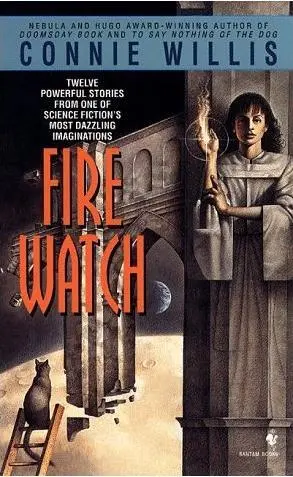
- Название:Fire Watch
- Автор:
- Издательство:Bantam Spectra
- Жанр:
- Год:1998
- Город:New York
- ISBN:978-0-307-57342-1
- Рейтинг книги:4 / 5. Голосов: 1
-
Избранное:Добавить в избранное
- Отзывы:
-
Ваша оценка:
Fire Watch: краткое содержание, описание и аннотация
Предлагаем к чтению аннотацию, описание, краткое содержание или предисловие (зависит от того, что написал сам автор книги «Fire Watch»). Если вы не нашли необходимую информацию о книге — напишите в комментариях, мы постараемся отыскать её.
In “Service for the Burial of the Dead,” a young woman mourning her lover comes upon a surprising funeral guest.
Biblical prophecies turn out to have unexpected meanings as the End Times approach in “Lost and Found.”
The dangers of ordering merchandise from the back pages of pulp magazines become apparent in “Mail-Order Clone.”
In “Blued Moon,” a young man uncovers a scientific property of coincidence—and falls in love.
As a tourist attraction, a total eclipse draws an even wider audience than (almost) anyone realizes in “And Come from Miles Around.”
In “Samaritan,” an enthusiastic young assistant pastor plunges the entire church hierarchy into a firestorm of controversy when she brings forward an orangutan to be baptized.
Parental abuse is all the rage in an institute of higher learning—for those who have no parents… and for those who have no children, in “All My Darling Daughters.”
Fire Watch — читать онлайн бесплатно полную книгу (весь текст) целиком
Ниже представлен текст книги, разбитый по страницам. Система сохранения места последней прочитанной страницы, позволяет с удобством читать онлайн бесплатно книгу «Fire Watch», без необходимости каждый раз заново искать на чём Вы остановились. Поставьте закладку, и сможете в любой момент перейти на страницу, на которой закончили чтение.
Интервал:
Закладка:
Esau was up among the beams. He swung arm over arm, one hand trailing a white dusting cloth. His long hairy arms moved surely among the crosspieces as he worked. They had tried ladders before Esau came, but they scratched the wood of the beams and were not safe. One had come crashing down within inches of the Lazetti window.
Reverend Hoyt decided to say nothing until he had made up his mind on the matter. To Natalie’s insistent questions, he gave the same patient answer. “I have not decided.” On Sunday he preached the sermon on humility he had already planned.
Reading the final scripture, however, he suddenly caught sight of Esau huddled on one of the pine cross-pieces, his arms wrapped around a buttress for support, watching him as he read. “‘But as for me, my feet had almost stumbled, my steps had well-nigh slipped. I was stupid and ignorant. I was like a beast toward thee.’”
He looked out over his congregation. They looked satisfied with themselves, smug. He looked at Esau.
“‘Nevertheless I am continually with thee; thou dost hold my hand. Afterward thou wilt receive me to glory My flesh and my heart may fail, but God is the strength of my heart and my portion forever.’” He banged the Bible shut. “I have not said everything I intend to say on the subject of humility a subject very few of you know anything about.” The congregation looked surprised. Natalie, in a bright red robe with a yellow silk chasuble over it, beamed.
He made Natalie shout the benediction over the uproar afterwards and went out the organists door and back to the parsonage. He turned down the bell on the telephone to almost nothing. An hour later Natalie arrived with Esau in tow. She was excited. Her cheeks were as red as her robe. “Oh, I’m so glad you decided to say something after all. I was hoping you would. You’ll see, they’ll all think it’s a wonderful idea! I wish you’d baptized him, though. Just think how surprised everyone would have been! The first baptism ever, and in our church! Oh, Esau, aren’t you excited! You’re going to be baptized!”
“I haven’t decided yet, Natalie. I told the congregation the matter had come up, that’s all.”
“But you’ll see, they’ll think it’s a wonderful idea.”
He sent her home, telling her not to accept any calls or talk to any reporters, an edict he knew she would ignore completely He kept Esau with him, fixing a nice supper for them both and turning the television on to a baseball game. Esau picked up Reverend Hoyt’s cat, an old tom that allowed people in the parsonage only on sufferance, and carried him over to his chair in front of the TV Reverend Hoyt expected an explosion of claws and hurt feelings, but tom settled down quite happily in Esau’s lap.
When bedtime came, Esau set him down gently on the end of the guest bed and stroked him twice. Then he crawled into the bed forwards, which always embarrassed Natalie so. Reverend Hoyt tucked him in. It was a foolish thing to do. Esau was fully grown. He lived alone and took care of himself. Still, it seemed the thing to do.
Esau lay there looking up at him. He raised up on one arm to see if the cat was still there, and turned over on his side, wrapping his arms around his neck. Reverend Hoyt turned off the light. He didn’t know the sign for “good night,” so he just waved, a tentative little wave, from the door. Esau waved back.
Esau ate breakfast with the cat in his lap. Reverend Hoyt had turned the phone back up, and it rang insistently. He motioned to Esau that it was time to go over to the church. Esau signed something, pointing to the cat. He clearly wanted to take it with him. Reverend Hoyt signed one rather gentle “no” at him, pinching his first two fingers and thumb together, but smiling so Esau would not think he was angry.
Esau put the cat down on the chair. Together they walked to the church. Reverend Hoyt wished there were some way he could tell him it was not necessary for him to walk upright all the time. At the door of Reverend Hoyt’s study, Esau signed, “Work?” Reverend Hoyt nodded and tried to push his door open. Letters shoved under the door had wedged it shut. He knelt and pulled a handful free. The door swung open, and he picked up another handful from the floor and put them on his desk. Esau peeked in the door and waved at him. Reverend Hoyt waved back, and Esau shambled off to the sanctuary. Reverend Hoyt shut the door.
Behind his desk was a little clutter of sharp-edged glass and a large rock. There was a star-shaped hole above them in the glass doors. He took the message off the rock. It read, “And I saw a beast coming up out of the earth, and upon his head the names of blasphemy.”
Reverend Hoyt cleaned up the broken glass and called the bishop. He read through his mail, keeping an eye out for her through the glass doors. She always came in the back way through the parking lot. His office was at the very end of the business wing of the church, the hardest thing to get to. It had been intended that way to give him as much privacy as possible. There had been a little courtyard with a crab apple tree in it outside the glass doors. Five years ago the courtyard and the crab apple tree had both been sacrificed to parking space, and now he had no privacy at all, but an excellent view of all comings and goings. It was the only way he knew what was going on in the church. From his office he couldn’t hear a thing.
The bishop arrived on her bicycle. Her short curly gray hair had been swept back from her face by the wind. She was very tanned. She was wearing a light green pantsuit, but she had a black robe over her arm. He let her in through the glass doors.
“I wasn’t sure if it was an official occasion or not. I decided I’d better bring something along in case you were going to drop another bombshell.”
“I know,” he sighed, sitting down behind his littered desk. “It was a stupid thing to do. Thank you for coming, Moira.”
“You could at least have warned me. The first call I got was some reporter raving that the End was coming, I thought the Charles had taken over again. Then some idiot called to ask what the church’s position on pigs’ souls was. It was another twenty minutes before I was able to find out exactly what you’d done. In the meantime, Will, I’m afraid I called you a number of highly uncharitable names.” She reached out and patted his hand. “All of which I take back. How are you doing, dear?”
“I didn’t intend to say anything until I’d decided what to do,” he said thoughtfully. “I was going to call you this week about it. I told Natalie that when she brought Esau in.”
“I knew it. This is Natalie Abreu’s brainchild, isn’t it? I thought I detected the hand of an assistant pastor in all this. Honestly, Will, they are all alike. Isn’t there some way to keep them in seminary another ten years until they calm down a little? Causes and ideas and reforms and more causes. It wears me out.
“Mine is into choirs: youth choirs, boy choirs, madrigals, antiphonals, glees. We barely have time for the sermon, there are so many choirs. My church doesn’t look like a church. It looks like a military parade. Battalions of colored robes trooping in and out, chanting responses.” She paused. “There are times when I’d like to throttle him. Right now I’d like to throttle Natalie. Whatever put it into her head?”
Reverend Hoyt shook his head. “She’s very fond of him.”
“So she’s been filling him with a lot of Bible stories and scripture. Has she been taking him to Sunday school?”
“Yes. First grade, I think.”
“Well, then, you can claim indoctrination, can’t you? Say it wasn’t his own idea but was forced on him?”
“I can say that about three-fourths of the Sunday school class. Moira, that’s the problem. There isn’t any argument that I can use against him that wouldn’t apply to half the congregation. He’s lonely. He needs a strong father figure. He likes the pretty robes and candles. Instinct. Conditioning. Sexual sublimation. Maybe those things are true of Esau, but they’re true of a lot of people I’ve baptized, too. And I never said to them, 'Why do you really want to be baptized?’”
Читать дальшеИнтервал:
Закладка:
Похожие книги на «Fire Watch»
Представляем Вашему вниманию похожие книги на «Fire Watch» списком для выбора. Мы отобрали схожую по названию и смыслу литературу в надежде предоставить читателям больше вариантов отыскать новые, интересные, ещё непрочитанные произведения.












Обсуждение, отзывы о книге «Fire Watch» и просто собственные мнения читателей. Оставьте ваши комментарии, напишите, что Вы думаете о произведении, его смысле или главных героях. Укажите что конкретно понравилось, а что нет, и почему Вы так считаете.