Connie Willis - Fire Watch
Здесь есть возможность читать онлайн «Connie Willis - Fire Watch» весь текст электронной книги совершенно бесплатно (целиком полную версию без сокращений). В некоторых случаях можно слушать аудио, скачать через торрент в формате fb2 и присутствует краткое содержание. Город: New York, Год выпуска: 1998, ISBN: 1998, Издательство: Bantam Spectra, Жанр: Фантастика и фэнтези, на английском языке. Описание произведения, (предисловие) а так же отзывы посетителей доступны на портале библиотеки ЛибКат.
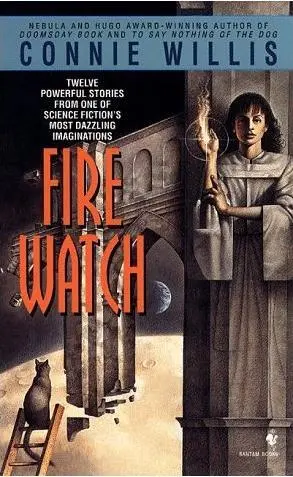
- Название:Fire Watch
- Автор:
- Издательство:Bantam Spectra
- Жанр:
- Год:1998
- Город:New York
- ISBN:978-0-307-57342-1
- Рейтинг книги:4 / 5. Голосов: 1
-
Избранное:Добавить в избранное
- Отзывы:
-
Ваша оценка:
Fire Watch: краткое содержание, описание и аннотация
Предлагаем к чтению аннотацию, описание, краткое содержание или предисловие (зависит от того, что написал сам автор книги «Fire Watch»). Если вы не нашли необходимую информацию о книге — напишите в комментариях, мы постараемся отыскать её.
In “Service for the Burial of the Dead,” a young woman mourning her lover comes upon a surprising funeral guest.
Biblical prophecies turn out to have unexpected meanings as the End Times approach in “Lost and Found.”
The dangers of ordering merchandise from the back pages of pulp magazines become apparent in “Mail-Order Clone.”
In “Blued Moon,” a young man uncovers a scientific property of coincidence—and falls in love.
As a tourist attraction, a total eclipse draws an even wider audience than (almost) anyone realizes in “And Come from Miles Around.”
In “Samaritan,” an enthusiastic young assistant pastor plunges the entire church hierarchy into a firestorm of controversy when she brings forward an orangutan to be baptized.
Parental abuse is all the rage in an institute of higher learning—for those who have no parents… and for those who have no children, in “All My Darling Daughters.”
Fire Watch — читать онлайн бесплатно полную книгу (весь текст) целиком
Ниже представлен текст книги, разбитый по страницам. Система сохранения места последней прочитанной страницы, позволяет с удобством читать онлайн бесплатно книгу «Fire Watch», без необходимости каждый раз заново искать на чём Вы остановились. Поставьте закладку, и сможете в любой момент перейти на страницу, на которой закончили чтение.
Интервал:
Закладка:
And that would have been too late. What would have happened when I lit the cigar? Would the house have gone up in a ball of flame, or all of St. Pierre? The hydrogen-oxygen ratio had been high enough in the upper atmosphere that we had had to shut off the engines above a kilometer and spiral in, and here the fans were pumping in even more oxygen. Half of Paylay might have gone up.
I knew how it had happened. Jewell had interrupted the downpilot before he could ask about sparkers, and now, because her feet had hurt, there was a live sparker in her house. And she had just convinced Jack I was not dangerous.
I had stopped playing, sitting there staring blindly at the keyboard, the unlit cigar clamped so hard between my teeth I had nearly bitten it through. The men were still shouting out the names of songs, but Jewell stepped between them and me and put a hardcopy on the music rack. “No more riquists,” she said. “Pearl is going to sing for you.”
Pearl stood up and walked unassisted from her white chair to the pianoboard. She stopped no more than an inch from me and put her hand down certainly on the end of the keyboard. I looked at the music. It showed a line of notes before her part began, but I did not know that version, only the song that Kovich had known, and that began on the first note of the verse. I could not nod at her, and she could not see my hands on the keys.
“I don’t know the introduction,” I said. “Just the verse. What should I do?”
She bent down to me. “Put your hand on mine when you are ready to begin, and I will count three,” she said, and straightened again, leaving her hand where it was.
I looked down at her hand. Carnie had told her about my hands, and if I touched her lightly with only the middle fingers, she might not even be able to tell it from a human’s touch. I wanted more than anything not to frighten her. I did not think I could bear it if she flinched away from me.
Now I think it would have been better if she had, that I could have stood it better than this, sitting here with her head on my lap, waiting. If she had flinched, Jack would have seen her. He would have seen her draw away from me, and that would have been enough for him to grab me by the dog collar and throw me out the door, kick me down the wooden steps so hard that the sparker bounced out, leave me to cook in the furnace of Paylay.
“Now whit did you do thit for?” Jewell would have said. “He din’t do innything but tich her hand.”
“And he’ll nivver do innything ilse to her either,” he would have said, and handed Jewell the sparker. And I would never have been able to do anything else to her.
But she did not flinch. She took a light breath that took no longer than it did for my hand to return to the keys and hit the first note on the count of three, and we began together. I did not do any trills, any octave stretches. Her voice was sweet and thready and true. She didn’t need me.
The men applauded after Pearl’s song and started calling out the names of other songs. Some I didn’t know, and I wondered how I could explain that to them, but Jewell said, “Now, now, boys. Lets not use up our pianoboard player in one shift. Lit him go to bid. He’ll be here next shift. Who wants a game of katmai?” She reached over and pulled the cover down over the keyboard. “Use the front stairs,” she said. “The tappers take the girls up the back way.”
Pearl bent toward me, said, “Good night, Ruby,” and then took Jack’s arm as if she knew right where he was and went through the curtained door to the card room. The others followed two by two until all the girls were taken, and then in a straggling line, and Jewell unfastened the heavy drapes so they fell across the door behind them.
I went upstairs and took off the paper shuffles and the uncomfortable collar and sat on the edge of the bed Jewell had fixed for me by putting a little table at the end for extra length. I thought about Pearl and Jack and how I was going to give Jewell the sparker at the beginning of the next shift, and wondered who I was copying. I looked at myself in the little plastic mirror over the bed, trying to see Jewell or Jack in my face.
I had left my cigar on the music rack. I didn’t want Jack to find it there and think I had rejected it. I put my shuffles back on and went downstairs. There was nobody in the music room, and the drapes were still drawn across the door of the card room. I went over to the pianoboard and got the cigar. I had bitten it almost through, and now I bit the ragged end off. Then I chomped down on the new end and sat down on the piano stool, spreading out my hands as far as they would go across the keyboard.
“I understand you’re a Mirror,” a man’s voice said from the recesses of Pearl’s chair. “I knew a Mirror once. Or he knew me. Isn’t that how it is?”
I almost said, “You’re not supposed to sit in that chair,” but I found I could not speak.
The man stood up and came toward me. He was dressed like the other men, with a broad black dog collar, but his hands and face were almost white, and there was no lighter band across his forehead. “My name is Taber,” He said in a slow, drawling voice unlike the fast, vowel-shortening accents of the others. I wondered if he had come from Solfatara. All the rest of them except Pearl shortened their vowels, bit them off like I had bit the end of the cigar. Pearl alone seemed to have no accent, as if her blindness had protected her from the speech of Solfatara, too.
“Welcome to St. Pierre,” he said, and I felt a shock of fear. He had lied to Jewell. I did not know who St. Pierre was, but I knew as he spoke that St. Pierre was not the patron saint of tappers, and that Taber’s calling the town that was some unspeakably cruel joke that only he understood.
“I have to go upstairs,” I said, and my hand shook as I held the cigar. “Jewell’s in the card room.”
“Oh,” he said lazily taking a cigar from his pocket and unwrapping it. “Is Pearl there, too?”
“Pearl,” I said, so frightened I could not breathe.
He patted his formals pockets and reached inside his shirt. “Yes. You know, the blind girl. The pretty one.” He pulled a sparker from his inside pocket, cocked it back, and looked at me. “What a pity she’s blind. I wish I knew what happened. She’s never told a soul, you know,” he said, and clicked the sparker.
It was not a real sparker. I could see, after a frozen moment, that there was no liquid in it at all. He clicked it twice more, held it to the end of his cigar in dreadful pantomime, and replaced it in his pocket.
“I do wish I could find out,” he said. “I could put the knowledge to good use.”
“I can’t help you,” I said, and moved toward the stairs.
He stepped in front of me. “Oh, I think you can. Isn’t that what Mirrors are for?” he said, and drew on the unlit cigar and blew imaginary smoke into my face.
“I won’t help you,” I said, so loudly I fancied Jewell would come and tell Taber to let me alone, as she had told Carnie. “You can’t make me help you.”
“Of course not,” he said. “That isn’t how it works. But of course you know that,” and let me pass.
I sat on my bed the rest of the shift, holding the real sparker between my hands, waiting till I could tell Jewell what Taber had said to me. But the next shift was sleeping-shift, and the shift after that I played tapper requests for eight hours straight, and most of that time Taber stood by the pianoboard, flicking imaginary ashes onto my hands.
After the shift Jewell came to ask me whether Jack or anyone else had bothered me, and I did not tell her after all. During the next sleeping-shift I hid the sparker between the mattress and the springs of my bed.
On the waking shifts I kept as close as I could to Jewell, trying to make myself useful to her, trying not to copy the way she walked on her bandaged feet. When I was not playing, I moved among the tappers with glasses of iced and watered-down liquor on a tray and filled out the account cards for the men who wanted to take girls upstairs. On the off-shifts I learned to work the boards that sent out accounts to Solfatara, and to do the laundry; and after a couple of weeks Jewell had me help with the body checks on the girls. She scanned for perv marks and sot scars as well as the standard CBS every abbey has to screen for. Pearl did not have a mark on her, and I was relieved. I had had an idea that Taber might be torturing her somehow.
Читать дальшеИнтервал:
Закладка:
Похожие книги на «Fire Watch»
Представляем Вашему вниманию похожие книги на «Fire Watch» списком для выбора. Мы отобрали схожую по названию и смыслу литературу в надежде предоставить читателям больше вариантов отыскать новые, интересные, ещё непрочитанные произведения.






Обсуждение, отзывы о книге «Fire Watch» и просто собственные мнения читателей. Оставьте ваши комментарии, напишите, что Вы думаете о произведении, его смысле или главных героях. Укажите что конкретно понравилось, а что нет, и почему Вы так считаете.