Connie Willis - Fire Watch
Здесь есть возможность читать онлайн «Connie Willis - Fire Watch» весь текст электронной книги совершенно бесплатно (целиком полную версию без сокращений). В некоторых случаях можно слушать аудио, скачать через торрент в формате fb2 и присутствует краткое содержание. Город: New York, Год выпуска: 1998, ISBN: 1998, Издательство: Bantam Spectra, Жанр: Фантастика и фэнтези, на английском языке. Описание произведения, (предисловие) а так же отзывы посетителей доступны на портале библиотеки ЛибКат.
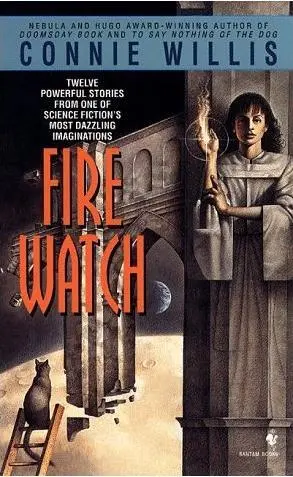
- Название:Fire Watch
- Автор:
- Издательство:Bantam Spectra
- Жанр:
- Год:1998
- Город:New York
- ISBN:978-0-307-57342-1
- Рейтинг книги:4 / 5. Голосов: 1
-
Избранное:Добавить в избранное
- Отзывы:
-
Ваша оценка:
Fire Watch: краткое содержание, описание и аннотация
Предлагаем к чтению аннотацию, описание, краткое содержание или предисловие (зависит от того, что написал сам автор книги «Fire Watch»). Если вы не нашли необходимую информацию о книге — напишите в комментариях, мы постараемся отыскать её.
In “Service for the Burial of the Dead,” a young woman mourning her lover comes upon a surprising funeral guest.
Biblical prophecies turn out to have unexpected meanings as the End Times approach in “Lost and Found.”
The dangers of ordering merchandise from the back pages of pulp magazines become apparent in “Mail-Order Clone.”
In “Blued Moon,” a young man uncovers a scientific property of coincidence—and falls in love.
As a tourist attraction, a total eclipse draws an even wider audience than (almost) anyone realizes in “And Come from Miles Around.”
In “Samaritan,” an enthusiastic young assistant pastor plunges the entire church hierarchy into a firestorm of controversy when she brings forward an orangutan to be baptized.
Parental abuse is all the rage in an institute of higher learning—for those who have no parents… and for those who have no children, in “All My Darling Daughters.”
Fire Watch — читать онлайн бесплатно полную книгу (весь текст) целиком
Ниже представлен текст книги, разбитый по страницам. Система сохранения места последней прочитанной страницы, позволяет с удобством читать онлайн бесплатно книгу «Fire Watch», без необходимости каждый раз заново искать на чём Вы остановились. Поставьте закладку, и сможете в любой момент перейти на страницу, на которой закончили чтение.
Интервал:
Закладка:
“We blow nitrogen and oxygen in from a tap behind the house,” she said. “The tappers din’t like having squeaky little helium voices when they’re with the girls. You can’t git rid of the helium, or the hydrogen either. They leak in ivverywhere. The bist you can do is dilute it. You shid be glad you weren’t here at the beginning, before they tapped an atmosphere. You had to wear vacuum suits thin.” She pried off her shoe. The bottom of her foot was a mass of blisters. She started to stand up and then sat down again.
“Yill for Carnie,” she said. “Till her to bring some bandages.”
I hung my outside shoes on the rack and opened the inner door. It fit tightly, though it opened with just a touch. It was made of the same insulation as the outer door. It opened onto a fancy room, all curtains and fur rugs and hanging looms that cast little pools of colored light, green and rose and gold. The pianoboard stood over against one wall on a carved plastic table. I could not see anyone in the room, and I could not hear voices for the sound of the blowers. I started across a blood-red fur rug to another door hung with curtains.
“Jewell?” a woman’s voice said. The blowers kicked off, and she said, “Jewell?” again, and I saw that I had nearly walked past her. She was sitting in a white velvet chair in a little bay that would have been a window if this were not Paylay. She was wearing a white satinpaper dress with a long skirt. Her hair was piled on top of her head, and there was a string of pearls around her long neck. She was sitting so quietly, with her hands in her lap and her head turned slightly away from me, that I had not even seen her.
“Are you Carnie?” I said.
“No,” she said, and she didn’t look up at me. “What is it?”
“Jewell got her feet burned,” I said. “She needs bandages. I’m the new pianoboard player.”
“I know,” the girl said. She lifted her head a little in the direction of the stairs and called, “Carnie. Get the remedy case.”
A girl came running down the stairs in an orange-red robe and no shoes. “Is it Jewell?” she said to the girl in the white dress, and when she nodded, Carnie ran past us into the other room. I could hear the hollow sound of an insulated door opening. The girl had made no move to come and see Jewell. She sat perfectly still in the white chair, her hands lying quietly in her lap.
“Jewell’s feet are pretty bad,” I said. “Can’t you at least come see them?”
“No,” she said, and looked up at me. “My name is Pearl,” she said. “I had a friend once who played the pianoboard.”
Even then I wouldn’t have known she was blind except that my uncle had told me. “Most of the girls are newcomers Jewell hired for Paylay right off the ships, before the happy houses could ruin them,” my uncle had said. “She only brought a couple of the girls with her from Solfatara, girls who worked with her in the happy house she came out of. Carnie, and I think Sapphire, and Pearl, the blind one.”
“Blind?” I had said. Solfatara is a long way out, but anyplace has doctors.
“He cut the optic nerve was severed. They did orb implants and reattached all the muscles, but it was only cosmetic repair. She can’t see anything.”
Even after all the horrible stories I had heard about Solfatara, it had shocked me to think that someone could do something like that. I remember thinking that the man must have been incredibly cruel to have done such a thing, that it would have been kinder to kill her outright than to have left her helpless and injured like that in a place like Solfatara.
“Who did it to her?” I said.
“A tapper,” he said, and for a minute he looked very much like Kovich, so much that I asked, “Was it the same man who broke Kovich’s hands?”
“Yes,” my uncle said.
“Did they kill him?” I said, and that was not the question I had intended to ask. I had meant did Kovich kill him, but I had said “they.”
And my uncle, not looking like Kovich at all, had said, “Yes, they killed him,” as if that were the right question after all.
The orb implants, the muscle reattachments had been very good. Her eyes were a beautiful pale gray; and someone had taught her to follow voices with them. There was nothing at all in the angle of her head or her eyes or her quiet hands to tell me she was blind or make me pity her, and standing there looking down at her, I was glad, glad that they had killed him. I hoped that they had cut his eyes out first.
Carnie darted past us with the remedy case, and I said, still looking down at Pearl, “I’ll go and see if I can help her.” I went back out into the anteroom and watched while Carnie put some kind of oil on Jewell’s feet and then a meshlike pad, and wrapped her feet in bandages.
“This is Carnelian,” Jewell said. “Carnie, this is our new pianoboard player.”
She smiled at me. She looked very young. She must have been only a child when she worked in the happy house on Solfatara with Jewell.
“I bit you can do real fancy stuff with those hands,” she said, and giggled.
“Don’t tease him,” Jewell said. “He’s here to play the pianoboard.”
“I meant on the pianoboard. You din’t look like a real Mirror. You know, shiny and ivverything? Who are you going to copy?”
“He’s not going to copy innybody,” Jewell said sharply “He’s going to play the pianoboard, and that’s all. Is supper riddy?”
“No. I was jist in the kitchen and Sapphire wasn’t even there yit.” She looked back up at me. “When you copy somebody, do you look like them?”
“No,” I said. “You’re thinking of a Chameleon.”
“You’re not thinking at all,” Jewell said to her and stood up. She winced a little as she put her weight on her feet. “Go borrow a pair of Garnet’s shuffles. I’ll nivver be able to git mine on. And go till Sapphire to doubletap hersilfinto the kitchen.”
She let me help her to the stairs, but not up them. “When Carnie comes back, you hivv her show you your room. We work an eight and eight here, and it’s nearly time for the shift. You kin practice till supper if you want.”
She went up two steps and stopped. “If Carnie asks you innymore silly questions, tell her I told her to lit you alone. I don’t want to hear any more nonsinse about copying and Mirrors. You’re here to play the pianoboard.”
She went on up the stairs, and I went back into the music room. Pearl was still there, sitting in the white chair, and I didn’t know whether she was included in the instructions to leave me alone, so I sat down on the hard wooden stool and looked at the pianoboard.
It had a wooden soundboard and bridges, but the strings were plastic instead of metal. I tried a few chords, and it seemed to have a good sound in spite of the strings. I played a few scales and more chords and looked at the names on the hardcopies that stood against the music rack. I can’t read music, of course, but I could see by the titles that I knew most of the songs.
“It isn’t nonsense, is it?” Pearl said. “About the copying.” She spoke slowly and without the clipped accent Jewell and Carnie had.
I turned around on the stool and faced her. “No,” I said. “Mirrors have to copy. They can’t help themselves. They don’t even know who they’re copying. Jewell doesn’t believe me. Do you?”
“The worst thing about being blind is not that things are done to you,” she said, and looked up at me again with her gray eyes. “It’s that you don’t know who’s doing them.”
Carnie came in through the curtained door. “I’m sipposed to show you around,” she said. “Oh, Pearl, I wish you kidd see him. He has eight fingers on each hand, and he’s really tall. Almost to the ceiling. And his skin is bright red.”
Читать дальшеИнтервал:
Закладка:
Похожие книги на «Fire Watch»
Представляем Вашему вниманию похожие книги на «Fire Watch» списком для выбора. Мы отобрали схожую по названию и смыслу литературу в надежде предоставить читателям больше вариантов отыскать новые, интересные, ещё непрочитанные произведения.










Обсуждение, отзывы о книге «Fire Watch» и просто собственные мнения читателей. Оставьте ваши комментарии, напишите, что Вы думаете о произведении, его смысле или главных героях. Укажите что конкретно понравилось, а что нет, и почему Вы так считаете.