Walter Tevis - Mockingbird
Здесь есть возможность читать онлайн «Walter Tevis - Mockingbird» весь текст электронной книги совершенно бесплатно (целиком полную версию без сокращений). В некоторых случаях можно слушать аудио, скачать через торрент в формате fb2 и присутствует краткое содержание. Город: London, Год выпуска: 2007, ISBN: 2007, Издательство: Gollancz, Жанр: Фантастика и фэнтези, на английском языке. Описание произведения, (предисловие) а так же отзывы посетителей доступны на портале библиотеки ЛибКат.
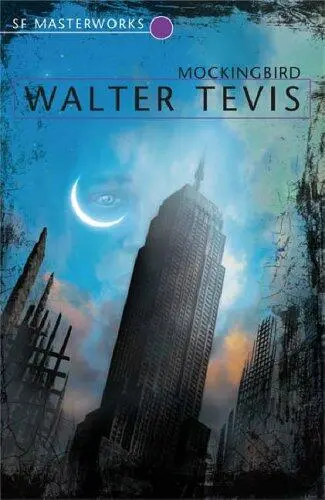
- Название:Mockingbird
- Автор:
- Издательство:Gollancz
- Жанр:
- Год:2007
- Город:London
- ISBN:978-0575079151
- Рейтинг книги:5 / 5. Голосов: 1
-
Избранное:Добавить в избранное
- Отзывы:
-
Ваша оценка:
Mockingbird: краткое содержание, описание и аннотация
Предлагаем к чтению аннотацию, описание, краткое содержание или предисловие (зависит от того, что написал сам автор книги «Mockingbird»). Если вы не нашли необходимую информацию о книге — напишите в комментариях, мы постараемся отыскать её.
Mockingbird
Review
From the Inside Flap “A moral tale that has elements of Aldous Huxley’s
,
, and
.”
—
“Set in a far future in which robots run a world with a small and declining human population, this novel could be considered an unofficial sequel to
, for its central event and symbol is the rediscovery of reading.”
—
“Because of its affirmation of such persistent human values as curiosity, courage, and compassion, along with its undeniable narrative power,
will become one of those books that coming generations will periodically rediscover with wonder and delight.”
—
“I’ve read other novels extrapolating the dangers of computerization but Mockingbird stings me, the writer, the hardest. The notion, the possibility, that people might indeed lose the ability, and worse, the desire to read, is made acutely probable.”
—
bestselling author ANNE MCCAFFREY “Walter Tevis is science fiction’s great neglected master, one of the definitive bridges between sf and literature. For those who know his work only through the movies, the lucid prose and literary vision of
and
will come as a revelation.”
—AL SARRANTONIO, Author of
saga
Mockingbird — читать онлайн бесплатно полную книгу (весь текст) целиком
Ниже представлен текст книги, разбитый по страницам. Система сохранения места последней прочитанной страницы, позволяет с удобством читать онлайн бесплатно книгу «Mockingbird», без необходимости каждый раз заново искать на чём Вы остановились. Поставьте закладку, и сможете в любой момент перейти на страницу, на которой закончили чтение.
Интервал:
Закладка:
My coffee was getting cold. I sipped from it a moment and then said, “What do you mean by ‘love’?”
He did not reply for a long time. Then he said, “Flutterings in the stomach. And about the heart. Wishing for your being happy. An obsession with you, with the way your chin tilts and your eyes at times stare. The way your hand holds that coffee cup. Hearing you snoring at night while I sit here.”
I was shocked. They were words of a kind I had read at times and had ignored. I knew without thinking that they had something to do with sex and with the families that had been a part of the ancient world; but they were never a part of my life. And how could they be a part of the “life” of this manufactured person, this elegant humanoid with its brown skin and kinky keratinoid hair? This false man, without a mother to gender him, without a penis; unable to eat food or drink water—a battery-powered doll with soulful brown eyes. What was this business of love he was speaking of—some of the madness, the dementia that had haunted his manufacture and the whole making of that last Promethean strain of synthetic intelligences, that mad over-humanness of the doomed series of Make Nines?
And yet, looking at him, I could have kissed him. Could have embraced his broad, handsome back and pressed my mouth against his moist lips.
And then I found that—oh, my good lord Jesus Christ—I was crying. Tears were running down my face freely. I let my face fall wet into my open hands and sobbed the way I had sobbed as a child when I learned that I was alone in the world. It was like a great gust of warm wind blowing through me.
After crying I felt subdued, calm. I looked at Bob. His face was calm, restful, as I felt mine was. “Have you ever done this before?” I said. “Fallen in love?”
“Yes. When I was… when I was young. There were human women, back then, who were undrugged. I loved one of them. There was something in her face, sometimes…. But I never tried to live with a woman before. The way we are living now.”
“Why me?” I said. “I was happy enough with Paul. We would have started a family. Why did you have to fall in love with me?”
He looked at me. “You’re the last one,” he said. “The last before I die. I wanted to recover my buried life. This erased part of my memory. I would like to know, before I die, what it was like to be the human being I have tried to be all my life.“ He looked away from me, out the window. ”Besides, prison will be good for Paul. If he grows up enough he’ll escape. Nothing works very well in the world anymore; most of the machines and most of the robots are breaking down. If he wants to get out of prison he will.“
“Have you remembered anything?” I said. “Since we’ve been living together? Have you filled in any of the blank spaces in your brain?”
He shook his head. “No, I haven’t. Not a one.”
I nodded. “Bob,” I said. “You ought to memorize your life, the way I am doing. You ought to dictate your whole story into a recorder. I could write it down for you, and teach you how to read it.”
He looked back toward me, and his face now seemed very old and sad. “I have no need to, Mary. I can’t forget my life. I have no means of forgetting. That was left out.”
“My God,” I said. “That must be awful.”
“Yes, it is,” he said. “It is awful.”
Once Bob said to me, “Do you miss Paul?”
I did not look up from my beer glass. “Only the mockingbird sings at the edge of the woods.”
“What was that?” Bob said.
“Something Paul used to say. When I think of him sometimes, I think of that.”
“Say it again,” Bob said. There was something urgent in his voice.
“ ‘Only the mockingbird sings at the edge of the woods’,” I said.
“ Woods ,” Bob said. And then “‘Whose woods these are I think I know.’ That’s the line.” He stood up and walked over toward me. “‘Whose woods these are I think I know. His house…’”
So Bob finally got the word for his poem, after over a hundred years of wondering. I’m glad I was able to give him something.
Bentley
The winter must have been coming to an end, for it was never as cold again after I left the toaster factory as it had been before. And I was never that sick again, even though I was still a bit weak when I left the unholy security of that place.
My progress northward became faster and the food I had taken from the factory, evil-tasting though it was, gave me strength. I continued to find clams and, later, mussels. And I frightened a sea gull on the beach away from a fish it had just caught; the stew it made lasted three days. Eventually my health returned better than it had ever been. I had become very firm and tough, and I could walk all day without fatigue, at a steady pace. I began to allow myself to think about Mary Lou and about the possibility of truly finding her. But I had a long way to go, I was certain; although I had no idea of just how far.
Then one afternoon I looked ahead of me and saw a road that wound its way across a field and down to the beach.
I ran up to it and saw that it was of ancient cracked asphalt, in places overgrown with weeds, with its surface old and faded and crumbled, but still walkable. I began to follow it, away from the beach.
I saw in the high weeds along the side of that decayed road something I had never seen before: a road sign. I had noticed them in films and read about them in books, but I had never seen one. It was of faded green and white Permoplastic, with its lettering almost obscured by dirt and vines; but when I pushed the vines away I could read it:
I looked at it for a long time. Something about the presence of this ancient thing, there in the weak sun of early spring, gave my body a sudden chill.
I picked up Biff in my arms and walked quickly down the road and around a bend.
And I saw spread out in front of me, half buried by trees and bushes, a cluster of Permoplastic houses—perhaps five hundred of them, filling a kind of shallow valley below me. The houses were set rather far from one another, with what once must have been parks and concrete streets between them. But there was no sign of human habitation. In what must have been the town’s center were two large buildings and a huge white obelisk.
As I approached the town I began to push through rosebushes and honeysuckle, near-dead from winter, and I saw that the houses, perhaps once brightly colored, were all faded to a uniform bone white.
I walked into Maugre with trepidation. Even Biff seemed nervous, and squirmed in my arms and clawed at the straps that held my backpack. Where the town began was a haphazard trail through the underbrush between the houses; I began to follow it. I could not tell if the houses had porches, since the fronts of them were so overgrown; on only a few of them were doors visible through the bushes and weeds and honeysuckles.
I was heading toward the obelisk. It seemed to be the thing to do.
One house I passed had fewer obstructions between me and its door and I set Biff down and pushed my way through the growth and came up to it, scratching myself several times on rosebushes as I did so. But I hardly noticed the scratches, the sensation of being in a dream or a hypnotic trance was so strong.
I was able, after some tearing of weeds, to get the front door open and, with a kind of awe, step inside. I was in a big living room with nothing in it. Absolutely nothing. The light was dim from the mold-covered and dusty plastic windows.
Opaque Permoplastic is the most tenacious—the most dead— material designed by man, and the entire room was merely a huge seamless hollow cube of it, all pink with rounded corners. There was no indication that anyone had ever lived there; but I knew that the nature of the material was such that the house could have been lived in for a hundred blues and have no signs—no scuff marks on the floor, handprints on the walls, smoke stains on the ceiling, no visible remnants of children playing or fighting or of where a favorite table had sat throughout the life of a family.
Читать дальшеИнтервал:
Закладка:
Похожие книги на «Mockingbird»
Представляем Вашему вниманию похожие книги на «Mockingbird» списком для выбора. Мы отобрали схожую по названию и смыслу литературу в надежде предоставить читателям больше вариантов отыскать новые, интересные, ещё непрочитанные произведения.




Обсуждение, отзывы о книге «Mockingbird» и просто собственные мнения читателей. Оставьте ваши комментарии, напишите, что Вы думаете о произведении, его смысле или главных героях. Укажите что конкретно понравилось, а что нет, и почему Вы так считаете.