Walter Tevis - Mockingbird
Здесь есть возможность читать онлайн «Walter Tevis - Mockingbird» весь текст электронной книги совершенно бесплатно (целиком полную версию без сокращений). В некоторых случаях можно слушать аудио, скачать через торрент в формате fb2 и присутствует краткое содержание. Город: London, Год выпуска: 2007, ISBN: 2007, Издательство: Gollancz, Жанр: Фантастика и фэнтези, на английском языке. Описание произведения, (предисловие) а так же отзывы посетителей доступны на портале библиотеки ЛибКат.
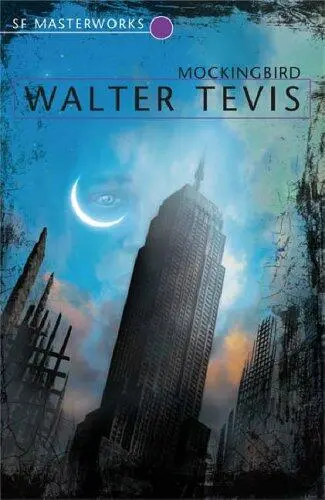
- Название:Mockingbird
- Автор:
- Издательство:Gollancz
- Жанр:
- Год:2007
- Город:London
- ISBN:978-0575079151
- Рейтинг книги:5 / 5. Голосов: 1
-
Избранное:Добавить в избранное
- Отзывы:
-
Ваша оценка:
Mockingbird: краткое содержание, описание и аннотация
Предлагаем к чтению аннотацию, описание, краткое содержание или предисловие (зависит от того, что написал сам автор книги «Mockingbird»). Если вы не нашли необходимую информацию о книге — напишите в комментариях, мы постараемся отыскать её.
Mockingbird
Review
From the Inside Flap “A moral tale that has elements of Aldous Huxley’s
,
, and
.”
—
“Set in a far future in which robots run a world with a small and declining human population, this novel could be considered an unofficial sequel to
, for its central event and symbol is the rediscovery of reading.”
—
“Because of its affirmation of such persistent human values as curiosity, courage, and compassion, along with its undeniable narrative power,
will become one of those books that coming generations will periodically rediscover with wonder and delight.”
—
“I’ve read other novels extrapolating the dangers of computerization but Mockingbird stings me, the writer, the hardest. The notion, the possibility, that people might indeed lose the ability, and worse, the desire to read, is made acutely probable.”
—
bestselling author ANNE MCCAFFREY “Walter Tevis is science fiction’s great neglected master, one of the definitive bridges between sf and literature. For those who know his work only through the movies, the lucid prose and literary vision of
and
will come as a revelation.”
—AL SARRANTONIO, Author of
saga
Mockingbird — читать онлайн бесплатно полную книгу (весь текст) целиком
Ниже представлен текст книги, разбитый по страницам. Система сохранения места последней прочитанной страницы, позволяет с удобством читать онлайн бесплатно книгу «Mockingbird», без необходимости каждый раз заново искать на чём Вы остановились. Поставьте закладку, и сможете в любой момент перейти на страницу, на которой закончили чтение.
Интервал:
Закладка:
But eventually I found some wood and, shaking terribly, managed to make a fire. And I reserved a sturdy, long stick of driftwood to use as a walking staff.
My backpack was empty now, except for my bowl. I was able to slide the denim material it was made of from the light metal tubes, take off my coat and sweater, and, shaking violently with the cold, button the fabric around me like a vest. Then I quickly put the sweater and coat back on and after I warmed my body up again at the fire I was even better sheltered from the cold. A scarf and a cap would have been very useful; but I had grown a beard and that helped keep my face and neck warm. I could have killed Biff and eaten her and used her skin for a hat; but I did not want to kill Biff. I was a changed person from what I had been trained to be; I no longer wished to be alone, private, or even self-reliant. I needed Biff. Self-reliance was not just a matter of drugs and silence.
I managed to tie the bowl with a string to the frame of my backpack. I put the frame back over my shoulders, took up my walking staff, and, still feverish and dizzy, but stronger now, continued northward along the empty beach.
It continued to snow, and as the day wore on I became colder. I stopped twice to attempt a fire, but I wasn’t able to get one lighted because of the wetness of what wood I could find and the way the wind kept blowing out my little lighter. When I became thirsty there was nothing to do but swallow handfuls of snow. The beach had become frozen too hard for me to be able to dig for clams. I kept moving ahead, slowly, and tried not to worry.
And then as I came around a curve in the beach toward evening, I saw in front of me, sitting on a low bluff back from the shore, a large old building, with lights in the windows. The snow was falling faster. The possibility of finding shelter, and warmth, gave me some strength, and I hurried forward, in a kind of limping half-run, until I came to the bottom of the bluff. But my heart sank. There were no stairs up to it—only loosely piled boulders all around, as a bulwark against the ocean.
I stood there for a while wondering what to do, until I realized that I must climb up there. I could not take the chance of sleeping on the beach and of being too weak and fevered in the morning even to sit up.
I began climbing, scrambling up a boulder, resting, and pushing myself slowly up the next one. Biff seemed to think I was playing, and ran up and down the rocks with ease, while my right wrist ached and my throat ached for water and the boulders scraped my legs and knees. It must have been immensely painful, but I did not think about the pain. I just kept clawing my way up those rocks, knowing that the snow-filled beach might be my death.
And I made it to the top and lay there, panting, while Biff snuggled against me. I patted her head. The palm of my hand was scratched and bleeding and there was a long gash in the sleeve of my jacket. But I was all right.
I had not been able to climb with my staff, so I had to half walk and half crawl to get to the door of the building. And it was, thank God, unlocked. I pushed, it open and fell into light and warmth.
I sat on some kind of hard floor for a long time, leaning back against the door I had come in, holding my head in my hands. I was dizzy, and sick; but I was warm.
When the dizziness subsided I looked around me.
I was in a vast, powerfully lighted room, under a high ceiling. In front of me and on either side were heavy gray machines, and a long conveyor belt and robots, their backs toward me, tending the machines. There was very little noise.
Strengthened by the warmth, I began to search the huge room for water. I found some almost immediately. One of the big machines was some sort of drill, with its bit cooled by a fine spray from a hose; the used water ran down a small trough in front of the conveyor belt and into a floor drain.
The robot who stood by the machine, doing nothing, ignored me and I ignored him. I kneeled by the belt, held my hands above the floor drain, caught the water and drank it from my hands. It was warm and slightly oily, but drinkable.
After I had my fill of it and while Biff was still lapping at the wetness around the floor drain, I washed my hands and face as best I could with the water. The oil in it seemed to soothe the scratched places on my skin.
Then I stood up, feeling better, and began to look more closely around me.
I now saw that there were actually three conveyor belts; one along each of three walls of the room. And moving along steadily on these belts were what I now recognized to be bright steel toasters. There had been toasters like them when I was a small child doing KP in the dormitory kitchen, but I hadn’t seen one since.
They were being constructed and wired by machines as they passed along the belts. Some machines would add a part and weld it in place as the toaster passed by. Each machine was tended by a Make Two robot—a kind of shuffling imbecile of an android—who stood by it, watching it work. Sheet steel came from a huge roll at the start of the line; completed toasters came off the end of it. Toasters were being made at a rapid pace, there in that over-lighted and cavernous room. Metal was being bent and formed by machine, with almost no noise, and parts were being made and added to the basic form. Standing there, finally warm but still half starved, I found myself wondering whatever became of the toasters and why it was that I had not seen one in thirty years. Whenever I wanted toast I had always stuck a fork in a slice of bread and held it over an open flame. I think that was what everybody did.
And then, walking toward the end of the line, I saw what was happening. A Make Three robot in a pale gray uniform was standing there. Unlike the others, he was rather deft in his movements. As each completed toaster came to him he would throw a switch on its side, just above the little nuclear battery, and when nothing happened—when no heating element became red hot—he would discard the toaster into a large, wheeled bin.
Like all of the other robots, he ignored my presence completely. I stood there, still a bit dazed by the warmth of the room, watching him for what seemed to be a long time. He would pick up each finished toaster as it came off the automatic production line, throw the switch, look inside, discover that it didn’t work, and then drop it in the bin at his side.
The robot had a round face and eyes that bulged slightly; he looked a bit like Peter Lorre but without the intelligence. While I was standing there by him the bin filled up with shiny new toasters and, seeing this, he shouted, in a deep, mechanical voice, “Recycle time!” and then reached under the conveyor belt and threw the handle of a switch.
The toaster line stopped, and all of the robots stood at attention, in their gray uniforms. From the ones I could see, they all had faces like Peter Lorre.
The bin full of discarded toasters began to roll along the floor; I had to move quickly to get out of its way. It rolled smartly down to the end of the room where the production line began and stopped in front of a small doorway. The door opened and a robot came out and began taking the toasters from the bin, carrying them awkwardly in his arms. He took them into a small room behind the door and I could see him putting them into a hopper that fed them into a machine of a kind I had seen at the prison. It was a machine for converting junked steel into new steel. The toasters were being made into sheet metal again.
The factory was a closed system. Nothing came in and nothing went out. It could have been making and unmaking defective toasters for centuries, for all I knew. If there was a robot-repair station anywhere nearby, the sub-moron robots would last nearly forever. And, apparently, no new raw materials were needed.
Читать дальшеИнтервал:
Закладка:
Похожие книги на «Mockingbird»
Представляем Вашему вниманию похожие книги на «Mockingbird» списком для выбора. Мы отобрали схожую по названию и смыслу литературу в надежде предоставить читателям больше вариантов отыскать новые, интересные, ещё непрочитанные произведения.





Обсуждение, отзывы о книге «Mockingbird» и просто собственные мнения читателей. Оставьте ваши комментарии, напишите, что Вы думаете о произведении, его смысле или главных героях. Укажите что конкретно понравилось, а что нет, и почему Вы так считаете.