Connie Willis - Passage
Здесь есть возможность читать онлайн «Connie Willis - Passage» весь текст электронной книги совершенно бесплатно (целиком полную версию без сокращений). В некоторых случаях можно слушать аудио, скачать через торрент в формате fb2 и присутствует краткое содержание. Год выпуска: 2001, ISBN: 2001, Издательство: Bantam Books, Жанр: Фантастика и фэнтези, на английском языке. Описание произведения, (предисловие) а так же отзывы посетителей доступны на портале библиотеки ЛибКат.
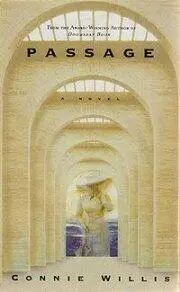
- Название:Passage
- Автор:
- Издательство:Bantam Books
- Жанр:
- Год:2001
- ISBN:0-553-11124-8
- Рейтинг книги:3 / 5. Голосов: 1
-
Избранное:Добавить в избранное
- Отзывы:
-
Ваша оценка:
Passage: краткое содержание, описание и аннотация
Предлагаем к чтению аннотацию, описание, краткое содержание или предисловие (зависит от того, что написал сам автор книги «Passage»). Если вы не нашли необходимую информацию о книге — напишите в комментариях, мы постараемся отыскать её.
Nominated for Nebula Award for Best Novel in 2001, Hugo, Campbell, and Clark awards in 2002.
Passage — читать онлайн бесплатно полную книгу (весь текст) целиком
Ниже представлен текст книги, разбитый по страницам. Система сохранения места последней прочитанной страницы, позволяет с удобством читать онлайн бесплатно книгу «Passage», без необходимости каждый раз заново искать на чём Вы остановились. Поставьте закладку, и сможете в любой момент перейти на страницу, на которой закончили чтение.
Интервал:
Закладка:
“I realize, of course, that nowadays English classes teach everything but English—rope-skipping rhymes and Navajo tribal chants and deconstructionist drivel. Why not maritime disasters?”
“Uncle Pat,” Kit said, but he didn’t even hear her.
“Perhaps the Titanic and Toni Morrison constitute what is taught nowadays, but in my classes I taught Wordsworth and Shakespeare.”
“Uncle Pat—”
“You asked me when I retired,” he said. “I’ll tell you when. When I could no longer bear to cast my pearls of English literature before my swinish students, when I could no longer tolerate their appalling grammar and their stupid questions.”
Joanna’s cheeks flushed with anger. Was this how he’d been the last few years he’d taught? If so, she could see why they’d egged his house. She set her cup and saucer down and stood up. “I’m sorry to have bothered you,” she said stiffly.
“I’ll see you out,” Kit said, standing up, too, and looking distressed.
“No, thank you, I can find my own way out.” She started for the door.
“Perhaps if you had paid more attention in class, Ms. Lander,” she heard him say as she went out the door, “you would not have found it necessary to—”
She shut the door behind her, and walked blindly out to her car, some part of her mind that wasn’t furious registering that it was late, that the afternoon light was fading. She opened the door of the car, fumbling for Vielle’s keys.
“Wait!”
Joanna looked up. Kit was on the porch. She ran down the steps, the tails of her flannel shirt flapping behind her. “Don’t leave! Please!” She caught up to Joanna. “Please. I wanted to explain.” She put her hand on the open car door. “I’m so sorry about what happened just now. This was all my fault. I shouldn’t have—” She stopped to catch her breath. “I don’t want you to think—”
“I had no right to come barging in without calling like that,” Joanna said. “He had every right to be angry with me.”
Kit shook her head. “It wasn’t you Uncle Pat was angry at.”
“Well, he gave a pretty good imitation of it,” Joanna said. “It’s all right. I’m sure it’s very irritating to have ex-students bothering him and asking him about—”
“You don’t understand. He didn’t know what you were talking about. He suffers from Alzheimer’s disease. He’s got severe memory loss. He—”
“Alzheimer’s?” Joanna said blankly.
“Yes. He didn’t know who you were. He thought you were a doctor—he’s afraid he’ll have to go into a nursing home. That’s why he was so angry, because he thought I’d asked you to come examine him.”
“Alzheimer’s,” Joanna said, trying to take this in. “He has Alzheimer’s disease?”
Kit nodded. “The anger’s part of the disease. He uses it to cover the fact that he can’t remember. I didn’t think that would happen. He was having a good day, and… I am so sorry.”
Kit’s hesitation when Joanna had said she wanted to ask Mr. Briarley a few questions, her finishing of his sentences, the alarm he’d shown at the mention of the word hospital. Alzheimer’s. “But he was able to quote The Rape of the Lock,” Joanna said, and remembered he hadn’t continued with the quotation from “The Rime of the Ancient Mariner.” “How bad is it?”
“It varies,” Kit said. “Sometimes he only has trouble remembering a few words, other days it’s pretty bad.”
Pretty bad. That was hardly the word. Alzheimer’s was a form of death by inches as the person lost his memory, his ability to speak, his control of bodily functions, descending into paranoia and darkness. She remembered one of her NDE subjects whose husband had suffered from Alzheimer’s. In the middle of the subject’s interview, he had stood up suddenly and said in a frightened voice, “What’s that stranger doing in my house? Who are you? What do you want?” and Joanna had started to try to explain, but he hadn’t been talking to her. He’d been talking to his wife of forty years.
“And you live with him?” Joanna asked. “You take care of him?”
She nodded. That was why he retired, Joanna thought suddenly, and not because the district offered an early-retirement bonus. Because he could no longer teach. She remembered him in class, reeling off pages and pages of Macbeth and “The Rime of the Ancient Mariner” from memory. Dates and plots and poetic meters. Conjunctions, couplets, quotations. The Briarley Anthology of English Literature, Ricky Inman had called him. Unable to remember the word for “spoons.”
“I didn’t want you to think he’s the way he was in there,” Kit said, shivering. She had to be freezing in that tank top and those flip-flops.
“You’d better get back inside,” Joanna said. “You’ll catch your death.”
“I’m okay,” she said, her teeth chattering. “I wanted to tell you not to give up, that sometimes he remembers things out of the blue, and other times he’ll answer a question you asked days, even weeks before, as if his mind had been searching for the memory all that time and finally found it. So he still might remember. You said it was something to do with the Titanic?”
“Yes,” Joanna said. “He said something, or he read something out loud—”
Kit nodded. “He is—was—a huge Titanic buff. If he remembers, or says anything about it, I’ll call you. I can reach you at Mercy General, right?”
Joanna nodded. “I’ve got an answering machine. Just leave a message and I’ll call you back—or is that a problem?”
“No,” Kit said. “If he answers, just tell him you want to talk to me.” She told her the number.
“And I should ask for Kit?” Joanna asked. “Or is your name Katherine?”
“It’s Kit. Kit Gardiner. I was named after Kit Marlowe, Uncle Pat’s favorite writer. He was the one who picked my name.”
And he’s forgotten that, Joanna thought, appalled. “I’ll call you if he says anything about the Titanic,” Kit said.
“I’d appreciate that.”
“Kit,” Mr. Briarley said, appearing at the door, “where have you put my Tragical History of Dr. Faustus?” He came out onto the porch.
“I’ll find it, Uncle Pat,” Kit called, and took off for the porch, hugging the flannel shirt to her thin form. “I’ll call you.”
“Thank you,” Joanna said.
“I’ve told you not to move my books,” Mr. Briarley said. “I can never find them.”
Kit ran back up the walk. Joanna got in the car, watching Kit run up onto the porch, watching her take Mr. Briarley’s arm and lead him inside. She put the car in gear and pulled away from the curb. She drove two blocks and then pulled the car over and turned it off and sat there with her hands on the steering wheel, staring blindly out at the fading winter light.
He didn’t know what he’d said about the Titanic. The memory was gone, as lost as if he had died. And he had died, was dying, syllable by syllable, a memory at a time, Coleridge and sarcasm and the word for sugar. And the name of his own niece, whom he had christened.
It had to be torture, forgetting the poems and the people that had made up your life, and torture for Kit, too, watching it happen. And the fact that he couldn’t remember a lecture about the Titanic was the least important aspect of the tragedy she’d just witnessed. But it wasn’t because of Kit or Mr. Briarley that she put her hands to her face, it wasn’t their loss she sat in the cold car and mourned in the fading light. It was her own.
He couldn’t tell her what he had said about the Titanic. He didn’t know. He didn’t remember. And it was important. It was the key.
Читать дальшеИнтервал:
Закладка:
Похожие книги на «Passage»
Представляем Вашему вниманию похожие книги на «Passage» списком для выбора. Мы отобрали схожую по названию и смыслу литературу в надежде предоставить читателям больше вариантов отыскать новые, интересные, ещё непрочитанные произведения.
Обсуждение, отзывы о книге «Passage» и просто собственные мнения читателей. Оставьте ваши комментарии, напишите, что Вы думаете о произведении, его смысле или главных героях. Укажите что конкретно понравилось, а что нет, и почему Вы так считаете.