Connie Willis - Passage
Здесь есть возможность читать онлайн «Connie Willis - Passage» весь текст электронной книги совершенно бесплатно (целиком полную версию без сокращений). В некоторых случаях можно слушать аудио, скачать через торрент в формате fb2 и присутствует краткое содержание. Год выпуска: 2001, ISBN: 2001, Издательство: Bantam Books, Жанр: Фантастика и фэнтези, на английском языке. Описание произведения, (предисловие) а так же отзывы посетителей доступны на портале библиотеки ЛибКат.
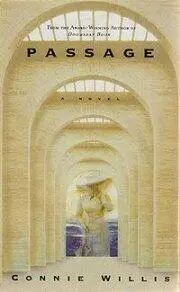
- Название:Passage
- Автор:
- Издательство:Bantam Books
- Жанр:
- Год:2001
- ISBN:0-553-11124-8
- Рейтинг книги:3 / 5. Голосов: 1
-
Избранное:Добавить в избранное
- Отзывы:
-
Ваша оценка:
Passage: краткое содержание, описание и аннотация
Предлагаем к чтению аннотацию, описание, краткое содержание или предисловие (зависит от того, что написал сам автор книги «Passage»). Если вы не нашли необходимую информацию о книге — напишите в комментариях, мы постараемся отыскать её.
Nominated for Nebula Award for Best Novel in 2001, Hugo, Campbell, and Clark awards in 2002.
Passage — читать онлайн бесплатно полную книгу (весь текст) целиком
Ниже представлен текст книги, разбитый по страницам. Система сохранения места последней прочитанной страницы, позволяет с удобством читать онлайн бесплатно книгу «Passage», без необходимости каждый раз заново искать на чём Вы остановились. Поставьте закладку, и сможете в любой момент перейти на страницу, на которой закончили чтение.
Интервал:
Закладка:
“They tell themselves that isn’t what it is, that it’s a morality play or a comedy of errors,” Mr. Briarley said. “They say it looks like class warfare or technological arrogance or the vengeance of a wrathful God, but they’re lying to themselves. They know, they know what it looks like. And so did he.
“That’s why he saw it,” Mr. Briarley said, and Joanna realized what he was talking about. He hadn’t heard her when she knelt next to his chair and asked him to remember. He had heard her before, talking to Kit, asking her why Greg Menotti had seen the Titanic, and he had spent the past fifteen minutes searching patiently through the passages of his blocked and damaged brain, trying to find the answer.
“ ‘I shall never forget it,’ ” he murmured. “Edith said that,” and, as if she had asked, “Edith Haisman. She said, ‘I shall never forget it, the darkness and the cold,’ but she wasn’t talking about the Titanic. And the forward lookout, who saw it first—who gave the warning—hanged himself from a lamppost. Because he knew what it really was. He knew it as soon as he saw it, knew—”
“I can’t find it anywhere,” Kit said, and Joanna could hear her pattering down the stairs.
No, Joanna thought, pressing herself against the back of the window seat as she had against the stairwell wall that day she and Richard had hidden from Mr. Mandrake.
“It wasn’t in the clothes hamper or under the mattress or behind the radiator,” Kit said, halfway down, two-thirds.
Don’t, Joanna prayed. Not now—
“Wait!” Kit said, only a few steps from the bottom. “I just thought of something. I know someplace else,” and ran back up.
Mr. Briarley looked after her, his head cocked as if listening for her voice, and then slumped back into his chair again. Joanna waited, but Kit’s voice, all unintending, had broken the spell, and he had sunk back into unawareness.
What does it look like, Mr. Briarley? Joanna nearly asked, but she was afraid of breaking the connection that might still be there in his mind. Wait, she thought, listening anxiously for Kit. Don’t lead. Wait.
“I kept losing my grade book,” Mr. Briarley said, and his voice had changed. It was introspective, even gentle. “And I couldn’t remember the names of Lear’s daughters. Ice warnings. But I didn’t listen to them. ‘Getting old,’ I told myself. ‘Typical absentminded professor.’ Very few of the passengers even heard the collision, you know. It was the engines stopping that woke them up.”
Joanna’s heart beat painfully. Wait.
“I told myself there was nothing to worry about,” he said. “Modern medicine had made the ship unsinkable, and the lights were still on, the decks were still comparatively level. But inside…”
He stared ahead blindly for a moment and then went on. “The perfect metaphor,” he said, “looming up suddenly out of nowhere in the middle of your maiden voyage, unseen until it is nearly upon you, unavoidable even when you try to swerve, unexpected even though there have been warnings all along. Literature, literature is a warning,” he said, and then waveringly, “ ‘No, no, my dream was lengthened after life.’ Shakespeare wrote that, trying to warn us of what’s coming. ‘I passed, methought, the melancholy flood, With that sour ferryman which poets write of, Unto the kingdom of perpetual night.’ ” He looked out over the library as if it were a classroom. “Can anyone tell me what that means?”
Above them, Kit slammed a drawer shut, and Mr. Briarley said, as if the sound had been a question, “Nothing can save you, not youth or beauty or wealth, not intelligence or power or courage. You are all alone, in the middle of an ocean, with the lights going out.”
Above, Kit shut a door, pattered into the hall. She would be down any minute. There was no time to wait.
“Why did he see the Titanic when he was dying?” Joanna asked, and Mr. Briarley turned and looked at her in surprise.
“He didn’t,” he said. “He saw death.”
Death. “And it looked like the Titanic,” Joanna said.
“And it looked like the Titanic.”
Kit appeared in the door. “I heard you talking,” she said. “Did you find it?”
36
“7 a.m. sailing today Thursday on Titanic on her maiden trip, to New York, her first trip on the Atlantic. Goodbye. Love, P. D.”
—Postcard sent by Patrick Dooley to Mary Tonnery from QueenstownJoanna wasn’t even sure of how she got back to the hospital. She had wanted only to get away, to escape what Mr. Briarley had told her, and what she might tell Kit.
“What’s wrong?” Kit had said after one look at her face. “What’s happened?”
“Nothing,” Joanna had said, trying to keep the knowledge out of her face. “I didn’t find the textbook.” Kit had come into the library and was standing in front of the banked pictures, so that the photo of Kevin smiled over her shoulder. I can’t tell her, Joanna had thought. I can’t let her find out. “I have to go,” she’d said and gone out into the hall.
“Uncle Pat didn’t say something, did he?” Kit had said anxiously, following her to the door. “He sometimes says terrible things, but he doesn’t mean them. They’re part of his illness. He doesn’t even know he says them.”
“No,” she’d said, trying to smile reassuringly. “He didn’t say anything terrible.” Only the truth. The terrible, terrible truth.
There was no question of its being true, even though, listening to him, she had felt no sudden “Eureka!,” no epiphany, only a feeling of dread. A sinking feeling, she thought, and her lips twisted. How appropriate. What had Mr. Briarley called it? The very mirror image of death.
Which was why it had resonated down through the years. All disasters—Maisie’s Hindenburg and Pompeii and the Hartford circus fire—had some of the attributes of death, its suddenness or its panic or its horror, but the Titanic had them all: courage and destruction and casualness and a dreadful confluence of coincidence and culpability, terror and gallantry and despair.
The tragedy of the Titanic was both sudden and slow—the impact with the iceberg as unexpected as a car accident, as a stroke. But it was also endless, the passengers sitting quietly on deck chairs after all the boats were gone or playing bridge in the smoking room, like patients in nursing homes, in the oncology ward, waiting forever to die.
All the attributes. The injury that seemed minor at first—a lump, a shadow on the X rays, a cough—nothing to worry about. Modern medicine has made the ship nearly unsinkable, and the captain surely knows what to do.
She thought of Greg Menotti, protesting that he went to the health club every day even as the killing pain clamped his chest. Of Maisie’s mother, insisting the new drug was stabilizing Maisie’s arrhythmia. Of the men on the Titanic leaning over the railing and laughing down to the women in the boats: “We’ll see you at breakfast,” and, “You’ll need a pass to get back on, ladies.”
Denial, and then worry. The doctor’s scheduled an exploratory, the CAT scan shows progressive degeneration of cortical nerve cells, the deck is starting to list. But there’s still no indication that it’s really serious. There’s certainly no need for your brother to come, no need to put on a lifejacket or draw up a will, not with the decks still lit and the band still playing.
More denial, and then a frantic rush for the lifeboats, for chemotherapy, for a clinic in Mexico, and then, with the boats all gone, good-byes and a desperate clinging to deck chairs, religion, positive thinking, Mr. Mandrake’s books, a light at the end of the tunnel. But nothing works, nothing holds, because the whole ship is coming apart, breaking up, crashing—that’s why they call it a crash cart, Joanna thought suddenly—the body’s crashing, going under, going down, and the Titanic isn’t just a mirror image of dying, but of what happened to the body, because it didn’t die all at once any more than the person did, but by stages, the breathing coming to a stop, and then the heart and the blood in the veins, one watertight compartment after another flooding and spilling over into the next: cerebral cortex, medulla, brain stem, all faltering and flickering out, and in their final moments seeing their own end. The ship going down by the head.
Читать дальшеИнтервал:
Закладка:
Похожие книги на «Passage»
Представляем Вашему вниманию похожие книги на «Passage» списком для выбора. Мы отобрали схожую по названию и смыслу литературу в надежде предоставить читателям больше вариантов отыскать новые, интересные, ещё непрочитанные произведения.


Обсуждение, отзывы о книге «Passage» и просто собственные мнения читателей. Оставьте ваши комментарии, напишите, что Вы думаете о произведении, его смысле или главных героях. Укажите что конкретно понравилось, а что нет, и почему Вы так считаете.