Orson Card - Pathfinder
Здесь есть возможность читать онлайн «Orson Card - Pathfinder» весь текст электронной книги совершенно бесплатно (целиком полную версию без сокращений). В некоторых случаях можно слушать аудио, скачать через торрент в формате fb2 и присутствует краткое содержание. Год выпуска: 2010, ISBN: 2010, Издательство: Simon Pulse, Жанр: Фантастика и фэнтези, на английском языке. Описание произведения, (предисловие) а так же отзывы посетителей доступны на портале библиотеки ЛибКат.
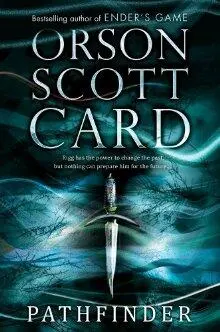
- Название:Pathfinder
- Автор:
- Издательство:Simon Pulse
- Жанр:
- Год:2010
- ISBN:978-1-4169-9176-2
- Рейтинг книги:5 / 5. Голосов: 1
-
Избранное:Добавить в избранное
- Отзывы:
-
Ваша оценка:
Pathfinder: краткое содержание, описание и аннотация
Предлагаем к чтению аннотацию, описание, краткое содержание или предисловие (зависит от того, что написал сам автор книги «Pathfinder»). Если вы не нашли необходимую информацию о книге — напишите в комментариях, мы постараемся отыскать её.
—secrets about Rigg's own past, his identity, and his destiny. And when Rigg discovers that he has the power not only to see the past, but also to change it, his future suddenly becomes anything but certain.
Rigg’s birthright sets him on a path that leaves him caught between two factions, one that wants him crowned and one that wants him dead. He will be forced to question everything he thinks he knows, choose who to trust, and push the limits of his talent…or forfeit control of his destiny.
Pathfinder — читать онлайн бесплатно полную книгу (весь текст) целиком
Ниже представлен текст книги, разбитый по страницам. Система сохранения места последней прочитанной страницы, позволяет с удобством читать онлайн бесплатно книгу «Pathfinder», без необходимости каждый раз заново искать на чём Вы остановились. Поставьте закладку, и сможете в любой момент перейти на страницу, на которой закончили чтение.
Интервал:
Закладка:
“But my lad, don’t you see? The only evidence we have of their innocence is your insistence on it—and the very point at issue is whether you can be believed or not.”
Without another word, Rigg bolted for the door to the cabin, but when he tried to pull it open, he found Citizen’s hand, above his head, was keeping it closed.
“You don’t really think I’d let you warn them, do you?” asked Citizen.
Rigg sat back down and fell silent. At least he knew his legal dilemma. But what he did not know was how to keep his friends safe. He couldn’t warn them. And yet . . . he knew that Umbo must live, at least long enough to come back from the future and give him the warning by the carriage near the Tower of O. Didn’t that mean that he not only would live, but would also remain in O? And Loaf must live and still be with Umbo, or why would future-Umbo have told Loaf to hide the rest of the jewels?
It was not possible that Loaf and Umbo would be tortured to death. And if that was so, then in all likelihood they would make their escape right now, while the boat was still at the dock.
There was a lurch, and the boat began to move.
All right, then, Umbo and Loaf must leap from the boat and swim to shore.
“You seem curiously untroubled by the movement of the boat,” said Citizen. “What do you know that I don’t know?”
“The movement of the boat,” said Rigg, “is not a surprise. That’s what I assumed it would do from the moment I got on it. That’s what boats are for.”
“But you were certainly calculating that your friends would try to escape while the boat was still at the dock.”
“Why are you so sure of what I was ‘calculating’?”
“Because the dock was the only place where they’d have a crowd to disappear into, where they could use their feet to run away. And, despite your skill at concealing your emotions, you still betrayed just a bit of it. Enough for a trained player of blackstone to detect it.”
“Then you aren’t very good at it,” said Rigg. “Because I definitely felt surprise when the boat moved. If you can read emotions at the gaming table, surely you can detect that.”
“Surprise, yes, but you were not troubled . Your worry dissipated instantly.”
“I don’t believe you’ll really kill them.”
“Oh, believe it, I won’t.”
“I’m glad to hear that,” said Rigg, allowing himself to feel a tiny trace of relief.
“Don’t try to fool me by letting yourself seem relieved. You can’t feel relief if you didn’t feel tension, and you didn’t. Besides, I won’t kill them or torture them because it’s not my job—the Revolutionary Council have specialists who handle all the judicial torture. I’m about fetching you; they’re about opening you up to examination.”
Rigg didn’t allow the implications of that—the hint that he, too, might be tortured—to enter his emotional consciousness. “I’ve been curious as to why a general would be sent to arrest me. Are you considered so worthless to the People’s Revolutionary Council that they would send you on a trivial errand like this?”
General Citizen laughed then. “You really are naive. I truly believe that. Because if you’re pretending, the things you pretend not to understand are so . . . stupidly chosen.”
“Again, I express my ingratitude to my father for the poor design of my education.”
“The reason I was sent to get you is because I maneuvered very carefully to win the assignment. And that’s because there are controversies centered on the Sessamoto Empire older and deeper than the mere matter of the royal family being deposed and the Revolutionary Council being in charge of the World Within the Walls.”
“I have no idea what you’re talking about,” said Rigg.
“It was the decree of Aptica Sessamin, the grandmother of the current non-queen, that only women could rule in the Sessamoto Empire. She gave this decree force by having all her male relatives killed. This put an end to a great many plots centered around removing her—a woman—from the Tent of Light.”
“Tent?” asked Rigg.
“Officially, every royal residence is the Tent of Light when the ruling monarch is in it. Aptica Sessamin murdered all her own sons, as I said, and her reigning daughter, Mutash Sessamin, had only the one child, a daughter, Hagia Sessamin.”
“Hagia—the one who is either my mother or not?”
“So you do know the names of the royal family!”
“Of course I know it now ,” said Rigg. “It’s been whispered by half the people we met. ‘He claims he’s the son of Hagia Sessamin.’”
“Cleverly done,” said Citizen. “I was very careful never to mention her name, in case you came up with it. But yes, I did hear the same comments, though I wouldn’t have thought you’d—never mind, I shouldn’t underestimate your cleverness or your powers of observation.”
Rigg showed absolutely no response to this—but by now he understood that to Citizen, not showing a response was, in fact, a response.
“So when Rigg Sessamekesh was born, the first male royal since the death of Aptica Sessamin, the very fact that he was given the suffix ‘ekesh’ was very controversial. That was the suffix given to the male child who was the heir presumptive, back in the days when males ruled. Hagia Sessamin claimed that the suffix only meant that he was the firstborn male child. Since by then the People’s Revolution had made sure there was nothing any royal child, still less a male one, could inherit, the name obviously had no implication of being heir. Others thought he was being named thus to stir up revolt and restore royal power. Still others thought that she was repudiating the law, started by her grandmother, that the Tent and the Stone must pass mother to daughter.”
“Tent and stone?” asked Rigg.
“Yes,” said Citizen. “The Tent that kept alive the memory of the days when the Sessamids were nomads, and the Stone, lost for thousands of years but still revered—its place symbolically taken by a common river rock—which you so kindly offered for sale.”
Rigg said nothing, for his thought now was upon the eighteen other stones, wondering why, when he stood there in Mr. Cooper’s office, he had managed to pick the one that would get him in the most trouble.
Citizen was going on with the story. “So when word came that Rigg Sessamekesh had died as an infant, those who believed the story were relieved. Others, however, thought it was a ploy, that conspirators had stolen away the baby to use him for the purpose of not only restoring the monarchy, but also abolishing female rule.”
“Then I must be an absolute fool to pretend to be him,” said Rigg. “Not only the Revolutionary Council but also those who still approve of the laws of Queen Aptica must want me dead. Any friends that such an impostor might have would be in a hopeless minority.”
“Well, that’s where things get complicated,” said Citizen, chuckling. “Because much of the support for the People’s Revolution was actually opposition to the continuation of female-only monarchy. At the time of the revolution, there was no male royal, so the only way to abolish the rule of queens was to abolish the monarchy entirely. But if a male heir turned up, some of the support of the Revolutionary Council—some say most of that support—would evaporate and regather behind the male child, since there have always been many who considered Aptica to be an abomination and her anti-male law to be sacrilege.”
“I’m surprised the real Rigg Sessamekesh wasn’t murdered the moment they saw his little ding,” said Rigg. “Just to save a lot of bother.”
Читать дальшеИнтервал:
Закладка:
Похожие книги на «Pathfinder»
Представляем Вашему вниманию похожие книги на «Pathfinder» списком для выбора. Мы отобрали схожую по названию и смыслу литературу в надежде предоставить читателям больше вариантов отыскать новые, интересные, ещё непрочитанные произведения.





Обсуждение, отзывы о книге «Pathfinder» и просто собственные мнения читателей. Оставьте ваши комментарии, напишите, что Вы думаете о произведении, его смысле или главных героях. Укажите что конкретно понравилось, а что нет, и почему Вы так считаете.