Orson Card - Pathfinder
Здесь есть возможность читать онлайн «Orson Card - Pathfinder» весь текст электронной книги совершенно бесплатно (целиком полную версию без сокращений). В некоторых случаях можно слушать аудио, скачать через торрент в формате fb2 и присутствует краткое содержание. Год выпуска: 2010, ISBN: 2010, Издательство: Simon Pulse, Жанр: Фантастика и фэнтези, на английском языке. Описание произведения, (предисловие) а так же отзывы посетителей доступны на портале библиотеки ЛибКат.
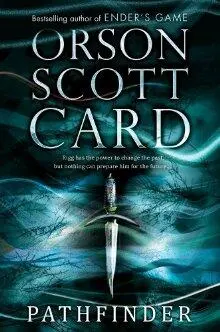
- Название:Pathfinder
- Автор:
- Издательство:Simon Pulse
- Жанр:
- Год:2010
- ISBN:978-1-4169-9176-2
- Рейтинг книги:5 / 5. Голосов: 1
-
Избранное:Добавить в избранное
- Отзывы:
-
Ваша оценка:
Pathfinder: краткое содержание, описание и аннотация
Предлагаем к чтению аннотацию, описание, краткое содержание или предисловие (зависит от того, что написал сам автор книги «Pathfinder»). Если вы не нашли необходимую информацию о книге — напишите в комментариях, мы постараемся отыскать её.
—secrets about Rigg's own past, his identity, and his destiny. And when Rigg discovers that he has the power not only to see the past, but also to change it, his future suddenly becomes anything but certain.
Rigg’s birthright sets him on a path that leaves him caught between two factions, one that wants him crowned and one that wants him dead. He will be forced to question everything he thinks he knows, choose who to trust, and push the limits of his talent…or forfeit control of his destiny.
Pathfinder — читать онлайн бесплатно полную книгу (весь текст) целиком
Ниже представлен текст книги, разбитый по страницам. Система сохранения места последней прочитанной страницы, позволяет с удобством читать онлайн бесплатно книгу «Pathfinder», без необходимости каждый раз заново искать на чём Вы остановились. Поставьте закладку, и сможете в любой момент перейти на страницу, на которой закончили чтение.
Интервал:
Закладка:
“Do you find this coincidence significant?” asked the expendable.
“Each computer was an observer and a meddler in spacetime at the time the fold was created,” said Ram. “You and I weren’t observers, because we could not sense or even understand the convolutions of the fields being generated. So for each observer, there had to be a distinct jump. And for each jump, there had to be an expenditure of mass equal to the total mass of the ship and its contents.”
“So if there had been only nine or ten computers,” said the expendable, “we would have come only halfway back to the present?”
“No,” said Ram. “I think if there had been only one computer, we would have crossed the fold only one-nineteenth as far into the past of the target star system before being shoved back, in reverse.”
“You seem to be very happy about this hypothesis,” said the expendable, “but I don’t see why. It still explains nothing.”
“Don’t you see?” said Ram. “Crossing the fold pushed us into the past a certain amount, based on the mass of the ship and its velocity or whatever. But the only way to pay for that passage across the fold was to send an equal mass backward. And because there were nineteen observers creating the fields that created the fold, it happened nineteen times.”
“But it happened only once,” said the expendable.
“No,” said Ram. “It happened nineteen times. For each jump, a copy of the ship was thrust backward in time. Eighteen other versions of ourselves occupy the identical space as the original ship, only moving the opposite direction through time as we journey toward Earth, all of us invisible to each other.”
“So our reliance on the computers caused the failure of the mission?” asked the expendable.
“The mission didn’t fail,” said Ram. “It succeeded nineteen times. We’re just the exhaust trail.”
Loaf was full of plans to sneak back into O and live there in hiding long enough for Umbo to deliver his messages. Only when Umbo finally convinced him that he had no idea how to do it did Loaf finally realize that learning how to go back in time might better be done somewhere else.
“I might not learn how to go back in time for weeks,” said Umbo as they walked through the woods, back toward O. “Or months.” If I ever do. “It was only Rigg who could go back in time. I helped, by slowing him down. Or speeding him up.”
“Which?”
“I always thought I was slowing other people down, but Rigg said I was really speeding them up so that everything around them seemed slower.”
Loaf grunted at that and moved a branch out of the way, holding it so it didn’t swing back and hit Umbo in the face.
“Thanks,” said Umbo. “You see, Rigg could always see the paths of people moving around in the past. Long before I ever helped him. He knew what he was looking for. I don’t.”
Another grunt.
“We need a safe place to go where I can practice trying to do to myself whatever it is I do to other people. And even then, who knows whether I’ll be able to see anything?”
“Look,” said Loaf, “we know you did it. We know it happens. We just have to be patient. And you have to work hard at it so we don’t waste too much time.”
“It’s not a waste of time,” said Umbo. “It’s however long the job takes.”
“Here’s how I see things,” said Loaf. “We must have gone through all this before, only the first time, Rigg got arrested without your moving the knife and without my hiding the jewels and money. Then you learned how to go back in time, came back to O, delivered the warnings, and now everything is happening differently. So why do you need to deliver the messages this time at all?”
“Because none of that has happened yet, so now it won’t,” said Umbo. “I have to learn how to travel in time so I can go back this time and deliver the same message again.”
“But you didn’t get the message twice, did you? So why deliver it twice?”
“I don’t know,” said Umbo. “I don’t think it is twice. I think there’s only one message, and I still have to deliver it.”
“But you only know you have to deliver it because you already did. And that’s the point. You already did. But I’m not going to argue with you. Even if you don’t have to deliver the same message again, it’ll be useful for you to learn how to do it. And then if it makes you feel better, go ahead and deliver the messages—if you remember what you actually said.”
“I have to do it because I know I already did, only when I did it, it was the future, so I have to get to the future in order to come back and do what I already did . . . This is so crazy that it has to be impossible.”
“Except it happened, so it is possible. We won’t do your figuring-it-out time in O, because we might get caught. But I’m still going back to get the jewels and the money. The coins will be convenient for us , right now—we can buy passage upriver to Leaky’s Landing and stay there in safety for a while. But the jewels and the knife—it’s not like we can cash those in. I think you came back to warn Rigg and yourself because first time we went through this experience, those items got taken by the soldiers, and that made everything worse for Rigg. That first stone—did it just happen to be the only one that was legendary and fabulously valuable? Or are there others that would make things even worse if Rigg was caught with them? And that knife—who knows what that would cause. It’s very old, but it looks very new, right? And Rigg never did know anything about the man he lifted it from.”
“So we should take the money and bury the knife and the jewels somewhere nobody can ever find them,” said Umbo.
“No,” said Loaf. “Because we don’t know but what we’ll need them later to buy Rigg’s freedom. Or some other thing. They’re Rigg’s inheritance from his father, so what we have to do is keep them out of the hands of the Revolutionary Council or anybody else who means us ill. But we still need to get it all to Aressa Sessamo so Rigg will have the use of them if he ever needs them.”
“Because having them has worked out so splendidly up to now,” said Umbo.
Loaf gave him a little shove. “Look what you’re wearing. Look what we’ve experienced, the people we’ve talked to, the things we’ve learned. A few weeks of being rich has taught me a lot.”
“Like what? That it gets you arrested?”
“It was Rigg’s name that got him arrested, not his money.”
“So what has being rich—or hanging around with a rich kid—taught you ?”
Loaf grinned. “That I like it a lot better than being poor.”
“I was fine with poor. I didn’t even know I was all that poor. I didn’t even know the stuff we were buying even existed, so I didn’t miss it. Life was good.”
“Spoken like a true privick,” said Loaf.
“So what’s the plan? We go into O, get the jewels and money—”
“You are so very, very wrong. I go into O, I get the money.”
“You’re not leaving me!”
“Yes I am,” said Loaf. “And we’re going to have a signal so that when I come back, I can call you. If I whistle like this . . .”—he whistled—“then I’m all alone and it’s safe. But if I whistle like this . . .”—a different sound—“then I have somebody dangerous with me and you should stay away.”
“There’s not a bird alive that makes sounds like those.”
“Then it’s a good thing I’m not calling any birds, isn’t it?” said Loaf. “Those are military signals from my old regiment.”
Читать дальшеИнтервал:
Закладка:
Похожие книги на «Pathfinder»
Представляем Вашему вниманию похожие книги на «Pathfinder» списком для выбора. Мы отобрали схожую по названию и смыслу литературу в надежде предоставить читателям больше вариантов отыскать новые, интересные, ещё непрочитанные произведения.





Обсуждение, отзывы о книге «Pathfinder» и просто собственные мнения читателей. Оставьте ваши комментарии, напишите, что Вы думаете о произведении, его смысле или главных героях. Укажите что конкретно понравилось, а что нет, и почему Вы так считаете.