Orson Card - Pathfinder
Здесь есть возможность читать онлайн «Orson Card - Pathfinder» весь текст электронной книги совершенно бесплатно (целиком полную версию без сокращений). В некоторых случаях можно слушать аудио, скачать через торрент в формате fb2 и присутствует краткое содержание. Год выпуска: 2010, ISBN: 2010, Издательство: Simon Pulse, Жанр: Фантастика и фэнтези, на английском языке. Описание произведения, (предисловие) а так же отзывы посетителей доступны на портале библиотеки ЛибКат.
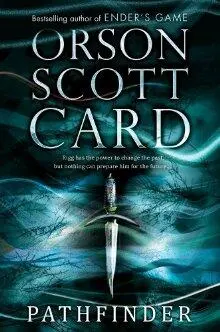
- Название:Pathfinder
- Автор:
- Издательство:Simon Pulse
- Жанр:
- Год:2010
- ISBN:978-1-4169-9176-2
- Рейтинг книги:5 / 5. Голосов: 1
-
Избранное:Добавить в избранное
- Отзывы:
-
Ваша оценка:
Pathfinder: краткое содержание, описание и аннотация
Предлагаем к чтению аннотацию, описание, краткое содержание или предисловие (зависит от того, что написал сам автор книги «Pathfinder»). Если вы не нашли необходимую информацию о книге — напишите в комментариях, мы постараемся отыскать её.
—secrets about Rigg's own past, his identity, and his destiny. And when Rigg discovers that he has the power not only to see the past, but also to change it, his future suddenly becomes anything but certain.
Rigg’s birthright sets him on a path that leaves him caught between two factions, one that wants him crowned and one that wants him dead. He will be forced to question everything he thinks he knows, choose who to trust, and push the limits of his talent…or forfeit control of his destiny.
Pathfinder — читать онлайн бесплатно полную книгу (весь текст) целиком
Ниже представлен текст книги, разбитый по страницам. Система сохранения места последней прочитанной страницы, позволяет с удобством читать онлайн бесплатно книгу «Pathfinder», без необходимости каждый раз заново искать на чём Вы остановились. Поставьте закладку, и сможете в любой момент перейти на страницу, на которой закончили чтение.
Интервал:
Закладка:
“You speak as if you were not he,” said Citizen.
“As far as I know, I’m not,” said Rigg. “But I’m also not a fraud. You keep omitting the possibility that everything I’ve said is true. That in my ignorance I’m innocent of any offense.”
“Be that as it may,” said Citizen, “I got this assignment because certain people believed I could be trusted to find out the truth about you.”
“So if I turn out to be the real Rigg Sessamekesh, you can kill me?”
General Citizen smiled at him. “I see I’m not the only one to lay traps.”
For it was indeed a trap that Rigg had laid for him. If the situation as Citizen outlined it was correct, a loyal servant of the People’s Revolutionary Council would not have hesitated to kill Rigg at the first opportunity, since no outcome that left him alive would be good for the Council. Of course he’d disguise it as an accident, but it would happen, because fraud or heir, he would have to die.
“General Citizen,” said Rigg, “it seems to me that you don’t care whether I’m really the Rigg Sessamekesh that Hagia Sessamin gave birth to thirteen years ago.”
“But I care very much,” said Citizen.
“What you care about is whether I can be made believable to the people of Aressa Sessamo—believable enough that the Council can be overthrown and replaced by a regent—you, perhaps?—who will rule in my name.”
“You have made only one mistake,” said Citizen.
“No I haven’t,” said Rigg. “You’re about to tell me that you were really trying to draw me out so you could see if I posed a danger, but in fact you’re perfectly loyal to the Council.”
Citizen said nothing, showed nothing.
“You may or may not be loyal, and you may or may not be ambitious,” said Rigg. “Whatever judgment you come up with, I can’t control. But there is absolutely nothing in what I’ve said or done to suggest that I would be willing to take part in a plan to overthrow the Council. And if I did not take part willingly, no conspiracy could use me.”
“What if the survival of your friends were at stake? Wouldn’t you do as you were told?” asked Citizen.
Would Citizen really count on Rigg’s loyalty to his friends to make him a reliable tool? Father had once quoted an ancient philosopher, who said, “The good man counts on others to share his virtues, while the evil man counts on the virtues of better men. They are both mistaken.” Was Citizen foolish enough to make either mistake?
There was suddenly a great deal of shouting outside the cabin, and in a moment someone shoved open the door. It was a soldier.
“They’ve jumped overboard, sir! And threw Shouter overboard!”
“Guard this prisoner,” said Citizen as he ran from the room.
The soldier closed the door and stood in front of it. “Don’t even try to talk to me,” he said to Rigg.
“Not even to ask who in the world has the horrible name of ‘Shouter’?”
The soldier stood there for a long time, and Rigg had concluded he wasn’t going to answer. And then he did.
“It’s not his real name, sir. It’s what we all call him behind his back. I hope the general didn’t notice.”
“I think you have little chance of that,” said Rigg. “He notices everything.”
The soldier nodded and sighed. “Hope it’s short rations and not the lash for me.” Then he blushed, probably because he shouldn’t have said any such thing to the prisoner.
“Would it help if I told him you were immediately remorseful?”
“No, because that would mean I had talked to you.”
“Which you certainly have not done,” said Rigg, “despite my efforts to induce you to speak.”
Long silence from the soldier. Lots of noise outside. A slackening of the speed of the boat, and then a reversal of direction. Then a return to forward motion. There was a double rap on the door. The soldier opened it a little, stepped through it—never turning his back on Rigg—and in a moment stepped back inside.
“Your friends got away safe, sir,” said the soldier softly, mouthing the words rather than speaking them, which he did so naturally that Rigg imagined this must be the way soldiers communicated when maintaining silence on duty.
Rigg did not ask the soldier why he said “sir.” He knew perfectly well that his supposed identity had spread among the soldiers, if not through the whole crew and half of O before they left. The soldier called him “sir” because he still had respect for royalty, and Rigg was purportedly the heir to the throne.
So the fear of there being support for a revolution against the Revolutionary Council was not ungrounded.
Was it possible that Father had taken him, as an infant, from the royal house? Then the only question was whether he did so in obedience to Rigg’s parents’ wishes, or against them. Had his real mother and father given him to the Wandering Man in hopes of saving his life? Or was he kidnapped?
Or—an intriguing possibility—had Father, knowing the real Rigg had been murdered and the body hidden or destroyed, taken a perfectly ordinary baby and raised him so as to prepare him to pretend to be the Sessamekesh? If so, Father would certainly have gone to great lengths to make sure to use a baby who could be expected to grow up to resemble the Sessamoto family enough that he would be believable as their long-lost son and brother.
What Rigg couldn’t figure out was why Father would arrange things so that this plot would start even after he died. Why wouldn’t he want to be there to help guide Rigg through this perilous path?
Or had he already given him all the guidance he needed?
Rigg sat there trying to imagine what else Father had taught him that might be applicable in this situation. Nothing came to mind. Hard as it was to believe, it seemed likely that Father had not thought of everything.
But Father knew that no one could think of everything. So he must have believed he gave Rigg the tools he needed to deal with any situation, including this one. The problem was that Rigg had no idea what to do, so whatever training Father might have thought would be applicable would not be applied as long as Rigg remained as stupid as he was right now.
The door opened. It was not General Citizen who came in, but rather a very wet officer—apparently the one called Shouter. He was shoved into the cabin by other soldiers and immediately manacled to Rigg, wrist to wrist and ankle to ankle.
Only then did General Citizen come to the door and shout at the dripping, shivering man, “Maybe you can keep this one from diving overboard, you blithering fool! Maybe you won’t get thrown over yourself!”
Rigg immediately assumed that the shouting was so that the other soldiers on the boat would get the message; to Rigg, Citizen did not look genuinely angry at Shouter. The sincere glance of rage was directed at Rigg.
When the general was gone and he was alone with Shouter, it took a great deal of effort for Rigg to keep himself from laughing. Good old Loaf had not only gotten himself and Umbo off the boat, he had tossed the watchdog into the water as well. And General Citizen, whatever his real purpose might be, was not happy.
CHAPTER 11
Backward
This time it took eleven days for the computers to come up with their answer.
“Converting the energy requirement into mass,” said the expendable, “all the computers agree that without violating previously observed laws of physics, the most likely cost of returning from the fold to our previous position in spacetime, but with the direction reversed, would be about nineteen times the mass of this ship and everything on it.”
“Nineteen computers,” said Ram, “and nineteen times the mass.”
Читать дальшеИнтервал:
Закладка:
Похожие книги на «Pathfinder»
Представляем Вашему вниманию похожие книги на «Pathfinder» списком для выбора. Мы отобрали схожую по названию и смыслу литературу в надежде предоставить читателям больше вариантов отыскать новые, интересные, ещё непрочитанные произведения.





Обсуждение, отзывы о книге «Pathfinder» и просто собственные мнения читателей. Оставьте ваши комментарии, напишите, что Вы думаете о произведении, его смысле или главных героях. Укажите что конкретно понравилось, а что нет, и почему Вы так считаете.