Orson Card - Pathfinder
Здесь есть возможность читать онлайн «Orson Card - Pathfinder» весь текст электронной книги совершенно бесплатно (целиком полную версию без сокращений). В некоторых случаях можно слушать аудио, скачать через торрент в формате fb2 и присутствует краткое содержание. Год выпуска: 2010, ISBN: 2010, Издательство: Simon Pulse, Жанр: Фантастика и фэнтези, на английском языке. Описание произведения, (предисловие) а так же отзывы посетителей доступны на портале библиотеки ЛибКат.
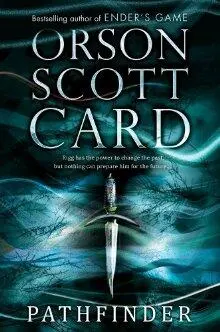
- Название:Pathfinder
- Автор:
- Издательство:Simon Pulse
- Жанр:
- Год:2010
- ISBN:978-1-4169-9176-2
- Рейтинг книги:5 / 5. Голосов: 1
-
Избранное:Добавить в избранное
- Отзывы:
-
Ваша оценка:
Pathfinder: краткое содержание, описание и аннотация
Предлагаем к чтению аннотацию, описание, краткое содержание или предисловие (зависит от того, что написал сам автор книги «Pathfinder»). Если вы не нашли необходимую информацию о книге — напишите в комментариях, мы постараемся отыскать её.
—secrets about Rigg's own past, his identity, and his destiny. And when Rigg discovers that he has the power not only to see the past, but also to change it, his future suddenly becomes anything but certain.
Rigg’s birthright sets him on a path that leaves him caught between two factions, one that wants him crowned and one that wants him dead. He will be forced to question everything he thinks he knows, choose who to trust, and push the limits of his talent…or forfeit control of his destiny.
Pathfinder — читать онлайн бесплатно полную книгу (весь текст) целиком
Ниже представлен текст книги, разбитый по страницам. Система сохранения места последней прочитанной страницы, позволяет с удобством читать онлайн бесплатно книгу «Pathfinder», без необходимости каждый раз заново искать на чём Вы остановились. Поставьте закладку, и сможете в любой момент перейти на страницу, на которой закончили чтение.
Интервал:
Закладка:
“This one’s good enough, and I need a bath,” said Loaf. Then he waved the servants away and they were alone.
“I asked for three recommendations,” said Rigg, “so that Mr. Cooper would know we didn’t intend to let him steer us to a place where he had an arrangement with the hotelier for a percentage of whatever we spend.”
“People do that?” asked Umbo.
Loaf chuckled. “He probably has an arrangement with all three of these. And spies watching what we do, as well. He struck me as a careful man.”
“But I had to keep up appearances,” said Rigg.
“Appearances,” snorted Loaf. “Where did you learn to talk like that ? You spoke high enough with me and Leaky that I thought you were putting on airs, but never like how you talked to Mr. Cooper!”
“I thought he’d wet his pants,” murmured Umbo.
“I used an educated accent with you and Leaky, because people downriver were having trouble understanding the way we talk in Fall Ford,” said Rigg. “But Mr. Cooper needed more than an accent. He needed to hear a lordly dialect and the attitude to go with it. Would talking rich have worked on you?” Rigg asked Loaf. “Or on Leaky?”
“Not a bit on me, and less on her.”
“So to you I talked like a boy of some education, but still one who grew up in a smallish town upriver. Father always said, If you talk like someone used to being obeyed, people will obey you. But if you talk like someone who fears being disobeyed, they will despise you.”
“What else did he say?” asked Umbo. “He never taught me that.”
There was no use trying to explain to Umbo how Father spent all day every day teaching and testing Rigg about things that Rigg thought he’d never use in his life. “I wish in all his saying he had given me a hint of where he found a jewel as valuable as that.”
“Nineteen of them,” said Loaf. “I think you carry in your crotch most of the wealth of this wallfold.” Then he laughed. “But that’s how all young men feel, isn’t it!”
Three baths and a dinner later, they were all napping on soft beds in their own rooms when a soft rap came at the door. Loaf got up and answered it. Rigg assumed it would be a summons from the banker, but it wasn’t—it was the banker himself. Loaf ushered him into the parlor of the suite and soon enough they had the tale.
“All three jewelers said the same, my lord,” said Mr. Cooper to Rigg. “This is every bit the gem I thought it was, but alas, it is more, too much more. This is a famous jewel, recognizable by particular marks which each of them identified with no prompting from me. I was told by one that it was the centerpiece of an ancient crown of a royal family from far northwest, in a kingdom whose name I had never heard of. It was won as a prize in battle by a great general, a hero. I thought the man was a mere legend, not real, but the jewelers believed in him. The story is that he struck the jewel from the crown—hence the mark—and bestowed it as a gift upon his great friend, the hero Wallwatcher, who walked the borders of the world, they say. However the skyblue gem of Wallwatcher might have come into your father’s hands, it is that very jewel, they’re sure of it. The value is so far beyond a purse that none of them will buy it, because they know of no one they could sell it to.”
Rigg felt a stab of fear when Mr. Cooper made his veiled reference to how Father might have got possession of the jewel. Might he declare that the jewel was stolen? No—if that were so, the People’s Revolutionary Council would confiscate it, and Mr. Cooper wouldn’t get a pigface. No, Mr. Cooper was merely explaining that he did not know how to sell it. Rigg calmed himself and began planning how to get around the problem.
Meanwhile, Loaf asked, “How far beyond a purse?”
“Without a buyer, who can say? A pounce at least. But who in this People’s Republic has wealth enough to buy it, or would admit it if they did, knowing it would just be taken from him?”
“Why is this a problem?” asked Rigg. “The jewel merely has to be sold privately, to someone who would value it without declaring to any other what he had.”
“But the price would be drastically discounted. Instead of fifty purses, no more than five, and in all likelihood less than that. Perhaps only two.”
“What about a consortium?” asked Rigg. “Would the three of them together undertake the purchase and the sale?”
“They might, if I suggested it. Perhaps a partnership among the three, with me as well.”
“Thereby converting your commission into a share of profit?”
“Unless your lordship disapproves,” said Mr. Cooper.
“I’m not a lord—or at least if my father was, he never told me so. Please call me Master Rigg and nothing more.”
“Of course, sir,” said Cooper.
“I see we’ll have to stay here longer than I intended. But I expect you to make this happen as I have described. I imagine that a jeweler in Aressa Sessamo will secretly sell the stone for a bargain price of three purses to a private party, and pass along two-and-a-half purses to this partnership you speak of, and you will credit me with two purses, telling me that you’re each making only a spill apiece.” Rigg said it with a smile, and shook his head at Mr. Cooper’s protests. “I have no quarrel with everyone’s taking a profit that makes their fortune, Mr. Cooper,” Rigg replied.
“I can hardly agree to this no matter how much I might make,” said Cooper. “The jewel is beyond price.”
“And yet I must have a price for it.”
“Even if it all works as you predict, Master Rigg, you will be getting only one twenty-fifth the true value of the stone.”
“My father certainly knew it would be hard to sell when he passed it on to me. If he had valued it more highly than the price the thing will fetch, he would have taken it with him.”
They all looked at him in shock and consternation.
“I was making the joke my father would have made. He could not take the jewel, so he left it to me. I cannot use the jewel for anything but money, and I need that money. So this precious ancient artifact will bring its money value, not the value of its fame. Meanwhile, I’ll have to wonder how the hero’s prize found its way into my hands, for my father cannot tell me now. Get busy, Mr. Cooper, and make this happen as quickly as you can. Here’s your incentive for speed: You will pay our lodging costs out of your personal profit from the sale, and not from mine.”
Cooper smiled. “I was already going to propose that.”
“I thought you didn’t like that three-quarter percent,” said Rigg, still smiling.
“You were generous to a fault, by normal practice, sir,” said Cooper. “It was yourself proposed the consortium, and I saw no reason that the jewelers should make a fortune, while I made do with my three-quarters of a point—which would have been a lovely sum, if I hadn’t known of others profiting much more.”
“I know of profit, too,” said Rigg, “and I begrudge you none of it. I only ask that these terms be kept as secret as the buyer’s name, so I don’t get a reputation for gullibility. And be sure of this: I will find out, in due time, what the private buyer paid, and if my portion is less than two-thirds of the amount, I’ll be back to see you, and if all I bring are lawyers, you’ll be fortunate.”
Rigg said it all so cheerfully that one might almost miss the fact that it was a threat of bloody retribution. Cooper responded just as happily, but he missed no part of the threat.
After he left, Rigg turned to Loaf at once and said, “Your fee, too, will be higher.”
“My fee will be what we agreed on,” said Loaf.
“If I had known what these jewels were worth, I would never have agreed to pay you so little.”
Читать дальшеИнтервал:
Закладка:
Похожие книги на «Pathfinder»
Представляем Вашему вниманию похожие книги на «Pathfinder» списком для выбора. Мы отобрали схожую по названию и смыслу литературу в надежде предоставить читателям больше вариантов отыскать новые, интересные, ещё непрочитанные произведения.





Обсуждение, отзывы о книге «Pathfinder» и просто собственные мнения читателей. Оставьте ваши комментарии, напишите, что Вы думаете о произведении, его смысле или главных героях. Укажите что конкретно понравилось, а что нет, и почему Вы так считаете.