Orson Card - Pathfinder
Здесь есть возможность читать онлайн «Orson Card - Pathfinder» весь текст электронной книги совершенно бесплатно (целиком полную версию без сокращений). В некоторых случаях можно слушать аудио, скачать через торрент в формате fb2 и присутствует краткое содержание. Год выпуска: 2010, ISBN: 2010, Издательство: Simon Pulse, Жанр: Фантастика и фэнтези, на английском языке. Описание произведения, (предисловие) а так же отзывы посетителей доступны на портале библиотеки ЛибКат.
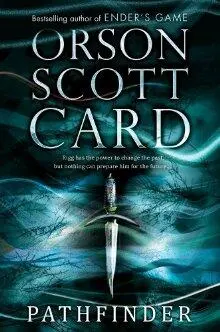
- Название:Pathfinder
- Автор:
- Издательство:Simon Pulse
- Жанр:
- Год:2010
- ISBN:978-1-4169-9176-2
- Рейтинг книги:5 / 5. Голосов: 1
-
Избранное:Добавить в избранное
- Отзывы:
-
Ваша оценка:
Pathfinder: краткое содержание, описание и аннотация
Предлагаем к чтению аннотацию, описание, краткое содержание или предисловие (зависит от того, что написал сам автор книги «Pathfinder»). Если вы не нашли необходимую информацию о книге — напишите в комментариях, мы постараемся отыскать её.
—secrets about Rigg's own past, his identity, and his destiny. And when Rigg discovers that he has the power not only to see the past, but also to change it, his future suddenly becomes anything but certain.
Rigg’s birthright sets him on a path that leaves him caught between two factions, one that wants him crowned and one that wants him dead. He will be forced to question everything he thinks he knows, choose who to trust, and push the limits of his talent…or forfeit control of his destiny.
Pathfinder — читать онлайн бесплатно полную книгу (весь текст) целиком
Ниже представлен текст книги, разбитый по страницам. Система сохранения места последней прочитанной страницы, позволяет с удобством читать онлайн бесплатно книгу «Pathfinder», без необходимости каждый раз заново искать на чём Вы остановились. Поставьте закладку, и сможете в любой момент перейти на страницу, на которой закончили чтение.
Интервал:
Закладка:
“And if I had known what the one jewel was worth, I would never have agreed to take you here at all,” said Loaf. “I know now that I was out of my depth before you ever showed Mr. Cooper the stone. This is all too high for me. The fee we agreed on was fair, and it’s still fair today.”
Rigg made no further protest, for he was reasonably sure that when they eventually discussed this with Leaky, she would agree instantly that a much higher fee would not impoverish Rigg—and was justified by the greater risk Loaf had incurred without knowing it. Why argue with Loaf now, when Leaky could do the arguing with him later?
In the end it took nearly two weeks for the consortium to be formed. Meanwhile Rigg, Umbo, and Loaf became more familiar with the taverns, restaurants, galleries, shops, parks, bookstalls, libraries, and other recreations of O than any of them had wished. But the wait seemed worth it when the sale was made for more than Rigg’s rough estimate, for his portion was three purses for himself.
On the last day, Rigg came from Mr. Cooper’s bank with a glimmer and twelve lights, one of which Rigg had asked him to convert on the spot into 120 fens—the rate of exchange in O between the River coinage and the People’s coin.
He also had two documents, signed by witnesses. One was a letter of credit for two purses, which Rigg would put on deposit in a bank or banks in Aressa Sessamo, whereupon the funds would be transferred—probably without ever actually passing through O or Cooper’s bank at all.
The other document was a certificate of deposit for one purse at three percent, secured against all of Mr. Cooper’s personal assets, which were partly enumerated. In effect, Rigg had bought the bank and leased it back to Cooper at an annual rate of return of three percent; if he demanded any portion of it back and Cooper could not (or declined to) pay, this document gave Rigg the right, without court action, to seize by force any and all of Mr. Cooper’s possessions.
Trust between friends was a good thing in business, but nice tight legal documents helped keep the friendship true despite long absence or far distance.
And in Rigg’s mind, as surely it was also in Loaf’s and Umbo’s, was the knowledge that he still kept tied to a ribbon around his waist another eighteen gems of whatever value they might be. They could not all be famous relics of the ancient past. Rigg might have chosen, by random chance, the only gemstone in the bag with a value greater than a spill or two. But even that would be enough to buy every stick of property in Fall Ford without even noticing the expenditure. It was wealth beyond their ability to calculate. If Rigg wanted to spend it all he wouldn’t know where to begin; he thought he could spend a fortune every day for his whole life without exhausting it.
Then again, his definition of “a fortune” had just undergone a change, and he was sure that if he really put his mind to it, he could probably waste it all. That’s what Father said: “There is no rich man so unfortunate as to lack for friends who are eager to spend his money for him.”
But so far, at least, Loaf and Umbo were not that kind of friend. The money frightened them. They still joked with him, yes, and they laughed together; but they also kept apart from him at odd times, and seemed surprised and even grateful when he paid ordinary attention to them.
Talking about this change in them would only make it worse, because they’d feel he was judging them now and finding them wanting; it would make them more awkward, more eager to please.
All Rigg could do was be himself and never speak to them in the way he had spoken to Mr. Cooper and the jewelers and the lawyers he had worked with to make the deal come through.
Truth be told, Rigg had come to enjoy his pose as a man of wealth and power, and to watch these men treat a thirteen-year-old boy with ridiculous deference. It occurred to him that if he really was of royal blood, as Nox had said, and if that still meant something under the People’s government, he would probably have grown up thinking he deserved the treatment he was getting.
But he knew—had Father not warned him?—that he must never value himself for the money he owned. “It can all be swept away,” said Father. “Money only retains the value that society places on it. Many a man has thought he was wealthy, only to discover that in the collapse of his nation or the inflation of the currency, his money was now tinscrap, and himself a beggar.”
Since that very thing had happened to thousands of noble families after the People’s Revolution, Rigg took the lesson to heart. Money is a thing separate from a man, Rigg knew. “I wasn’t born with it, I won’t have it when I die, it’s all temporary.”
Yet even as he told this to himself, he felt the warm glow of knowing that he would never have to worry about money again. That separated him from most people in the world. It was impossible to have wealth like this and remain unchanged, and he knew it. He could only try to make sure the changes were neither too extreme nor all to the worse.
CHAPTER 8
The Tower
Ram thought about it sitting, standing, walking, lying down. He thought about it with eyes closed and open, playing computer games and reading books and watching films and doing nothing at all.
Finally he thought of a question that might lead to a useful bit of information. “The light of stars behind us—blue or red shifted?”
“By ‘behind us,’ do you mean in the spatial position we occupied moments ago? Or in the direction of the stern of this vessel?”
“Stern of the vessel,” said Ram. “Earthward.”
“Red shift.”
“If we were moving toward Earth, it should be blue-shifted.”
“This is an anomaly,” said the expendable. “We are closer to Earth with the passage of each moment, and yet the shift is red. The computers are having a very hard time coping with the contradictory data.”
“Compare the degree of red shift with the red shift when we were in the same position on our way to the fold.”
The expendable didn’t even pause. It was a simple data lookup, and to a human mind it seemed to take no time at all.
“The red shift is identical to what was recorded on the outbound voyage.”
“Then we are simply repeating the outbound voyage,” said Ram. “The ship is moving forward, as propelled by the drive. But we, inside the ship, are moving backward in time.”
“Then why are we not observing ourselves as we were two days ago on the outbound voyage?” asked the expendable.
“Because that version of ourselves is not moving through time in the same direction as we are,” said Ram.
“You say this as if it made sense.”
“If I started crying and screaming, you’d stop taking me seriously.”
“I’m already not taking you seriously,” said the expendable. “My programming requires that I keep your most recent statements in the pending folder, because they cannot be reconciled with the data.”
“It’s really quite elegant,” said Ram. “The ship is the same ship. Everything about it that does not need to change remains exactly as it was on the outbound voyage. It occupies the same space and the same time. But the flow of electrical data and instructions through the computers and your robot brain and my human one, and our physical motions through space, are not the same, because our causality is moving in a different direction. We are moving through the same space as our earlier selves, but we are not on the same timestream, and therefore we are invisible to each other.”
“This is an impossible explanation,” said the expendable.
“Come up with a better one, then.”
Читать дальшеИнтервал:
Закладка:
Похожие книги на «Pathfinder»
Представляем Вашему вниманию похожие книги на «Pathfinder» списком для выбора. Мы отобрали схожую по названию и смыслу литературу в надежде предоставить читателям больше вариантов отыскать новые, интересные, ещё непрочитанные произведения.





Обсуждение, отзывы о книге «Pathfinder» и просто собственные мнения читателей. Оставьте ваши комментарии, напишите, что Вы думаете о произведении, его смысле или главных героях. Укажите что конкретно понравилось, а что нет, и почему Вы так считаете.