Orson Card - Pathfinder
Здесь есть возможность читать онлайн «Orson Card - Pathfinder» весь текст электронной книги совершенно бесплатно (целиком полную версию без сокращений). В некоторых случаях можно слушать аудио, скачать через торрент в формате fb2 и присутствует краткое содержание. Год выпуска: 2010, ISBN: 2010, Издательство: Simon Pulse, Жанр: Фантастика и фэнтези, на английском языке. Описание произведения, (предисловие) а так же отзывы посетителей доступны на портале библиотеки ЛибКат.
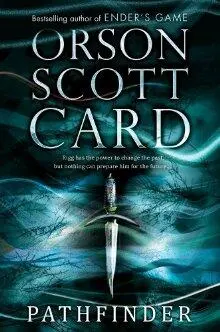
- Название:Pathfinder
- Автор:
- Издательство:Simon Pulse
- Жанр:
- Год:2010
- ISBN:978-1-4169-9176-2
- Рейтинг книги:5 / 5. Голосов: 1
-
Избранное:Добавить в избранное
- Отзывы:
-
Ваша оценка:
Pathfinder: краткое содержание, описание и аннотация
Предлагаем к чтению аннотацию, описание, краткое содержание или предисловие (зависит от того, что написал сам автор книги «Pathfinder»). Если вы не нашли необходимую информацию о книге — напишите в комментариях, мы постараемся отыскать её.
—secrets about Rigg's own past, his identity, and his destiny. And when Rigg discovers that he has the power not only to see the past, but also to change it, his future suddenly becomes anything but certain.
Rigg’s birthright sets him on a path that leaves him caught between two factions, one that wants him crowned and one that wants him dead. He will be forced to question everything he thinks he knows, choose who to trust, and push the limits of his talent…or forfeit control of his destiny.
Pathfinder — читать онлайн бесплатно полную книгу (весь текст) целиком
Ниже представлен текст книги, разбитый по страницам. Система сохранения места последней прочитанной страницы, позволяет с удобством читать онлайн бесплатно книгу «Pathfinder», без необходимости каждый раз заново искать на чём Вы остановились. Поставьте закладку, и сможете в любой момент перейти на страницу, на которой закончили чтение.
Интервал:
Закладка:
When the sound of sliding and shuffling stools was silent, Mr. Cooper turned around, and there was an eyeblink of a moment in which he took in the fact that Rigg remained standing at the end of the table, his bag resting open upon it.
Rigg met his gaze calmly, trying to keep the same steady emotionless regard he had practiced on the guard downstairs. And as he did, he noticed the path that Mr. Cooper had most recently followed. There had been a back-and-forth from table to bookshelves, a half a dozen little trips, and Rigg realized that when their arrival had first been announced, while they were still waiting outside the door, Mr. Cooper had rushed around to clear everything off the table. His stance by the window was nothing but a pose. He did indeed regard Loaf’s arrival as a matter of some importance, and he had gone to some trouble to make an impression of loftiness and lack of need, which suggested that he needed the business they were bringing him.
“Mr. Cooper,” said Rigg, though Loaf had been about to speak and now glowered at Rigg for preempting him. “I have come into an inheritance from my late father. I was to take it to Aressa Sessamo, where I have kinfolk that I have never met. He gave me a letter of introduction to bankers there, but I find that it is inconvenient to make the rest of the journey without converting a little of it into ready money. Therefore I wish you to oversee the sale of a particular item, return a small part of the value to me in coin, and provide me with a letter of credit that will be convertible in Aressa Sessamo when I arrive. I assume you have a relationship with at least one banking house in Aressa Sessamo?”
Loaf’s irritation had changed to something more like awe. Well, hadn’t Father made Rigg practice rhetoric? “Say the same thing, but now say it to someone you love, to whom you are in great debt.” “Say it now to someone who thinks he has power over you, but whom you wish to intimidate.” “Say it to someone of a higher class than you wish to seem to be of.” “Say it now to make sure someone knows he is of a lower class.” It all seemed like such a game to Rigg, but he had mastered all these tricks of rhetoric before he reached the age of ten, and had done it well enough that Father laughed with delight at some of the things he said. He had used these skills well enough with farmers and taverners and other travelers coming down the North Road, and had dealt with Loaf and Leaky well enough, but in those cases it served him to seem what in fact he was—a harmless boy in need of help.
Now, though, Loaf and Umbo were seeing him in another guise—as a boy quite aware of his own worth, relative to a man of whom he expected a service, and for which he would pay not a penny more than the service warranted.
“Yes, yes,” said Mr. Cooper, after a moment’s hesitation. “I have a good relationship with two Aressid bankers, at either of which my letter of credit will have a good reception.”
“At what discount?” asked Rigg, for Father had made sure he was aware that letters of credit might be accepted, but at a discount sometimes as high as ninety percent, until the funds could be transferred and verified.
“No discount, I assure you!” said Mr. Cooper, a little flustered. And the reason for his blush emerged when he was forced to add, “At one of them, anyway, the house of Rududory and Sons.”
“And the other one, the one that discounts your note?”
Cooper turned a little red. “Does it matter?”
“I intend to take the note first to the house that discounts you, and disdain their discount, and take my custom to Rududory. You may be sure they will regret the loss and not discount you in the future.”
“That is . . . generous of you.” But Cooper seemed still to have his doubts.
“If you serve me well, I shall serve you well,” said Rigg. “The best legacy my father left me were his principles of honest trade. He taught me that it is better to make a friend of a man through fair dealing than to make a momentary profit and lose his trust. Sergeant-major Loaf assures me that you do business in such a way as well, which is why I have stopped at O to deal with you, if you are interested in performing the service I require.”
Of course Loaf had told him no such thing, and it probably wasn’t true, though it might be. But Father had also taught him: Treat a man as if he had a fine reputation to protect, and he will usually endeavor to deserve it.
“The other house,” said Mr. Cooper, “is Longwater and Longwater.”
Rigg nodded gravely. “Now it is time for me to show you the item I wish you to sell for me. Please turn your back, sir.”
Loaf’s eyes widened and he looked like he was about to speak, but thought better of it. Rigg knew perfectly well that in his place, Loaf would have turned his own back to remove the bag of jewels from his trousers; for Rigg to demand that Mr. Cooper be the one to turn his back was nothing short of outrageous—unless, of course, Rigg were a lordly young man accustomed to other people showing him respect, and not the other way around.
Mr. Cooper once more hesitated, then turned his back to look out the window again, affecting the air of one who simply decided it was an apt occasion to study the birds flying to and from nests in the eaves of the building opposite.
Rigg reached down into his trousers, pulled out the bag, opened its mouth wide, and looked at the jewels, wondering which to offer. He settled on the light blue teardrop-shaped one that had hidden in the seam of his trousers back at Leaky’s Landing, for that was the only thing that had made any one of them different from the others since he’d had them. Holding that gem, he tightened the bag’s mouth, tucked it back down into his trousers, and strode around the table. “Here, sir,” he said, “let’s look at this by the light of the window.”
It was generous, for a man of the status Rigg was pretending to have, to walk around the table himself to show the jewel to Cooper. Thus, a moment after diminishing the other man, Rigg made him feel that he was respected in turn, and perhaps even liked, by this rich young stranger.
Rigg set the jewel on the table, well back from the edge. “I realize you are not a jeweler, sir, and that your valuation of this stone must depend on what consultants tell you. But I believe you are experienced enough with all forms of collateral to know what you are looking at.” Because I certainly am not, Rigg thought—but did not say.
Before Mr. Cooper could sit in his chair, Rigg deftly slid it back out of reach of the table. “Let’s not have the back of the chair blocking any of the light,” he said.
As a result, Cooper was forced to sit on a stool at the side in order to examine the stone in the light, while Rigg sat in the chair. Thus Cooper’s strategem of keeping his visitors in a lower, supplicative position was quite reversed. During Cooper’s examination of the stone, Rigg glanced at Loaf and Umbo and saw that Loaf was only barely suppressing a grin, for Mr. Cooper was shorter than Loaf and no taller than Umbo, and at his age looked even more absurd sitting on the stool.
The moment Cooper stood up again, Rigg also rose from the chair and slid it back into place. What could be taken as perfectly natural during the examination of the light-blue jewel would be insolence if Rigg remained in the chair when the need had passed.
Mr. Cooper cleared his throat and spoke. “If this is what it seems, and I have no doubt of it, you understand, then you do my little banking house great honor, sir.”
“It is the honor due to all good men of business,” said Rigg, “when a matter of great trust is in hand.”
“Do you wish me to advance you against the value of the stone, while I pursue its sale on your behalf?”
Читать дальшеИнтервал:
Закладка:
Похожие книги на «Pathfinder»
Представляем Вашему вниманию похожие книги на «Pathfinder» списком для выбора. Мы отобрали схожую по названию и смыслу литературу в надежде предоставить читателям больше вариантов отыскать новые, интересные, ещё непрочитанные произведения.





Обсуждение, отзывы о книге «Pathfinder» и просто собственные мнения читателей. Оставьте ваши комментарии, напишите, что Вы думаете о произведении, его смысле или главных героях. Укажите что конкретно понравилось, а что нет, и почему Вы так считаете.