Orson Card - Pathfinder
Здесь есть возможность читать онлайн «Orson Card - Pathfinder» весь текст электронной книги совершенно бесплатно (целиком полную версию без сокращений). В некоторых случаях можно слушать аудио, скачать через торрент в формате fb2 и присутствует краткое содержание. Год выпуска: 2010, ISBN: 2010, Издательство: Simon Pulse, Жанр: Фантастика и фэнтези, на английском языке. Описание произведения, (предисловие) а так же отзывы посетителей доступны на портале библиотеки ЛибКат.
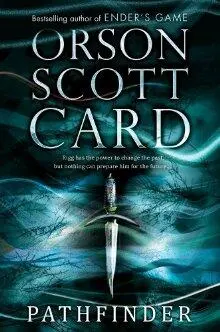
- Название:Pathfinder
- Автор:
- Издательство:Simon Pulse
- Жанр:
- Год:2010
- ISBN:978-1-4169-9176-2
- Рейтинг книги:5 / 5. Голосов: 1
-
Избранное:Добавить в избранное
- Отзывы:
-
Ваша оценка:
Pathfinder: краткое содержание, описание и аннотация
Предлагаем к чтению аннотацию, описание, краткое содержание или предисловие (зависит от того, что написал сам автор книги «Pathfinder»). Если вы не нашли необходимую информацию о книге — напишите в комментариях, мы постараемся отыскать её.
—secrets about Rigg's own past, his identity, and his destiny. And when Rigg discovers that he has the power not only to see the past, but also to change it, his future suddenly becomes anything but certain.
Rigg’s birthright sets him on a path that leaves him caught between two factions, one that wants him crowned and one that wants him dead. He will be forced to question everything he thinks he knows, choose who to trust, and push the limits of his talent…or forfeit control of his destiny.
Pathfinder — читать онлайн бесплатно полную книгу (весь текст) целиком
Ниже представлен текст книги, разбитый по страницам. Система сохранения места последней прочитанной страницы, позволяет с удобством читать онлайн бесплатно книгу «Pathfinder», без необходимости каждый раз заново искать на чём Вы остановились. Поставьте закладку, и сможете в любой момент перейти на страницу, на которой закончили чтение.
Интервал:
Закладка:
Loaf had already warned them many times to stay silent and say nothing, so Rigg merely looked at the guard with candid interest, showing no apprehension or any other thing if he could help it. Just wide-open eyes, regarding him. Whether the man could read the dread and the hope behind his eyes, Rigg could not guess. But at least Rigg wasn’t blurting things out, or showing the gems around, the way he had spilled his money on Loaf’s bar.
The man stared especially long at Rigg, trying perhaps to break the steadiness of his gaze. But Rigg had done this exercise with Father, so the more the man tried to stare him down, the calmer Rigg became, the steadier his gaze. Until the man looked away.
Then Loaf spoke to him. “I see that you can recognize quality, however weary the traveler,” said Loaf. “This boy and I”—he indicated Umbo—“have kept company with young master here, to ensure his safe arrival here at Mr. Cooper’s bank. But Mr. Cooper has had dealings with me before. I’m Loaf of Leaky’s Landing now, but once a sergeant major in the People’s Army, and I have accounts here, credit and debit both.”
“Then the boys stay outside,” said the guard.
“I’m not here on my own business, but on young master’s, and we go inside all three.”
“Then you go inside none. What do your accounts matter, if the business isn’t your own? And this boy”—he gestured with the head of the quarterstaff toward Rigg—“he’s no customer of Mr. Cooper’s.”
“And yet Mr. Cooper would be sorry to lose his custom,” said Loaf without a hint of temper. “Mr. Cooper has trusted me with loans before, and I have trusted him with my deposits. Let him say for himself if he trusts me now when I say this boy is worth a thousand times the trade that Mr. Cooper’s bank has had with me. Mr. Cooper knows I lie not, and pay my debts, and that is honor enough to win us entrance, I think you’ll find.”
“Mr. Cooper wants no visitors right now,” said the guard.
“And yet I say he will want us,” said Loaf, still as pleasant as could be. Rigg thought: It must be a skill a taverner has to have, if he’s to succeed—to stay calm and friendly in tone and look, regardless of the provocation. And it was quite possible the guard was showing so much resistance precisely because it was obvious that Loaf could pick the man up and break him against the stone walls if he was so inclined. The guard had to prove he was both brave and manly, by making Loaf stand begging at the door. Though in fact, now that Rigg thought about it, Loaf had not begged, but rather demanded, however cheerfully, nothing less than exactly what he wanted.
Which is what Father taught me to do, if I can only overmaster my fear.
Rigg forced himself to become calm, slowing his breath and relaxing his muscles. If Rigg was to be a worthy son of his father and claim his inheritance, he would have to stay clearheaded and confident, putting fear aside. He could not afford to wait until he was as old as Loaf to have that kind of sureness.
When the guard turned around and went inside—leaving the doorway unattended, Rigg noticed—it had not been more than a minute or two that he’d delayed them at the door. And his return was even swifter, and his manner completely changed, for when the door reopened, the grey guard bowed deeply and solemnly, and ushered Rigg inside first, taking him at Loaf’s valuation. Rigg, for his part, carried himself in a relaxed manner, as if being treated with deference were the most normal thing in the world to him.
The moment they were inside, a sharp-faced old woman led them up a wide flight of stairs while the guard returned to duty at the door.
“Why are these stairs so wide?” asked Umbo. “Do so many people have to go up and down them at the same time?”
“No,” said Loaf, patient-sounding as if talking to a favored son.
And that was right, Rigg thought—as right as Rigg remaining silent, as if he had no curiosity about the place.
“It’s important for a banker to impress those who are not yet his customers with how prosperous he is. A rich banker will not be tempted to steal from his customers, and his wealth shows that he knows how to use money wisely.”
Umbo opened his mouth to speak, but Rigg put up a finger that the old woman could not see, twitching it to warn Umbo to keep silence. For Rigg knew exactly what Umbo was going to say, since he had thought of it himself: A banker who looked rich might have gotten that way precisely by stealing from his customers. But now was not the time to bandy words that they would not want repeated to Mr. Cooper.
So they walked in silence up yet another flight, which ended in a spacious landing with a huge double door paned with glass at the far end of it. Other, more modest doors led off on either side.
The old woman brought them to a halt a few steps short of the great doors, and though there was no one to be seen, she said, not particularly loudly, “Loaf of Leaky’s Landing, former master sergeant of the People’s Army, and two boys, one of whom he vouches for as being of quality, sir.”
Without any hand touching them, the doors opened, but not by swinging in or out. Instead they slid aside to left and right, and in front of them was a large, bright room, with many tall windows in the walls and a table larger than the one in Nox’s dining room. Bookshelves filled the gaps between the windows, and they were jammed with books, not a space left over.
Mr. Cooper himself stood at the largest window, directly behind the table, silhouetted by the bright light coming through it. He faced outward, as if there were something important to examine on the wall of the building opposite.
“Come in and be seated,” said Mr. Cooper, his voice like a whisper of someone speaking directly into their ears.
As they walked through the doorway, Loaf stopped them long enough to show them a finger pressed to his lips, to remind them that only Loaf was to do any talking. At first, Rigg decided to comply, letting Loaf take care of everything. He’d handled things well so far.
Yet Rigg knew that it was only his fear and self-doubt that made him imagine he could let Loaf deal with everything. When it came to banking in large amounts, Loaf knew little and Rigg knew much. Father had never taught Rigg how to talk with surly rivermen in a dark tavern by the river, but he had taught him the principles of banking and finance. And Rigg also understood that if he was to be credible as the rightful possessor of whatever money these jewels were worth, he must show that he alone was making the decisions, that he could not easily be fooled.
The only seats were stools around the table. And the stools were low, almost to the point of being milking stools, so that when they sat, even Loaf looked a bit ridiculous, like a child sitting at the grownups’ table. Umbo was not tall for fourteen years of age, so he looked even sillier, lacking only a bib for the babyish effect to be complete.
Rigg, seeing the effect, did not sit down. He recognized at once a thing that Father had warned him about: Men jealous of their power and fearful of losing it will use tricks to dominate other men. “But if you refuse to let such a man deploy these tricks against you, he will be afraid of you. If that’s what you desire, then refuse to submit. But if you want to deceive him into complacency, submit happily, and keep your resistance in your heart.”
In this case, Rigg decided not to submit, because he knew he needed to be seen as bringing great wealth into the bank, not asking for a favor. It was the banker who must prove himself to Rigg, and not the other way around—that was how Rigg knew this conversation must be framed.
And he also realized that Father had spent those forest journeys preparing him for such a moment as this. My life was in the woods among the beasts, up to my elbows in blood, the skinning knife worn down to fit my callused hands—but my education was for rooms like this.
Читать дальшеИнтервал:
Закладка:
Похожие книги на «Pathfinder»
Представляем Вашему вниманию похожие книги на «Pathfinder» списком для выбора. Мы отобрали схожую по названию и смыслу литературу в надежде предоставить читателям больше вариантов отыскать новые, интересные, ещё непрочитанные произведения.





Обсуждение, отзывы о книге «Pathfinder» и просто собственные мнения читателей. Оставьте ваши комментарии, напишите, что Вы думаете о произведении, его смысле или главных героях. Укажите что конкретно понравилось, а что нет, и почему Вы так считаете.