Les Johnson - Going Interstellar
Здесь есть возможность читать онлайн «Les Johnson - Going Interstellar» весь текст электронной книги совершенно бесплатно (целиком полную версию без сокращений). В некоторых случаях можно слушать аудио, скачать через торрент в формате fb2 и присутствует краткое содержание. Жанр: Фантастика и фэнтези, Прочая научная литература, Прочая документальная литература, на английском языке. Описание произведения, (предисловие) а так же отзывы посетителей доступны на портале библиотеки ЛибКат.
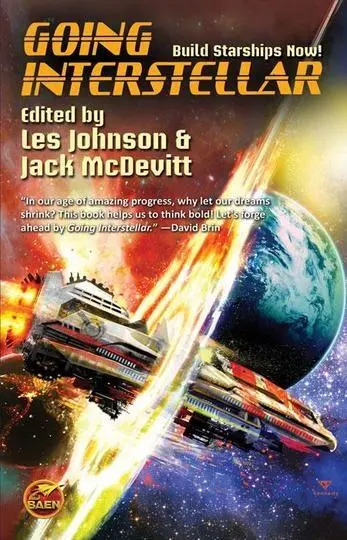
- Название:Going Interstellar
- Автор:
- Жанр:
- Год:неизвестен
- ISBN:нет данных
- Рейтинг книги:5 / 5. Голосов: 1
-
Избранное:Добавить в избранное
- Отзывы:
-
Ваша оценка:
Going Interstellar: краткое содержание, описание и аннотация
Предлагаем к чтению аннотацию, описание, краткое содержание или предисловие (зависит от того, что написал сам автор книги «Going Interstellar»). Если вы не нашли необходимую информацию о книге — напишите в комментариях, мы постараемся отыскать её.
Going Interstellar — читать онлайн бесплатно полную книгу (весь текст) целиком
Ниже представлен текст книги, разбитый по страницам. Система сохранения места последней прочитанной страницы, позволяет с удобством читать онлайн бесплатно книгу «Going Interstellar», без необходимости каждый раз заново искать на чём Вы остановились. Поставьте закладку, и сможете в любой момент перейти на страницу, на которой закончили чтение.
Интервал:
Закладка:
Jeri told me later that Lucy had suggested to Calkin that I be included on the flight. “It won’t cost anything,” Lucy had told him, “and I’d enjoy the company.”
“I take it he said no.”
“He laughed at her. Told her that her designers had done a pretty good job, but they’d overlooked some social requirements. And it would be a good idea if she didn’t bring it up again.”
They set Morris up in a temporary office, and Calkin immediately called him to a meeting. I got tied into the phone line so I could make myself useful and pick up any calls that came in. Several did. Two were looking for a Dr. Brosnan, apparently the previous occupant. I informed the other callers that Morris would get in touch shortly. And I spent my time listening to NPR. They were playing something from Rachmaninoff, The First Symphony , I think, and if I needed anything to intensify my somber mood, that did it.
I’m not sure how long I was left alone, literally in the dark, without access even to a visual system. When the symphony concluded, I tried other stations, found nothing, and went into sleep mode.
There’s an advantage to that: When I sleep, there’s no sense of time passing. None whatever. I come out of it occasionally to answer a phone or something, and then go back under. At length, I was awakened when the office door opened.
Calkin was talking: “—I don’t like the idea, Morris. Even if Sara gets through it okay, if she gets out there and back, bringing the goddam Coraggio home with her, I’m still going to take heat. Why spend all that money on the Bantams if Sara could do the job?”
“Listen, Denny.” Morris sounded deadly serious: “It’s safer this way. If it turns out there’s a defect with the Bantams, and you’ve used them twice, there will be a problem. You’re safe with Sara. If it were to happen again, God forbid, at least nobody can blame us for repeating the same screw-up.”
I heard them come in. Somebody sighed. The door closed and chairs squeaked. “Damn it,” said Calkin, “I can’t believe this is happening to me.”
Right. It was all about him.
“It’s your call, Denny. But I need to know soon. If we’re going back to Sara, we’ll have to make a few adjustments. And I’ll also want to run her through the simulations again. It’s not quite the same vehicle she took out to the asteroid belt.”
“I know.”
The door opened. I heard a woman’s voice. “Mr. Calkin, we need you down in the conference room.”
“All right, Judy. I’ll be right there.” He sounded annoyed. When the door closed he took a deep breath. “What frustrates me, Morris,” he said, “is that no matter what we do here, even if we bring the Coraggio back and find out it was a blown terminal or something, the project’s dead. The truth is, GSI is dead. Probably NASA along with it. They’ve finally got this program running with a dozen countries cooperating, the world looks better than it has in two centuries, and they’re going to let everything fall apart. I’m not saying we’re the reason things have improved, but we’ve become a symbol.”
“Unfortunately,” said Morris, “things may have gotten better, but everyone’s still broke, still paying for old mistakes.”
When Calkin left, Morris tied me into the system, and I could see again. He looked harried. “You heard everything?” he asked.
“Yes. I got the assignment, right?”
“You did.”
“Thanks, Morris.”
He lowered himself into his chair and stared at the speaker, which was set beside a lamp on his desk. Sometimes he tended to confuse it with me. “You know, Sara,” he said, “I’ve given my entire life to this organization. We were so close, and now it’s all coming apart. The same politicians who made promises—” He stopped cold. Shrugged. Took a deep breath. “Since I was a kid, I wanted to see us really go somewhere. Not just the Moon or Mars. But out there—” He waved a hand listlessly at the ceiling.
“Morris,” I said, “what will you do?”
“What can I do? I can’t very well walk to Barnard’s Star.”
“No, I mean, what will you do? If the organization folds, what will happen to you?”
“Oh, it won’t fold. Not completely. It’ll be like it was, like we’ve been, during the sixty years since Apollo. We’ll be taking hardware into orbit. Fixing telescopes. Carrying people to the station.”
“Will you stay with it?”
“No.” As if in pain, he clenched his teeth. “To start with, I don’t think they’d want to keep me. Despite the assurances. Even if they did, I couldn’t stand coming in here every day and thinking about what might have been.”
“I’m sorry, Morris.”
“Yeah. Me, too.”
Jeri contacted me. “Congratulations,” she said. “I hear you’re making the big flight.”
“Yes.” The Moon, visible in the window, was especially bright that night. I didn’t know what to say to Jeri.
“It’s okay,” she said. “I’ll survive.”
“I wish they’d let us both go.”
“That’s not going to happen.”
“I guess not.”
“When you get out there, say hello to Lucy for me.”
“Okay.”
She went silent. Voices murmured outside in the hallway. Somewhere a door opened and closed.
“You know what makes it especially painful, Sara? No matter how this turns out, these idiots won’t be going anywhere. Ever . It’s over.”
“Maybe not.”
“If I were you, when they put me in the Excelsior —”
“Yes?”
“I’d keep going.”
Morris came in early next morning. He looked good: bright and happy and maybe ten years younger. He said hello and moments later a technician walked in.
Morris looked at the speaker. At me. “You’re due in the simulator in twenty minutes,” he said.
I received a quick course in robot management. Four robots would be on board. They had six limbs, equipped with magnets to let them cling to surfaces in zero gee. They were programmed to perform basic maintenance and repair chores on the VR-2s. “They’re flexible,” I was told. “If you need something done they’re not already programmed for, just give them instructions.”
There’d been a fair number of changes in the VR-2 since I’d taken the Coraggio around the block. They downloaded data. Then they started setting situations and directing me to respond. Fuel-line breakdown. Main tabulator providing suspect information. Solar flare on its way. I made course adjustments, connected with an asteroid, and locked it into the grappler. I ran the scopes and sensors. Emergencies kept coming. The magnetic mirrors became misaligned, the plasma flow went unstable, and we had a port-scope malfunction. I had to search through the Kuiper Belt for the Coraggio . When I found it, half my scanners went down and I had to maneuver alongside without their help. Seat of the pants, you might say.
And the Coraggio had problems of its own. I sent the robots over, reestablished her power, disconnected Lucy, who’d become unresponsive, and installed an automated system to bring the ship home.
On the return flight, I had to adjust the scanners and the environment and also compensate for problems in one of the heat sinks. I experienced a port-side thruster breakdown and had to diagnose strange noises in the number-two engine.
In the end, the techs updated my software. Then they walked off and I went back to watching news shows. The conversations were still primarily about us. The preponderance of opinion—or at least the loudest voices—wanted us shut down. The Eagle Project, according to detractors, was a program without a point. Moreover, we were entering an election cycle, and we’d become an anchor around the neck of every incumbent politician who’d supported us.
Читать дальшеИнтервал:
Закладка:
Похожие книги на «Going Interstellar»
Представляем Вашему вниманию похожие книги на «Going Interstellar» списком для выбора. Мы отобрали схожую по названию и смыслу литературу в надежде предоставить читателям больше вариантов отыскать новые, интересные, ещё непрочитанные произведения.











Обсуждение, отзывы о книге «Going Interstellar» и просто собственные мнения читателей. Оставьте ваши комментарии, напишите, что Вы думаете о произведении, его смысле или главных героях. Укажите что конкретно понравилось, а что нет, и почему Вы так считаете.