Les Johnson - Going Interstellar
Здесь есть возможность читать онлайн «Les Johnson - Going Interstellar» весь текст электронной книги совершенно бесплатно (целиком полную версию без сокращений). В некоторых случаях можно слушать аудио, скачать через торрент в формате fb2 и присутствует краткое содержание. Жанр: Фантастика и фэнтези, Прочая научная литература, Прочая документальная литература, на английском языке. Описание произведения, (предисловие) а так же отзывы посетителей доступны на портале библиотеки ЛибКат.
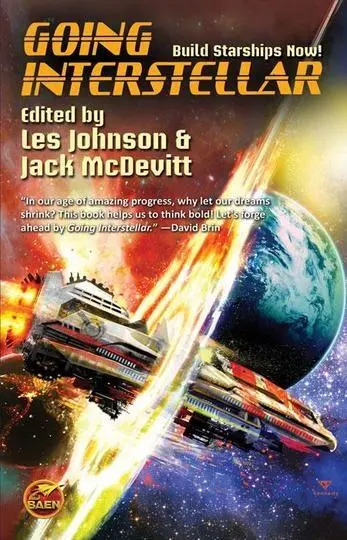
- Название:Going Interstellar
- Автор:
- Жанр:
- Год:неизвестен
- ISBN:нет данных
- Рейтинг книги:5 / 5. Голосов: 1
-
Избранное:Добавить в избранное
- Отзывы:
-
Ваша оценка:
Going Interstellar: краткое содержание, описание и аннотация
Предлагаем к чтению аннотацию, описание, краткое содержание или предисловие (зависит от того, что написал сам автор книги «Going Interstellar»). Если вы не нашли необходимую информацию о книге — напишите в комментариях, мы постараемся отыскать её.
Going Interstellar — читать онлайн бесплатно полную книгу (весь текст) целиком
Ниже представлен текст книги, разбитый по страницам. Система сохранения места последней прочитанной страницы, позволяет с удобством читать онлайн бесплатно книгу «Going Interstellar», без необходимости каждый раз заново искать на чём Вы остановились. Поставьте закладку, и сможете в любой момент перейти на страницу, на которой закончили чтение.
Интервал:
Закладка:
“Okay.”
“We can’t rush this.” He put one hand on my casing. “I’ll keep you informed.”
“Make sure Calkin knows I took the Coraggio out to the asteroid belt.”
“He knows. I’ve already reminded him.”
“Okay. Thanks.”
“It’s beautiful out there,” he said.
At first I thought we were still talking about the asteroid belt. Then I realized he was looking out the window. I couldn’t see him, of course. Anyhow, it was only an attempt to change the subject. One of the other passengers, a woman with a soft voice, had apparently overheard us talking and asked about me. He introduced me, and we began discussing NASA’s current state. The President, in his weekly press conference held while we were headed for the airport, had denied that more cuts were coming. The Coraggio story broke while he was still onstage. Somebody asked what had happened. Another reporter wanted to know whether it wasn’t time to quit on the space program and stop wasting money. The President tried to sound reassuring.
I didn’t really know what I was hoping for. Lucy reporting back that she was okay? Or a blown drive unit and me riding to the rescue? It seemed unlikely they’d give me a chance to do that, though I thought it would have been the right move. We took to making small talk, which I’m not good at. So I focused my attention on the radio. We were already the prime topic on several talk shows. On NPR’s Afternoon Bill , the host predicted that even if we found the Coraggio , wholesale changes would ensue at NASA. A reporter from the Washington Post thought we should be closed down: “Let’s face reality, Bill. Space flight’s expensive, and we get no benefit from it. It’s time to back off.”
The Jake Wallace Show had Marvin Clavis as a guest. Clavis had done the breakthrough work to put together the fusion drive. When asked for his opinion about what might have gone wrong, he admitted that, at this stage, everything was guesswork.
But he had a prediction: “If they haven’t heard from the Coraggio within the next few hours, they’ll never find her.”
I doubted that twenty percent of the population had even heard of the Coraggio , and maybe half that many who might have known her mission. This despite the fact that the program had been wildly successful …until now, of course.
But no human beings were aboard, and if the VR-2 ever did leave for Barnard’s Star, nobody would go along for that ride either. So why would anyone care? With the fusion drive, the VR-2s were allegedly capable of getting up to six percent of light speed on a full load of fuel. An incredible velocity, and an achievement that, a few years earlier, had seemed hopelessly beyond reach.
Eventually, according to plan, each of the three vehicles would receive a destination, Barnard’s Star, Wolf 359, and Lalande 21185. The closest projected launch date, to Wolf 359, was six months away. The other two would happen during the following year. Incredibly, some people still wondered why we weren’t headed for Centauri.
The flight to Barnard’s Star, nearest of the three, would require fifty years—one way. Even had Captain Future been aboard, nobody was going to get excited. Call me later.
I knew Morris pretty well. Despite what he said, he wasn’t prepared to accept the possibility that the program would ever shut down. Not now, especially after President Ferguson had managed to put together the Global Space Initiative. After Clavis and his team had provided the fusion reactor. When success seemed so close.
Ed Sakkinen, on Coffee With Ed , was outraged. “Why are we spending so much money to send a robot ship to visit a rock anyway? I still don’t get it.”
Rita D’Esposito, NBC’s White House correspondent, tried to make sense of the project: “Ed, a lot of people think that, unless we establish ourselves on Mars, or somewhere, eventually the human race will take a fatal hit. Maybe by an asteroid, or a nuclear war. Or climate change. Something will take us out.”
“When’s the last time that happened?” Ed asked.
She sighed. “It only has to happen once .”
Sakkinen laughed.
“Listen,” she said, “a rock crashed in Siberia near the beginning of the last century. It didn’t do much other than knock down a lot of trees. But if it had been maybe a half-mile wider, it would have been goodbye baby for all of us.”
A political consultant on the show sounded annoyed: “Some people argue that if we don’t go to Mars and set up I don’t know, malls out there somewhere, we’ll just wind up hanging out on the front porch.”
Armand Hopper, on Round Table , demanded to know how many more damned ways the government could find to waste money. Simultaneously, he was beating the drums for a military intervention in Uzbekistan.
Fortunately, it was a short flight to the Cape, and when the Political Roughnecks began arguing that the space age was over and it was time for us all to grow up, Morris told me that we’d begun our descent into the spaceport. He noted that this was the first time he’d been flown into the space center. “It’s nice to be a VIP,” he added.
We touched down on the skid strip, and Morris said something about welcome to Cape Canaveral. When the plane stopped moving he put me back in the briefcase. “Sorry, Sara,” he said. “I’ll get you connected as soon as I can.”
It wasn’t a problem. I was glad to have gotten that far.
We went directly into the Ops and Checkout Building, where Morris contacted Calkin. “We’re on the ground,” he said.
“Good. We have a lot of work to do.”
“Any change in the situation?”
“Nothing, Morris. Not a peep. The son of a bitch is gone.”
“Denny, did you make a decision yet on the Excelsior ?”
“What kind of decision?”
“Just in case you want to use a proven AI, I brought Sara along.”
Calkin thought that was funny. “Good man.”
“Denny, when do we expect to launch?”
“Looks like Thursday.” Four days.
“We can’t move it up?”
“We’re fitting the Excelsior with robots and some other equipment in case the Coraggio needs repairs. We need to get it right this time, Morris. And I know time’s a factor. We’re doing the best we can.”
Getting there would take two months. If the Coraggio were drifting, it could be pretty far away by then.
Lucy and Jeri were good. Nobody knew that better than I did, and I couldn’t argue the logic when the Telstar Coordinators were moved into second place. Admittedly I’d hoped from the beginning that there’d be a problem, that they would be found wanting in some critical way. And I know what that suggests about my character, but I told myself that I couldn’t be responsible for defects in my programming. In truth, I was perfectly capable of taking the VR-2 to Minetka, or to Barnard’s Star, or anywhere else in the neighborhood. But it was time to face reality. My window of opportunity had been open only a short time, less than a year, and now it had closed. I’d never again see a day when I wasn’t taking phone messages.
Unless something went seriously wrong.
I’d admitted my jealousy to them and asked if there was a possibility they might come up short. “For me,” I added.
You might think Lucy wasn’t capable of smiling, but I heard it in her tone. “Anything not prohibited by physical law,” she told me, “is possible.” There was a long moment during which I became conscious of the electronic hum of her protocols. “Sara, I understand. I’d feel the same way. I wish there were something I could do.”
Читать дальшеИнтервал:
Закладка:
Похожие книги на «Going Interstellar»
Представляем Вашему вниманию похожие книги на «Going Interstellar» списком для выбора. Мы отобрали схожую по названию и смыслу литературу в надежде предоставить читателям больше вариантов отыскать новые, интересные, ещё непрочитанные произведения.









Обсуждение, отзывы о книге «Going Interstellar» и просто собственные мнения читателей. Оставьте ваши комментарии, напишите, что Вы думаете о произведении, его смысле или главных героях. Укажите что конкретно понравилось, а что нет, и почему Вы так считаете.