Les Johnson - Going Interstellar
Здесь есть возможность читать онлайн «Les Johnson - Going Interstellar» весь текст электронной книги совершенно бесплатно (целиком полную версию без сокращений). В некоторых случаях можно слушать аудио, скачать через торрент в формате fb2 и присутствует краткое содержание. Жанр: Фантастика и фэнтези, Прочая научная литература, Прочая документальная литература, на английском языке. Описание произведения, (предисловие) а так же отзывы посетителей доступны на портале библиотеки ЛибКат.
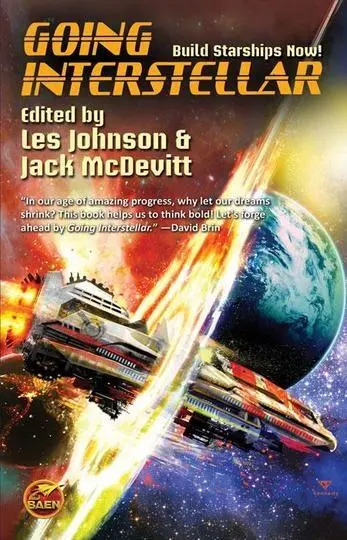
- Название:Going Interstellar
- Автор:
- Жанр:
- Год:неизвестен
- ISBN:нет данных
- Рейтинг книги:5 / 5. Голосов: 1
-
Избранное:Добавить в избранное
- Отзывы:
-
Ваша оценка:
Going Interstellar: краткое содержание, описание и аннотация
Предлагаем к чтению аннотацию, описание, краткое содержание или предисловие (зависит от того, что написал сам автор книги «Going Interstellar»). Если вы не нашли необходимую информацию о книге — напишите в комментариях, мы постараемся отыскать её.
Going Interstellar — читать онлайн бесплатно полную книгу (весь текст) целиком
Ниже представлен текст книги, разбитый по страницам. Система сохранения места последней прочитанной страницы, позволяет с удобством читать онлайн бесплатно книгу «Going Interstellar», без необходимости каждый раз заново искать на чём Вы остановились. Поставьте закладку, и сможете в любой момент перейти на страницу, на которой закончили чтение.
Интервал:
Закладка:
“That’s not true. We ran multiple simulations—”
“That’s not the same as onboard operations.”
“Morris, there’s no point doing all those tests again. We’d get the same results. There’s nothing wrong with the Bantams.”
“Okay, Denny. But we’ve got a battle-tested system already. We know it works. Why not use it?”
“Because we’ve spent too much money on the Bantams, damn it.”
“Denny, Sara’s done all the test flights with the Coraggio . If we use her, it removes one potential source of trouble from the equation.”
I liked the sound of that. I’d have smiled if I could, while I finished a press release for an upcoming welcome-back event for several cosmonauts and astronauts. I felt sorry for them. They’d been on active duty for an average of nineteen years, and none of them had ever gotten beyond the space station. Calkin responded just as I was sending the document to the public information office. “We’ll talk about it when you get here.”
He hung up, and it was a long minute before Morris put the phone down. He’d been an astronaut himself, more years ago than he wanted to remember. Now he sat staring out the window. And finally he took a deep breath: “Sara?”
“I heard, Morris.”
“What do you think?”
“The most vulnerable piece of equipment on the ship is the AI.”
“You wouldn’t really mind that, would you? If the Bantams are screwed up some way.”
“That’s not true, Morris. I’m just answering your question.”
“And you’d love to go to the rescue, right?”
“As opposed to what? Opening the mail in the Admin Building? Sure.”
“Yeah. It would be nice. But don’t get your hopes up, kid.”
The Bantam Level-3 was billed as the most advanced AI on the planet. I’m a Level-2, and I’m a Telstar product, purchased during a previous period of austerity.
The Bantams, Lucy and Jeri, were easy to get along with, and did not adopt a superior attitude. It would in fact have surprised me had they done so. They were simply too smart to behave like that. Sure, I was moderately jealous of the attention they received, and maybe of their abilities. How could I not be? Still, I kept it under control, and we’d become friends despite having only limited time together. It’s what civilized entities do. When they arrived I was conducting training simulations at the Kennedy Space Center. A few days later, suddenly redundant, I was shipped to Huntsville.
I hated thinking of Lucy adrift out there, in the Kuiper Belt almost five billion miles from Earth. She was probably trying to deal with a power failure. Which meant she might be alone in a dark ship so far away that a radio transmission would take seven and a half hours to reach her.
I’d been picked up during the Global Space Initiative with high hopes of leading the exploration of the solar system, and ultimately taking the new VR-2 vehicle, with its fusion engines, into the era of interstellar travel.
But I shouldn’t complain. I did get offworld. I’d taken the Coraggio to the asteroid belt on a test run. There, I’d secured an asteroid to the grappler and used it to fuel the return flight. And that had been about it for me. Although more than any astronaut had managed, it was nothing close to what I’d been led to expect. So yes, the disappearance of the Coraggio presented a golden opportunity, and I would have given anything to take over the Excelsior or the Audacia and ride to Lucy’s rescue. It wouldn’t happen, though. Not with Jeri available. So I decided to try for a compromise. “Morris, couldn’t you send us both out? It wouldn’t be a bad idea to have a back-up. Just in case.”
“You mean send both ships?”
“No, that wouldn’t work politically. But why not, just as insurance, maybe put us both in one or the other?”
He grinned weakly. “Sara, I would if I could. In fact, I’d like to go myself.”
“Morris, there’s an article by Harvey Bradshaw in the current Scientific American . He says there won’t be any humans on any of the interstellar flights. Ever. So why do we keep pretending?”
“Really? He said Ever ?”
“Well, something like that. You know the argument.”
He nodded. “I know.”
The shortest feasible trip to any star was twenty-five years one way, and that would be to Alpha Centauri, where there was apparently not a thing worth looking at. Barnard’s Star was the only nearby destination of serious interest: one of its worlds was right in the middle of the biozone, and had an oxygen atmosphere, which very possibly meant life. And that, of course, from a human perspective, was the only reason to go. But Barnard’s lay twice as far as Alpha Centauri. So no . Unless Captain Kirk’s Enterprise showed up, nobody was going anywhere …at least for a while.
Except us machines.
Moreover, no one could see an economic advantage to the space program. And the various governments supporting GSI were all struggling to stay fiscally afloat. None of this, of course, was news to Morris. He knew the politics. Knew the science. Knew the math. But he had real trouble buying into the death of a dream. He sat staring out the window, his eyes probably fixed on the admin building, or maybe just on Lunar Park. Finally he made a resigned sound deep in his throat. “Sara?”
“Yes, Morris?”
“How serious are you? About wanting to go after the Coraggio ?”
“Are you kidding? I’d do anything.”
He took a deep breath. “All right,” he said finally. “No promises, but I’ll try—”
Had there been a few people aboard the Coraggio , the media would have been all over us. People might be in trouble. Get out there and do the rescue. Breaking news all over the place. But, of course, you didn’t have to worry about an AI using up the available supply of oxygen, or freezing because of a climate-control malfunction, or whatever. In fact, you didn’t have to worry about an AI at all. And that realization didn’t help. Public interest focused instead on the inefficiency of the people who’d sent a multi-billion dollar vehicle out into the Kuiper Belt, and lost it.
I wasn’t connected to operational radio communications, so if a message arrived from Lucy, I wouldn’t know about it until someone told me. And so, during the first few hours after Calkin’s call, I was constantly asking whether we’d heard anything. I could see that everyone was coming to regard me as a nuisance, and finally Morris promised to let me know if the situation changed. “Immediately,” he added.
Late that afternoon, he came back from a conference. “Sara,” he said, “I can’t promise anything, but you and I are headed for the Cape.”
A technician came in and disconnected me. That eliminated my visual capability, though I could still hear what was going on around me. Morris wrapped me in plastic and put me in his briefcase. Then we took the elevator down to the first floor. “A car’s waiting for us,” he said.
“Are Mary and the kids coming?” I asked.
“No, Sara. We didn’t want to pull the guys out of school. I’ll bring everybody out in June.”
An hour later we boarded a small jet with two other passengers and headed for the Cape.
The other passengers knew about the Coraggio . They were being called in to run tests on the Excelsior .
Once in the air, Morris took me out of the briefcase. “Morris,” I said, trying to sound perfectly cool, “what are my chances?”
He shook his head. “I haven’t pushed for it yet, Sara. But you wouldn’t have any kind of chance at all if you’re not there when the decision gets made.”
Читать дальшеИнтервал:
Закладка:
Похожие книги на «Going Interstellar»
Представляем Вашему вниманию похожие книги на «Going Interstellar» списком для выбора. Мы отобрали схожую по названию и смыслу литературу в надежде предоставить читателям больше вариантов отыскать новые, интересные, ещё непрочитанные произведения.









Обсуждение, отзывы о книге «Going Interstellar» и просто собственные мнения читателей. Оставьте ваши комментарии, напишите, что Вы думаете о произведении, его смысле или главных героях. Укажите что конкретно понравилось, а что нет, и почему Вы так считаете.