Les Johnson - Going Interstellar
Здесь есть возможность читать онлайн «Les Johnson - Going Interstellar» весь текст электронной книги совершенно бесплатно (целиком полную версию без сокращений). В некоторых случаях можно слушать аудио, скачать через торрент в формате fb2 и присутствует краткое содержание. Жанр: Фантастика и фэнтези, Прочая научная литература, Прочая документальная литература, на английском языке. Описание произведения, (предисловие) а так же отзывы посетителей доступны на портале библиотеки ЛибКат.
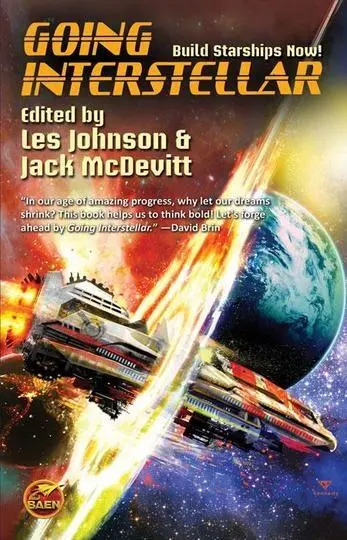
- Название:Going Interstellar
- Автор:
- Жанр:
- Год:неизвестен
- ISBN:нет данных
- Рейтинг книги:5 / 5. Голосов: 1
-
Избранное:Добавить в избранное
- Отзывы:
-
Ваша оценка:
Going Interstellar: краткое содержание, описание и аннотация
Предлагаем к чтению аннотацию, описание, краткое содержание или предисловие (зависит от того, что написал сам автор книги «Going Interstellar»). Если вы не нашли необходимую информацию о книге — напишите в комментариях, мы постараемся отыскать её.
Going Interstellar — читать онлайн бесплатно полную книгу (весь текст) целиком
Ниже представлен текст книги, разбитый по страницам. Система сохранения места последней прочитанной страницы, позволяет с удобством читать онлайн бесплатно книгу «Going Interstellar», без необходимости каждый раз заново искать на чём Вы остановились. Поставьте закладку, и сможете в любой момент перейти на страницу, на которой закончили чтение.
Интервал:
Закладка:
Robert Forward’s work is reviewed in The Starflight Handbook and other interstellar monographs. His final report to the US Air Force Rocket Propulsion Laboratory is entitled AFRPL TR-83-067, “Alternate Propulsion Energy Sources.” Many of Bob Forward’s ideas regarding antimatter (and a host of other subjects) are also published in a more accessible form: R. Forward, Indistinguishable from Magic , Baen, Riverdale, NY (1995).
Antimatter production by black holes is described by C. Bambi, A. D. Dogov and A. A. Petrov in “Black Holes as Antimatter Factories,” which was published in Sept. 2009 in the Journal of Cosmology and Astroparticle Physics , which is an on-line journal. This paper is also available from a physics archive as arXiv.org/astro-ph>arXiv:086.3440v2.
A NASA web publication, titled “Antimatter Factory on Sun Yields Clues to Solar Explosions,” describes the discovery of gamma rays in solar flares. http://www.nasa.gov/vision/universe/solarsystem/rhessi _antimatter.html.
To learn more about the surprising discovery of positrons associated with terrestrial lightning discharges, consult R. Cowen, “Signature of Antimatter Detected in Lightning,” www.wired.com/wiredscience/2009//11/antimatter-lightning/.
Information regarding the current capabilities of the Tevatron was obtained from Wikipedia and the Fermilab website. Operational details regarding the Large Hadron Collider are available on the CERN website.
Many books on SETI (the Search for Extraterrestrial Intelligence) deal with the Kardashev scheme for categorizing the capabilities of advanced technological civilizations. A very readable and authoritative one is W. Sullivan’s We Are Not Alone , revised edition, Dutton, NY (1993).
A number of researchers have considered the application of solar-sail technology to the construction of huge planetary sunshades or solar collectors. Analysis by Robert Kennedy, Ken Roy and David Fields is discussed and reviewed by L. Johnson, G. L. Matloff and C Bangs in Paradise Regained: The Regreening of Earth , Springer-Copernicus, NY (2009).
The cited antimatter-storage paper by S. D. Howe and G. A. Smith is entitled “Development of High-Capacity Antimatter Storage.” It was delivered at the Space-Technology and Applications International Forum-2000, University of New Mexico, Albuquerque, NM, July 30-February 3, 2000 and is available on line.
LUCY
Jack McDevitt
Jack McDevitt is a former English teacher (the first of three in this anthology), naval officer, Philadelphia taxi driver, customs officer and a motivational trainer. He is a Nebula Award-winning author and John W. Campbell Memorial Award winner. Jack also served as one of the editors of this anthology.
In “Lucy,” Jack merges two favorite themes of futurists—artificial intelligence and deep space travel—into a story that actually makes you care deeply about the fate of a sentient computer.
“We’ve lost the Coraggio .”Calkin’s voice was frantic. “The damned thing’s gone, Morris.”
When the call came in, I’d been assisting at a simulated program for a lunar reclamation group, answering phones for eleven executives, preparing press releases on the Claymont and Demetrius projects, opening doors and turning on lights for a local high-school tour group, maintaining a cool air flow on what had turned into a surprisingly warm March afternoon, and playing chess with Herman Mills over in Archives. It had been, in other words, a routine day. Until the Director got on the line.
Denny Calkin is a small, narrow man, in every sense of the word. And he has a big voice. He was a political appointment at NASA, and consequently was in over his head. He thought well of himself, of course, and believed he had the answers to everything. On this occasion, though, he verged on hysteria. “Morris, did you hear what I said?” He didn’t wait for an answer. “We’ve lost the Coraggio .”
“How’s that again, Denny? What do you mean, lost the Coraggio ?”
“What do you think I mean? Lucy isn’t talking to us anymore. We haven’t a clue where she is or what’s going on out there.”
Morris’s face went absolutely white. “That’s not possible. What are you telling me, Denny?”
“The Eagle Project just went over the cliff, damn it.”
“You have any idea what might be wrong?”
“No. She’s completely shut down, Morris.” He said it as if he were talking to a six-year-old.
“Okay.” Morris tried to assume a calm demeanor. “How long ago?”
“It’s been about five hours. She missed her report and we’ve been trying to raise her since.”
“All right.”
“We’re trying to keep it quiet. But we won’t be able to do that much longer.”
The Coraggio , with its fusion drive and array of breakthrough technology, had arrived in the Kuiper Belt two days earlier and at 3:17 a.m. Eastern Time had reported sighting its objective, the plutoid Minetka. It had been the conclusion of a 4.7 billion-mile flight.
Morris was always unfailingly optimistic. It was a quality he needed during these days of increasingly tight budgets. “It’s probably just a transmission problem, Denny.”
“I hope so! But I doubt it.”
“So what are we doing?”
“Right now, we’re stalling for time. And hoping Lucy comes back up.”
“And if she doesn’t?”
“That’s why I’m calling you. Look, we don’t want to be the people who lost a twenty-billion-dollar vehicle. If she doesn’t respond, we’re going to have to go out after her.”
“Is the Excelsior ready?”
“We’re working on it.”
“So what do you need from me, Denny?”
He hesitated. “Baker just resigned.”
“Oh. Already?”
“Well, he’s going to be resigning.”
Over in the museum, one of the high school students asked a question about the Apollo flights, what it felt like to be in a place where there was no gravity. The teacher directed it to me, and I answered as best I could, saying that it was a little like being in water, that you just sort of floated around, but that you got used to it very quickly. Meantime I made a rook move against Herman, pinning a knight. Then Morris said what he was thinking. “I’m sorry to hear it.” It was an accusation.
“Sometimes we have to make sacrifices, Morris. Maybe we’ll get a break and they’ll come back up.”
“But nobody expects it to happen.”
“No.” There was a sucking sound: Calkin chewing on his lower lip.
“It leaves us without an operations chief.”
“That’s why—”
“—You need me.”
“Yes, Morris, that’s why we need you. I want you to come to the Cape posthaste and take over.”
“Do you have any idea at all what the problem might be?”
“Nothing.”
“So you’re just going to send the Excelsior out and hope for the best.”
“What do you suggest?”
“In all probability, you’ve had a breakdown in the comm system. Or it’s the AI.”
“That’s my guess.”
“You’ve checked the comm system in the Excelsior ?”
“Not yet. They’re looking at it now.”
“Good. What about the AI?”
“We’re going to run some tests on Jeri, too. Don’t worry about it, Morris, okay? You just get down here and launch this thing.”
“Denny, Jeri and Lucy are both Bantam level-3 systems.”
“So what are you saying, Morris? Those are the best SIs we have. You know that.”
“I also know they’re untested.”
Читать дальшеИнтервал:
Закладка:
Похожие книги на «Going Interstellar»
Представляем Вашему вниманию похожие книги на «Going Interstellar» списком для выбора. Мы отобрали схожую по названию и смыслу литературу в надежде предоставить читателям больше вариантов отыскать новые, интересные, ещё непрочитанные произведения.











Обсуждение, отзывы о книге «Going Interstellar» и просто собственные мнения читателей. Оставьте ваши комментарии, напишите, что Вы думаете о произведении, его смысле или главных героях. Укажите что конкретно понравилось, а что нет, и почему Вы так считаете.