Marcus Sakey - Brilliance
Здесь есть возможность читать онлайн «Marcus Sakey - Brilliance» весь текст электронной книги совершенно бесплатно (целиком полную версию без сокращений). В некоторых случаях можно слушать аудио, скачать через торрент в формате fb2 и присутствует краткое содержание. Город: Las Vegas, Год выпуска: 2013, ISBN: 2013, Издательство: Thomas & Mercer, Жанр: Фантастика и фэнтези, Триллер, на английском языке. Описание произведения, (предисловие) а так же отзывы посетителей доступны на портале библиотеки ЛибКат.
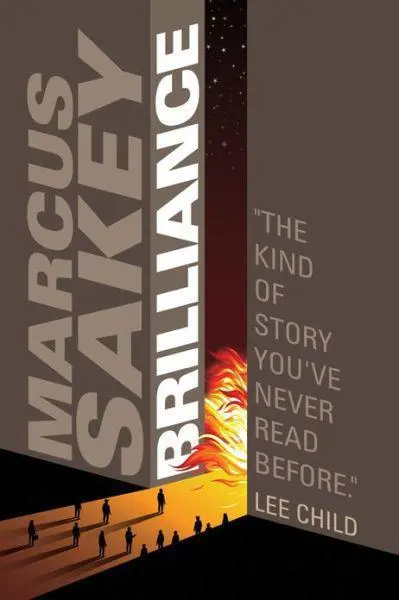
- Название:Brilliance
- Автор:
- Издательство:Thomas & Mercer
- Жанр:
- Год:2013
- Город:Las Vegas
- ISBN:9781611099690
- Рейтинг книги:5 / 5. Голосов: 1
-
Избранное:Добавить в избранное
- Отзывы:
-
Ваша оценка:
Brilliance: краткое содержание, описание и аннотация
Предлагаем к чтению аннотацию, описание, краткое содержание или предисловие (зависит от того, что написал сам автор книги «Brilliance»). Если вы не нашли необходимую информацию о книге — напишите в комментариях, мы постараемся отыскать её.
From Marcus Sakey, “a modern master of suspense” (Chicago Sun-Times) and “one of our best storytellers” (Michael Connelly), comes an adventure that’s at once breakneck thriller and shrewd social commentary; a gripping tale of a world fundamentally different and yet horrifyingly similar to our own, where being born gifted can be a terrible curse.
Brilliance — читать онлайн бесплатно полную книгу (весь текст) целиком
Ниже представлен текст книги, разбитый по страницам. Система сохранения места последней прочитанной страницы, позволяет с удобством читать онлайн бесплатно книгу «Brilliance», без необходимости каждый раз заново искать на чём Вы остановились. Поставьте закладку, и сможете в любой момент перейти на страницу, на которой закончили чтение.
Интервал:
Закладка:
He didn’t have anything to say to that, just drove in silence for a moment.
“It’s kind of ironic, actually,” she said. “Those clothes were knockoffs of Lucy Veronica’s new line. You know her stuff?”
“I know her name. She’s gifted, right?”
“Jesus, Cooper, pick up a magazine. Her styles have reinvented the fashion industry. The way she sees things—she’s spatial—changed everything. Her clothes are fetishized by socialite women. And those rich women are fetishized by middle-class suburban chicks, who want to be like the socialites, but can’t afford original Lucy Veronica. So what do they do to get the next best thing to couture designed by a brilliant? They buy a knockoff sewn by a brilliant. In a sweatshop.”
“Yeah, well, Sammy Davis Junior got to be in the Rat Pack, but that didn’t mean we had racial equality.”
Shannon half nodded, a noncommittal sort of gesture. He read her desire to launch into rhetoric, but instead she leaned back, slipped out of her shoes, and put her bare feet up on the glove box. “Anyway. It was nice of you. Paying for him, I mean. A nice thing to do.”
“Well, what the hell, right? Got to help each other out.” Realizing as he said it that he meant it, that it wasn’t just a line to play her. He was finding things murkier out here than he had expected; the relative clarity of his position at the DAR didn’t seem to translate. But you’re still with department. Don’t forget that. “Anyway, it wasn’t really my money.” He looked over at her, putting on a smile. “Turns out, I’m a pretty good thief.”
That got a laugh—he really liked her laugh, full-spirited and adult—which morphed into a yawn.
“Tired?”
“Dodging sniper fire, riding on top of a train, touring a sweatshop—it’ll wear a girl out.”
“Wuss.”
“I rode. On top of. A train.”
It was his turn to laugh. “All right. We’ll find a couple of beds.”
“I know a place we can go. Some friends of mine. We’d be safe.”
“How do you know?”
“Because they’re my friends.” She looked at him quizzically, the exterior lights glowing off her eyes. “Not everyone’s friends shoot at them.”
“Yeah, well, how do I know your friends won’t want to shoot at me ?”
She shook her head. “They’re not part of the movement. Just friends.”
He eased the car left and got on the Eisenhower heading east. A low bank of clouds cut the skyline in half, the lights on the tallest buildings bright as a fairytale against indigo skies. The Jaguar’s tires hummed on the pavement. There were moments driving when he felt a perfect calm, as though he were the car, skimming above the road, power and control and distance. But tonight it felt off. The distance part, maybe. The last six months seemed like they had been all about distance: from his children, from Natalie, from the world he had so carefully built and the sensible position he occupied in it. Though he was a man who enjoyed his own company, talking to Shannon, having a partner, it made him realize he’d been lonely, too. It sounded nice to be around people.
Besides. Getting closer to her is getting closer to John Smith.
“Okay. Where to?”
CHAPTER TWENTY-THREE
Chinatown had given the DAR headaches since the beginning.
Not just in Chicago, and frankly, not just the DAR. Whatever the city, law enforcement always had trouble with Chinatown. The places were closed systems, insular worlds that existed within cities, traded with them, drew tourists from them, but nonetheless were never really of them. Police working Chinatown carried a bubble around, a small radius of American rule that extended only as far as they could see, that moved with them and left the place unchanged in their wake.
Which made law enforcement difficult. There weren’t very many Chinese cops, and the other races stood out like they were backlit. It wasn’t just a matter of not speaking the language; they didn’t even know how to ask the questions, which questions to ask. And in a world that existed within itself, a tight-knit community with its own leaders and factions, its own sense of and system for justice, what good could an outsider cop do? And all of that was before the gifted came along and complicated the picture.
Shortly after midnight, and the river was a ribbon of black. Light industry and warehouses gave way to dense clusters of brick buildings decorated with green awnings and pagodas, up-down shops with a riot of colorful signs, the characters meaningless as a paint squiggle to him. A handful had English subtitles with awkward phrasing: EAT OR TAKE WITH, THE ALL-BEST CAMERAS, NOODLE FRESH SHOP. Overlapping neon lit the night with science fiction colors.
“Where’s your friend’s place?”
“An alley off Wentworth. Park wherever you can, we’ll walk.”
He found a pay lot on Archer. He was about to get out of the Jag when she said, “Leave the gun.”
“Huh?”
“These are my friends. I’m not bringing a gun into their house.”
Cooper looked at her for a moment, wishing he had the call girl Samantha’s gift, that he could read Shannon, see the real her, understand her intentions. Was this some sort of a trick? Get him unarmed and outnumbered? She stared back. Cooper shrugged, unclipped the holster from his belt, slipped the rig under the front seat.
“Thank you.”
Shannon walked half a step in front of him. The windows of shops held a riotous array of crap—waving cats and colorful fans and plastic ninja swords. Tourist junk, but the tourists had gone for the night. Everyone on the sidewalk was a local, and many seemed to know each other. They passed the window of a butcher where the plucked carcasses of birds dangled by their feet. “So how do you know these people?”
“Lee Chen and I have been friends for a long time. He runs a business here.”
“Yeah, but how? How did you meet?”
“Oh, you know, in our mutual abnorm hatred of the world we recognized each other as kindred souls in a long battle.”
“Right.”
She grinned. “We went to high school.”
His gift followed the chain back—school together, but her friend is established here, odds are she grew up in Chicago, a good starting point if he ever needed to track her down. “Funny to think of you in high school.”
“Why?”
“The whole mysterious thing you have going.”
“Mysterious thing?”
“Yeah. You keep appearing out of nowhere, then disappearing. Before I knew your name, I called you the Girl Who Walks Through Walls.”
She laughed. “Better than what they called me in high school.”
“What was that?”
“Freak, mostly. At least until I got breasts.” They passed a restaurant called Tasty Place, another called Seven Treasures, and turned down an alley. The glow of the street faded. Dumpsters overflowed, the smell of rotting trash sweet. At the back of an unmarked brick building she stepped into an alcove, knocked on a heavy door painted green.
There was the sound of a heavy lock, and the green door opened. Within was a small antechamber with a metal folding chair, a paperback book split facedown on it. The guard nodded at Shannon, gestured to a door at the opposite wall, and then leaned on a button. Cooper heard an electronic buzz of a lock.
“What is this place?”
“This is Lee’s. Social club.” She opened the opposite door.
The room beyond was bright with bad lighting, overhead fluorescents battling thick clouds of cigarette smoke. There were eight or nine tables, half of them occupied. No one looked up. The men around the tables—it was all men, mostly older—stared forward, lost in a game played with dominos. Loose stacks of bills were scattered between ashtrays and bottles of beer.
Читать дальшеИнтервал:
Закладка:
Похожие книги на «Brilliance»
Представляем Вашему вниманию похожие книги на «Brilliance» списком для выбора. Мы отобрали схожую по названию и смыслу литературу в надежде предоставить читателям больше вариантов отыскать новые, интересные, ещё непрочитанные произведения.









Обсуждение, отзывы о книге «Brilliance» и просто собственные мнения читателей. Оставьте ваши комментарии, напишите, что Вы думаете о произведении, его смысле или главных героях. Укажите что конкретно понравилось, а что нет, и почему Вы так считаете.