Greg Bear - Darwin's Children
Здесь есть возможность читать онлайн «Greg Bear - Darwin's Children» — ознакомительный отрывок электронной книги совершенно бесплатно, а после прочтения отрывка купить полную версию. В некоторых случаях можно слушать аудио, скачать через торрент в формате fb2 и присутствует краткое содержание. Город: New York, Год выпуска: 2010, ISBN: 2010, Издательство: Del Rey Books, Жанр: Фантастика и фэнтези, на английском языке. Описание произведения, (предисловие) а так же отзывы посетителей доступны на портале библиотеки ЛибКат.
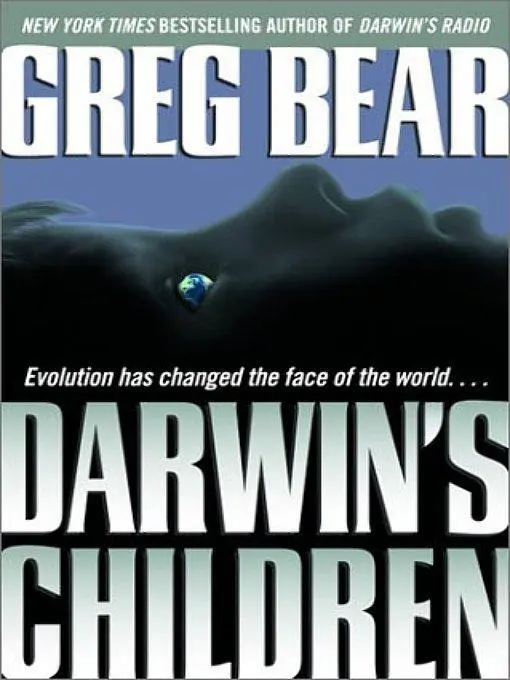
- Название:Darwin's Children
- Автор:
- Издательство:Del Rey Books
- Жанр:
- Год:2010
- Город:New York
- ISBN:9780345448361
- Рейтинг книги:3 / 5. Голосов: 1
-
Избранное:Добавить в избранное
- Отзывы:
-
Ваша оценка:
Darwin's Children: краткое содержание, описание и аннотация
Предлагаем к чтению аннотацию, описание, краткое содержание или предисловие (зависит от того, что написал сам автор книги «Darwin's Children»). Если вы не нашли необходимую информацию о книге — напишите в комментариях, мы постараемся отыскать её.
, painted a chilling portrait of humankind on the threshold of a radical leap in evolution—one that would alter our species forever. Now Bear continues his provocative tale of the human race confronted by an uncertain future, where “survival of the fittest” takes on astonishing and controversial new dimensions.
Eleven years have passed since SHEVA, an ancient retrovirus, was discovered in human DNA—a retrovirus that caused mutations in the human genome and heralded the arrival of a new wave of genetically enhanced humans. Now these changed children have reached adolescence… and face a world that is outraged about their very existence. For these special youths, possessed of remarkable, advanced traits that mark a major turning point in human development, are also ticking time bombs harboring hosts of viruses that could exterminate the “old” human race.
Fear and hatred of the virus children have made them a persecuted underclass, quarantined by the government in special “schools,” targeted by federally sanctioned bounty hunters, and demonized by hysterical segments of the population. But pockets of resistance have sprung up among those opposed to treating the children like dangerous diseases—and who fear the worst if the government’s draconian measures are carried to their extreme.
Scientists Kaye Lang and Mitch Rafelson are part of this small but determined minority. Once at the forefront of the discovery and study of the SHEVA outbreak, they now live as virtual exiles in the Virginia suburbs with their daughter, Stella—a bright, inquisitive virus child who is quickly maturing, straining to break free of the protective world her parents have built around her, and eager to seek out others of her kind.
But for all their precautions, Kaye, Mitch, and Stella have not slipped below the government’s radar. The agencies fanatically devoted to segregating and controlling the new-breed children monitor their every move—watching and waiting for the opportunity to strike the next blow in their escalating war to preserve “humankind” at any cost. DARWIN’S CHILDREN
Darwin's Children — читать онлайн ознакомительный отрывок
Ниже представлен текст книги, разбитый по страницам. Система сохранения места последней прочитанной страницы, позволяет с удобством читать онлайн бесплатно книгу «Darwin's Children», без необходимости каждый раз заново искать на чём Вы остановились. Поставьте закладку, и сможете в любой момент перейти на страницу, на которой закончили чтение.
Интервал:
Закладка:
Now that he knew the type of virus, he could focus on the origin of the disease and its etiology—how it had mutated, how it spread, and where it would be expected to spread next.
Dicken typed in a request for numerical results from each set of specimens, with identification of individuals and their circumstances. The computer prepared a table, but it was complicated and unintuitive.
Dicken took out a piece of paper and began organizing the results in his own favored plot. Using a small marker, he drew three large circles on the paper. Within the first circle he swooped a C, representing the children. Inside he drew a smaller circle, labeled IC for Infected Children. Outside the first, he drew a second large circle and labeled it BT for brave teachers and staff, those who had remained.
The third circle he labeled Tr, for traitors, those who had fled.
He picked up a red felt-tip pen and began categorizing the specimen ID numbers and marking them + or – for their viral status. He then recorded them within the appropriate circles. Two of the circles rapidly filled with numbers and status marks. For now, there were no numbers in the Tr circle—he was leaving that open in case information from outside became available.
He now had points of proximity or actual contact and, presumably, opportunities for viral transmission. The pattern he saw emerging was already clear, but he refused to jump to conclusions. He did not trust either intuition or instinct. He trusted hard facts, indisputable associations, and repeated correlations.
He drew the results a second way, in columns and rows. When he had completed his chart, he drew a new table, reversing the order, and filled the boxes with the categorized numbers.
Dicken cleaned up his work and tapped the plastic end of the pen on the columns, marching down, climbing back up, sweeping the marker to the right across the rows, color-coding the associations.
Any way he drew it out, the pattern was clear.
Within the special treatment center, children who had had no contact with teachers or other students for more than three days had not contracted the virus. Eight children had been in isolation cells and had been abandoned when the staff evacuated. Three had died, but all of their specimens tested negative.
Five hours ago, Middleton had phoned the lab to tell Dicken that one of the rescued children had fallen ill, and Kelson said she was likely to die. That child had almost certainly been exposed after her “rescue.”
Dicken had taken specimens from six children who had been locked in a shower room by a fleeing teacher, and not found until late yesterday. One had died from lack of special medication. None had had any contact with teachers or staff for the past forty-eight hours. Their specimens tested negative.
DeWitt and Middleton had identified fifty children whom they knew had had close contact with teachers and staff in the past sixty hours. Of these, forty had fallen ill, and twenty had died. All of their specimens tested positive. Somehow, ten had managed to avoid exposure.
He looked over the results for twenty-two teachers, staff, and security officers. All had had continuous contact with infected children for the past forty-eight hours. They were exhausted, stressed, worn down. Six of these—four nurses from the main pool and one teacher from the special treatment wing, and the counselor, Dewitt—tested positive for the virus, but in low titers compared to infected children. None showed symptoms of infection.
Neither he nor Mark Augustine tested positive.
Dicken held up his chart once more. The conclusions were compelling.
Only infected SHEVA children showed symptoms.
SHEVA children lacking recent adult contact tested negative for the virus and showed no symptoms.
Contagion did not spread from the children to adults with much efficiency, if at all; and if it was passed on, did not cause illness in adults.
Contagion probably did spread from child to child, but the chain always began with children who had had recent contact with adults.
He had not gathered specimens from every child, alive or dead, or from all the adults that had been at the school; it was possible that an asymptomatic child was the source; it was also possible that exposed adults would get ill, eventually.
But he doubted it. The children were almost certainly not the source. And adults did not get sick. The river flowed in only one direction, downstream from teachers and staff, adults, to the new children.
The computer chimed again. Dicken looked at the screen. The Ideator had identified a sequence from its standard human genomic library. He touched a box on the screen. It expanded outward, showing a gene map for an obscure and defective HERV. Coxsackie viruses—for that matter, the superfamily of Picornaviridae—had never been known to recombine with legacy retroviral genes. Yet he was looking at a protein traced to a gene from the suspect virus, and it was very similar—90 percent homologous—to a protein once coded for by an ancient human endogenous retrovirus found in two chromosomes.
The presence of the protein converted a relatively benign RNA virus into one that killed, in large numbers.
He typed in another search. The Ideator scanned the Genesys bank for a match within the 52-chromosome genome of the new children. According to the Genesys bank, that particular defective primordial HERV did not exist in any SHEVA child.
Both of its copies had been discarded during the supermitotic splitting and rearrangement of the old chromosomes.
Dicken stared at the screen for several minutes, thinking furiously. His vision blurred. He grabbed the crumpled wipe and dabbed again at his face. His left leg cramped. He pushed away from the bench and walked around the small lab room, bracing on tables, equipment.
What Augustine and the Emergency Action people feared most had happened. Ancient viruses had somehow self-corrected and contributed one or more novel genes to a common virus, producing a deadly disease. But the recombination had not taken place in SHEVA-affected children.
It had begun in adults.
Adults were creating viruses that could infect and kill the SHEVA children. Those same viruses did not harm the adults. Dicken could yet be sure, but he suspected that the viral protein took advantage of yet another protein expressed only in the children—two units not in themselves toxic, but lethal in combination.
A new role for viruses: agents of a species-level immune response. Biological warfare, one generation against another.
An old species trying desperately to kill the new? Or just an awful mistake, a slip-up with deadly consequences?
He secured the samples, backed up the computer files, made a set of printouts, locked up the lab, and brutally shoved the outer door of the research building. It slammed open, and he walked out into the glare of the afternoon sun.
50
PENNSYLVANIA
Mitch had put on one of George Mackenzie’s white terry robes to check on Stella. He now lay on the bed beside Kaye, the robe ridiculously short over his long legs. His breathing was even. She could feel his hand, large and wide, with long, thick fingers, resting on her arm.
Kaye rolled over and put her head on his chest, where the robe had pulled open. “Have I been acting a little crazy?” she asked.
Mitch shook his head. “Defensive.”
“Do you remember before we were together? You were doing archaeology. I was working away madly, and confused.”
“I wasn’t doing much archaeology,” Mitch said. “I’ve been out of action for longer than I’ve known you. My own damned fault.”
“I loved your rough hands. All the calluses. What would we be without Stella?”
Читать дальшеИнтервал:
Закладка:
Похожие книги на «Darwin's Children»
Представляем Вашему вниманию похожие книги на «Darwin's Children» списком для выбора. Мы отобрали схожую по названию и смыслу литературу в надежде предоставить читателям больше вариантов отыскать новые, интересные, ещё непрочитанные произведения.




Обсуждение, отзывы о книге «Darwin's Children» и просто собственные мнения читателей. Оставьте ваши комментарии, напишите, что Вы думаете о произведении, его смысле или главных героях. Укажите что конкретно понравилось, а что нет, и почему Вы так считаете.