Greg Bear - Darwin's Children
Здесь есть возможность читать онлайн «Greg Bear - Darwin's Children» — ознакомительный отрывок электронной книги совершенно бесплатно, а после прочтения отрывка купить полную версию. В некоторых случаях можно слушать аудио, скачать через торрент в формате fb2 и присутствует краткое содержание. Город: New York, Год выпуска: 2010, ISBN: 2010, Издательство: Del Rey Books, Жанр: Фантастика и фэнтези, на английском языке. Описание произведения, (предисловие) а так же отзывы посетителей доступны на портале библиотеки ЛибКат.
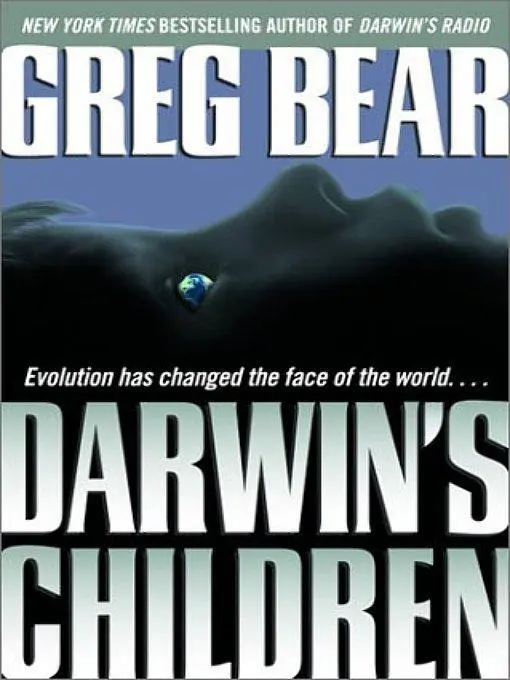
- Название:Darwin's Children
- Автор:
- Издательство:Del Rey Books
- Жанр:
- Год:2010
- Город:New York
- ISBN:9780345448361
- Рейтинг книги:3 / 5. Голосов: 1
-
Избранное:Добавить в избранное
- Отзывы:
-
Ваша оценка:
Darwin's Children: краткое содержание, описание и аннотация
Предлагаем к чтению аннотацию, описание, краткое содержание или предисловие (зависит от того, что написал сам автор книги «Darwin's Children»). Если вы не нашли необходимую информацию о книге — напишите в комментариях, мы постараемся отыскать её.
, painted a chilling portrait of humankind on the threshold of a radical leap in evolution—one that would alter our species forever. Now Bear continues his provocative tale of the human race confronted by an uncertain future, where “survival of the fittest” takes on astonishing and controversial new dimensions.
Eleven years have passed since SHEVA, an ancient retrovirus, was discovered in human DNA—a retrovirus that caused mutations in the human genome and heralded the arrival of a new wave of genetically enhanced humans. Now these changed children have reached adolescence… and face a world that is outraged about their very existence. For these special youths, possessed of remarkable, advanced traits that mark a major turning point in human development, are also ticking time bombs harboring hosts of viruses that could exterminate the “old” human race.
Fear and hatred of the virus children have made them a persecuted underclass, quarantined by the government in special “schools,” targeted by federally sanctioned bounty hunters, and demonized by hysterical segments of the population. But pockets of resistance have sprung up among those opposed to treating the children like dangerous diseases—and who fear the worst if the government’s draconian measures are carried to their extreme.
Scientists Kaye Lang and Mitch Rafelson are part of this small but determined minority. Once at the forefront of the discovery and study of the SHEVA outbreak, they now live as virtual exiles in the Virginia suburbs with their daughter, Stella—a bright, inquisitive virus child who is quickly maturing, straining to break free of the protective world her parents have built around her, and eager to seek out others of her kind.
But for all their precautions, Kaye, Mitch, and Stella have not slipped below the government’s radar. The agencies fanatically devoted to segregating and controlling the new-breed children monitor their every move—watching and waiting for the opportunity to strike the next blow in their escalating war to preserve “humankind” at any cost. DARWIN’S CHILDREN
Darwin's Children — читать онлайн ознакомительный отрывок
Ниже представлен текст книги, разбитый по страницам. Система сохранения места последней прочитанной страницы, позволяет с удобством читать онлайн бесплатно книгу «Darwin's Children», без необходимости каждый раз заново искать на чём Вы остановились. Поставьте закладку, и сможете в любой момент перейти на страницу, на которой закончили чтение.
Интервал:
Закладка:
“You looked peaceful. I’m sorry if I said anything strange last night.”
“You?” She laughed and fumbled the box of tea bags, picked up the spilled ones, then took down two mugs from a rack over the kitchen window. One mug said Kiss a Clown, You Know You Want to. The other was from Smith College, gold emblem of a gate on dark blue. “Not at all,” Kaye murmured, and filled a kettle with water. Somewhere, a pump started chuckling, and the water jerked from the tap, finally flowing in a steady stream. She swished her hand back and forth, fingers spreading through the coldness.
Not at all the same.
“How are we, Kaye?” Mitch asked, standing beside her at the sink.
“Stella is going to be fine,” Kaye said before she could think.
“How are we, Kaye?”
Kaye reached out and gripped Mitch’s hand on the counter. She had not spent much time lately simply touching her husband. He had been gone so much, and so often, of course.
She must have looked miserable and lost. But what she felt was very, very physical.
Mitch pulled her close. He was always the one to make the first move; except that she had made the move that had produced Stella. Mitch had held back, worried about Kaye, or perhaps just scared at the thought of being a parent to a new kind of human being. They had been so in love, and the problem was, Kaye could not answer Mitch’s question now, not truthfully, because she did not know.
There was still love. What kind of love? “We are going to be better,” she said into his shoulder. “There is certainly better to be.”
“They shouldn’t hound us,” he said with the boyish sternness of the night before.
“I don’t think we have any control over that.”
“We won’t stay here long,” he said, and glared out the window at the woods, the dock, the sunshine. “This place is too nice. I don’t trust it.”
“It is nice. Why not stay a while? The Mackenzies would never tell anyone.”
Mitch brushed her cheek with his palm. “Their son is in a camp. The children in the camps are getting sick.”
Kaye drew her eyebrows together. She could not follow this line of reasoning.
“Mark Augustine has been looking for you, for us. He’s been waiting for the right moment to reel us in. The illness is scaring people badly. This is his moment.”
Kaye squeezed his forearm hard, as if to punish him.
“Ow,” he said.
She loosened her grip. “We need to keep Stella quiet and calm. She needs to rest for a few days at least. She can’t rest in a bouncing Jeep.”
“All right,” Mitch said.
“We’ll stay here,” Kaye said. “Will it be okay?”
“It’ll have to be,” Mitch said.
Kaye leaned her head against Mitch’s chest. Her eyes lost focus and then closed. “Is she still asleep?” she asked.
“Let’s check,” Mitch said, and they walked together into the living room.
She was. Kaye took Mitch’s hand and led him into the bedroom. They took off their clothes, and Kaye pulled back the covers on the bed until the bottom sheet was completely revealed.
“I need you,” she said.
Her fingers on his lips smelled of tea leaves.
49
OHIO
Dicken had prepared and racked up his seventy specimen sets. He used a Kim Wipe to take the sting of sweat out of his eyes. His sense of urgency was extreme but counterproductive. He could work no faster than produced good results. Anything less would be worse than not having worked at all.
He had labored nine hours straight, first separating and classifying the specimens based on his labels and field notes, then preparing them for the automated lab equipment. Most of the manual labor involved preparing specimens and racking them up for runs through the instruments.
PCR instruments had been the size of large suitcases when he had been a student. Now he could hold one in the palm of his hand. The racks carried what had been the equivalent of a whole building full of equipment fifteen years ago.
Oligos—small but highly specific segments of DNA mounted in each tiny square cell of the whole-genome array chips—attached themselves to complementary segments of RNA expressed by the cell, including viral genes, if any, and labeled them with fluorescent markers. Scanners would count the markers and approximate their positions in the chromosome sequence.
From a prepared set of serological fractions, the sequencers would amplify and analyze the exact genetic code of any viruses in the samples. The proteomizers would list all proteins found within the targeted cells—both viral and host proteins. Proteins could then be matched by the Ideator to the open reading frames of the sequenced genes.
All this would give him a road map of the disease at the cellular level.
He tapped commands into the server controlling the lab machines. Fortunately, the code gaining entry to this computer had been simple to guess. He had tried combinations of JURIE and ARAM and, finally, ARAMJURIE#1, and that had worked.
The lab filled with humming and faint clicking, first to his right, then to his left. Dicken stood up and checked the progress of the little plastic tubes marching in their metal tracks one by one into the prissy little mouths of the white-and-silver machines. He had to admire the way the doctors had set up the lab. It was economical, the equipment neatly arranged, with good flow-through from task to task.
Jurie and Pickman had known their business.
Still, virus hunters who fled at the first signs of a disease were not highly regarded by their peers. Very likely, Jurie and Pickman had never chased down viruses in the field. They had behaved more like lab lizards, pale from lack of tropical sun, utter cowards when confronted by their real prey.
For a moment, Dicken felt a chill. How dumb of him not to think of it earlier. Jurie and Pickman had already done the work, discovered the results; that was why they had run away. The results had been very bad.
But Dicken had found no sign of specimen kits anywhere in the lab. The equipment had barely been used, it was so new.
The chill passed, but slowly.
An hour later, he tapped the space bar on the keyboard to turn off the screen saver. A flashing green bar with “Eureka!” written across it told him he had results. The results were displayed first as thumbnails on a grid, then, at his command, as a slide show.
With grim satisfaction, Dicken saw that he had isolated a recombined variety of unencapsulated RNA virus from the blood and sputum of all the afflicted children, in titers sufficient to suggest massive infection. No other titers were so prominent.
From the beginning, seeing the buccal lesions and stomatitis, Dicken had suspected coxsackie A, known to cause most of the symptoms in the sick SHEVA children. But this strain was seldom associated with fatal illness. Coxsackie B, however, sometimes produced myocarditis, inflammatory heart disease, in infants and children. According to Dr. Kelson, myocarditis was a possible cause of death in the outbreak. Kelson had said, “There’s massive tissue damage. The heart just stops.”
Coxsackie A and B typically spread by fecal contact or exchange of saliva. He did not know of any historical instances where it had spread by skin contact or in aerosols—droplets of moisture from breath or sneezing—or through residues left on surfaces, yet those kinds of transmission were necessary to explain the outbreak’s rapid and pervasive expansion.
Something had changed. Coxsackie A or B, or both, had suddenly become easier to spread, and targeted to a particular population not heretofore known to be vulnerable to most common childhood viruses.
Читать дальшеИнтервал:
Закладка:
Похожие книги на «Darwin's Children»
Представляем Вашему вниманию похожие книги на «Darwin's Children» списком для выбора. Мы отобрали схожую по названию и смыслу литературу в надежде предоставить читателям больше вариантов отыскать новые, интересные, ещё непрочитанные произведения.






Обсуждение, отзывы о книге «Darwin's Children» и просто собственные мнения читателей. Оставьте ваши комментарии, напишите, что Вы думаете о произведении, его смысле или главных героях. Укажите что конкретно понравилось, а что нет, и почему Вы так считаете.