Greg Bear - Darwin's Children
Здесь есть возможность читать онлайн «Greg Bear - Darwin's Children» — ознакомительный отрывок электронной книги совершенно бесплатно, а после прочтения отрывка купить полную версию. В некоторых случаях можно слушать аудио, скачать через торрент в формате fb2 и присутствует краткое содержание. Город: New York, Год выпуска: 2010, ISBN: 2010, Издательство: Del Rey Books, Жанр: Фантастика и фэнтези, на английском языке. Описание произведения, (предисловие) а так же отзывы посетителей доступны на портале библиотеки ЛибКат.
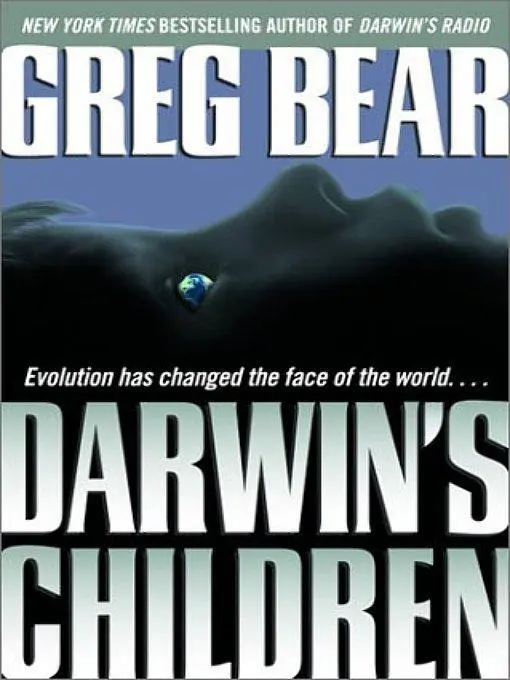
- Название:Darwin's Children
- Автор:
- Издательство:Del Rey Books
- Жанр:
- Год:2010
- Город:New York
- ISBN:9780345448361
- Рейтинг книги:3 / 5. Голосов: 1
-
Избранное:Добавить в избранное
- Отзывы:
-
Ваша оценка:
Darwin's Children: краткое содержание, описание и аннотация
Предлагаем к чтению аннотацию, описание, краткое содержание или предисловие (зависит от того, что написал сам автор книги «Darwin's Children»). Если вы не нашли необходимую информацию о книге — напишите в комментариях, мы постараемся отыскать её.
, painted a chilling portrait of humankind on the threshold of a radical leap in evolution—one that would alter our species forever. Now Bear continues his provocative tale of the human race confronted by an uncertain future, where “survival of the fittest” takes on astonishing and controversial new dimensions.
Eleven years have passed since SHEVA, an ancient retrovirus, was discovered in human DNA—a retrovirus that caused mutations in the human genome and heralded the arrival of a new wave of genetically enhanced humans. Now these changed children have reached adolescence… and face a world that is outraged about their very existence. For these special youths, possessed of remarkable, advanced traits that mark a major turning point in human development, are also ticking time bombs harboring hosts of viruses that could exterminate the “old” human race.
Fear and hatred of the virus children have made them a persecuted underclass, quarantined by the government in special “schools,” targeted by federally sanctioned bounty hunters, and demonized by hysterical segments of the population. But pockets of resistance have sprung up among those opposed to treating the children like dangerous diseases—and who fear the worst if the government’s draconian measures are carried to their extreme.
Scientists Kaye Lang and Mitch Rafelson are part of this small but determined minority. Once at the forefront of the discovery and study of the SHEVA outbreak, they now live as virtual exiles in the Virginia suburbs with their daughter, Stella—a bright, inquisitive virus child who is quickly maturing, straining to break free of the protective world her parents have built around her, and eager to seek out others of her kind.
But for all their precautions, Kaye, Mitch, and Stella have not slipped below the government’s radar. The agencies fanatically devoted to segregating and controlling the new-breed children monitor their every move—watching and waiting for the opportunity to strike the next blow in their escalating war to preserve “humankind” at any cost. DARWIN’S CHILDREN
Darwin's Children — читать онлайн ознакомительный отрывок
Ниже представлен текст книги, разбитый по страницам. Система сохранения места последней прочитанной страницы, позволяет с удобством читать онлайн бесплатно книгу «Darwin's Children», без необходимости каждый раз заново искать на чём Вы остановились. Поставьте закладку, и сможете в любой момент перейти на страницу, на которой закончили чтение.
Интервал:
Закладка:
Augustine had lost weight since Dicken last saw him. “If I don’t get the facts and plug them into some tight little bureaucratic columns in the next few days, we may have something that goes far beyond sick children.”
“Goddammit, Mark, we know how Shiver works,” Dicken said. “Whatever this is, it is not Shiver.”
“I’m sure you’re right,” Augustine said. “But we need more than facts. We need a hero.”
28
PENNSYLVANIA
Grief had been tracking Mitch Rafelson like a hunter. It had him in its eyebeams, painting him like a target, preparing to bring him down and settle in for a long feast.
He felt like stopping the Dodge on the side of the road, getting out, and running. As always, he stuffed these dark thoughts into a little drawer in the basement of his skull. Anything that demonstrated he was other than a loving father, all the emotions that had not been appropriate for eleven years and more, he hid away down there, along with the old dreams about the mummies in the Alps.
All the spooky little guesses about the situation of the long-dead Neandertals, mother and father, and the mummified, modern infant they had made before dying in the cold, in the long deep cave covered with ice.
Mitch no longer had such dreams. He hardly dreamed at all. But then, there wasn’t much else left of the old Mitch, either. He had been burned away, leaving a thin skeleton of steel and stone that was Stella’s daddy. He did not even know anymore whether his wife loved him. They hadn’t made love in months. They didn’t have time to think about such things. Neither complained; that was just the way it was, no energy or passion left after dealing with the stress and worry.
Mitch would have killed Fred Trinket if the police and the van hadn’t been there. He would have broken the man’s neck, then looked into the bastard’s startled eyes as he finished the twist. Mitch ran that image through his head until he felt his stomach jump.
He understood more than ever how the Neandertal papa must have felt.
Seven miles. They were on the outskirts of Pittsburgh. The road was surrounded by blaring ads trying to get him to buy cars, buy tract homes, spend money he did not have. The houses beyond the freeway were packed close, crowded and small, and the big brick industrial buildings were dirty and dark. He hardly noticed a tiny park with bright red swings and plastic picnic tables. He was looking for the right turnoff.
“There it is,” he told Kaye, and took the exit. He glanced into the backseat. Stella was limp. Kaye held her. Together like that, they reminded him of a statue, a Pietà. He hated that metaphor, common enough on the fringe sites on the Internet: the new children as martyrs, as Christ. Hated it with a passion. Martyrs died. Jesus had died horribly, persecuted by a blind state and an ignorant, bloodthirsty rabble, and that was certainly not going to happen to Stella.
Stella was going to live until long after Mitch Rafelson had rotted down to dry, interesting bones.
The safe house was in the rich suburbs. The tree-filled estates here were nothing like the land around the little frame house in Virginia. Smooth asphalt and concrete roads served big new houses from the last hot run of the economy. Here the streets were lined on both sides with fresh-cut stone walls set behind mature pines and broken only by black iron gates topped with spikes.
He found the number painted on the curb and pulled the Dodge up to a hooded security keypad. The first time, he fumbled the number and the keypad buzzed. A small red light blinked a warning. The second time, the gate rolled open smoothly. Leaves rustled in the maple trees overarching the driveway.
“Almost there,” he said.
“Hurry,” Kaye said quietly.
29
Joseph Goldberger School for Children With Special Needs,
Emergency Action Ohio, Central District Authority
Asmall contingent of Ohio National Guard trucks—Dicken counted six, and about a hundred troops—had drawn up at the crossroads. A perennial around the school, blooming every spring and summer, dying back in the winter, protesters stood in clumps away from the troops and the alarm trip wires. Dicken guessed that today they numbered three or four hundred today, more than usual and more energetic as well. Most of the protesters were younger than thirty, many younger than twenty. Some wore brightly tie-dyed T-shirts and baggy slacks and had felted their hair in long bleached dreadlocks. They sang and shouted and waved signs denouncing “Virus Abominations” genetically engineered by corporate mad scientists. Two news trucks poked their white dish antennae at the sky. Reporters were out interviewing the protesters, feeding the hungry broadband predigested opinion and some visuals. Dicken had seen all this many times.
On the news, the protesters’ standard line was that the new children were artificial monsters designed to help corporations take over the world. GM Kids , they called them, or Lab Brats , or Monsanto’s Future Toadies.
Pushed back almost into the grass and gravel of a makeshift parking lot were a few dozen parents. Dicken could easily tell them apart from the protesters. The parents were older, conservatively dressed, worn down and nervous. For them, this was no game, no bright ritual of youthful passage into a dull and torpid maturity.
The staff car and its two escorts approached the first perimeter gate through a weave of concrete barricades. Protesters swarmed the fence, swinging their signs in the direction of the protected road. The largest sign out front, scrawled in red marker and brandished by a skinny boy with prominent bad teeth, read, hey hey usa/ don’t fuck with nature’s dna!
“Just shoot them,” Dicken muttered.
Augustine nodded his tight-lipped concurrence.
Damn, we agree on something, Dicken thought.
In the beginning, the protesters had nearly all been parents, arriving at the schools by the thousands, some hangdog and guilty, some grim and defiant, all pleading that their children be allowed to go home. Back then, the nursery buildings had been filled and the dorms under construction or empty. The parents had mounted their vigils year-round, even in the dead of winter, for more than five years. They had been the best of citizens. They had surrendered their children willingly, trusting government promises that they would eventually be returned.
Mark Augustine had been unable to fulfill that promise, at first because of what he thought he knew, but in later years because of grim political reality.
Americans by and large believed they were safer with the virus children put away. Sealed up, out of sight. Out of range of contagion.
Dicken watched Augustine’s expression change from studied indifference to steely impassivity as the staff car climbed the sloping road to the plateau. There the massive complex sat flat and ugly like a spill of children’s blocks on the Ohio green.
The car maneuvered around the barricades and pulled up to the dazzling concrete gatehouse, whiter even than the clouds. As the guards checked their schedule of appointments and consulted with the Secret Service agents, Augustine stared east through the car window at a row of four long, ocher-colored dormitories.
It had been a year since Augustine had last inspected Goldberger. Back then, lines of kids had moved between classrooms, dormitories, and cafeteria halls, attended by teachers, interns, security personnel. Now, the dormitories seemed deserted. An ambulance had been parked by the inner gate to the barracks compound. It, too, was unattended.
“Where are the kids?” Dicken asked. “Are they all sick?”
Читать дальшеИнтервал:
Закладка:
Похожие книги на «Darwin's Children»
Представляем Вашему вниманию похожие книги на «Darwin's Children» списком для выбора. Мы отобрали схожую по названию и смыслу литературу в надежде предоставить читателям больше вариантов отыскать новые, интересные, ещё непрочитанные произведения.




Обсуждение, отзывы о книге «Darwin's Children» и просто собственные мнения читателей. Оставьте ваши комментарии, напишите, что Вы думаете о произведении, его смысле или главных героях. Укажите что конкретно понравилось, а что нет, и почему Вы так считаете.