Greg Bear - Darwin's Children
Здесь есть возможность читать онлайн «Greg Bear - Darwin's Children» — ознакомительный отрывок электронной книги совершенно бесплатно, а после прочтения отрывка купить полную версию. В некоторых случаях можно слушать аудио, скачать через торрент в формате fb2 и присутствует краткое содержание. Город: New York, Год выпуска: 2010, ISBN: 2010, Издательство: Del Rey Books, Жанр: Фантастика и фэнтези, на английском языке. Описание произведения, (предисловие) а так же отзывы посетителей доступны на портале библиотеки ЛибКат.
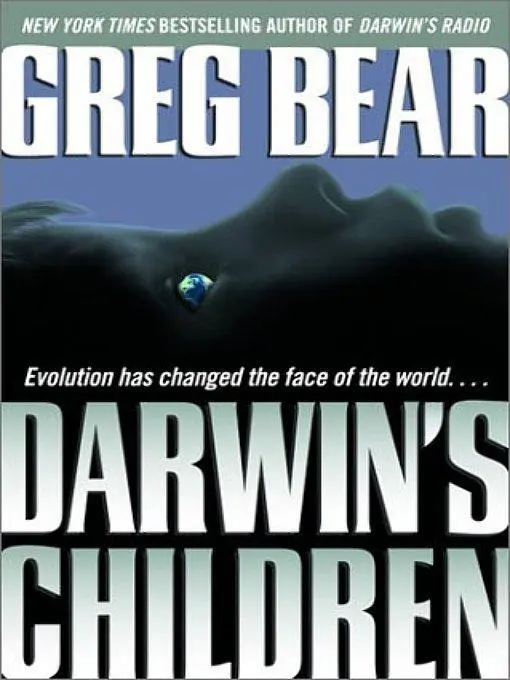
- Название:Darwin's Children
- Автор:
- Издательство:Del Rey Books
- Жанр:
- Год:2010
- Город:New York
- ISBN:9780345448361
- Рейтинг книги:3 / 5. Голосов: 1
-
Избранное:Добавить в избранное
- Отзывы:
-
Ваша оценка:
Darwin's Children: краткое содержание, описание и аннотация
Предлагаем к чтению аннотацию, описание, краткое содержание или предисловие (зависит от того, что написал сам автор книги «Darwin's Children»). Если вы не нашли необходимую информацию о книге — напишите в комментариях, мы постараемся отыскать её.
, painted a chilling portrait of humankind on the threshold of a radical leap in evolution—one that would alter our species forever. Now Bear continues his provocative tale of the human race confronted by an uncertain future, where “survival of the fittest” takes on astonishing and controversial new dimensions.
Eleven years have passed since SHEVA, an ancient retrovirus, was discovered in human DNA—a retrovirus that caused mutations in the human genome and heralded the arrival of a new wave of genetically enhanced humans. Now these changed children have reached adolescence… and face a world that is outraged about their very existence. For these special youths, possessed of remarkable, advanced traits that mark a major turning point in human development, are also ticking time bombs harboring hosts of viruses that could exterminate the “old” human race.
Fear and hatred of the virus children have made them a persecuted underclass, quarantined by the government in special “schools,” targeted by federally sanctioned bounty hunters, and demonized by hysterical segments of the population. But pockets of resistance have sprung up among those opposed to treating the children like dangerous diseases—and who fear the worst if the government’s draconian measures are carried to their extreme.
Scientists Kaye Lang and Mitch Rafelson are part of this small but determined minority. Once at the forefront of the discovery and study of the SHEVA outbreak, they now live as virtual exiles in the Virginia suburbs with their daughter, Stella—a bright, inquisitive virus child who is quickly maturing, straining to break free of the protective world her parents have built around her, and eager to seek out others of her kind.
But for all their precautions, Kaye, Mitch, and Stella have not slipped below the government’s radar. The agencies fanatically devoted to segregating and controlling the new-breed children monitor their every move—watching and waiting for the opportunity to strike the next blow in their escalating war to preserve “humankind” at any cost. DARWIN’S CHILDREN
Darwin's Children — читать онлайн ознакомительный отрывок
Ниже представлен текст книги, разбитый по страницам. Система сохранения места последней прочитанной страницы, позволяет с удобством читать онлайн бесплатно книгу «Darwin's Children», без необходимости каждый раз заново искать на чём Вы остановились. Поставьте закладку, и сможете в любой момент перейти на страницу, на которой закончили чтение.
Интервал:
Закладка:
“I threw up back there,” Stella said.
“How far to the next house?” Kaye asked Mitch.
“The map says twenty miles. We’ll be in Pittsburgh soon.”
“I think she’s sick,” Kaye said.
“It isn’t Shiver, is it, Kaye?” Stella asked.
“You don’t get Shiver, honey.”
“Everything hurts. Is it mumps?”
“You’ve had shots for everything.” But Kaye knew that couldn’t possibly be true. Nobody knew what susceptibilities the new children might have. Stella had never been sick, not with colds or flu; she had never even had a bacterial infection. Kaye had thought the new children might have improved immune systems. Mitch had not supported this theory, however, and they had given Stella all the proper immunizations, one by one, after the FDA and the CDC had grudgingly approved the old vaccines for the new children.
“An aspirin might help,” Stella said.
“An aspirin would make you ill,” Kaye said. “You know that.”
“Tylenol,” Stella added, swallowing.
Kaye poured her some water from a bottle and lifted her head for a drink. “That’s bad, too,” Kaye murmured. “You are very special, honey.”
She pulled back Stella’s eyelids, one at a time. The irises were bland, the little gold flecks clouded. Stella’s pupils were like pinpricks. Her daughter’s eyes were as expressionless as her cheeks. “So fast,” Kaye said. She set Stella down into a pillow in the corner of the backseat and leaned forward to whisper into Mitch’s ear. “It could be what the dead girl had.”
“Shit,” Mitch said.
“It isn’t respiratory, not yet, but she’s hot. Maybe a hundred and four, a hundred and five. I can’t find the thermometer in the first aid kit.”
“I put it there,” Mitch said.
“I can’t find it. We’ll get one in Pittsburgh.”
“A doctor,” Mitch said.
“At the safe house,” Kaye said. “We need a specialist.” She was working to stay calm. She had never seen her daughter with a fever, her cheeks and eyes so bland.
The car sped up.
“Keep to the speed limit,” Kaye said.
“No guarantees,” Mitch said.
27
OHIO
Christopher Dicken got off the C-141 transport at Wright-Patterson Air Force Base. At Augustine’s suggestion, he had hitched a late-afternoon ride from Baltimore with a flight of National Guard troops being moved into Dayton.
He was met on the concrete apron by a neatly dressed middle-aged man in a gray suit, the civilian liaison, who accompanied him through a small, austere passenger terminal to a black Chevrolet staff car.
Dicken looked at two unmarked brown Fords behind the Chevrolet. “Why the escort?” he asked.
“Secret Service,” the liaison said.
“Not for me, I hope,” Dicken said.
“No, sir.”
As they approached the Chevrolet, a much younger driver in a black suit snapped to military attention, introduced himself as Officer Reed of Ohio Special Needs School Security, and opened the car’s right rear door.
Mark Augustine sat in the backseat.
“Good afternoon, Christopher,” he said. “I hope your flight was pleasant.”
“Not very,” Dicken said. He hunched awkwardly into the staff car and sat on the black leather. The car drove off the base, trailed by the two Fords. Dicken stared at huge billows of clouds piling up over the green hills and suburbs beside the wide gray turnpike. He was glad to be on the ground again. Changes in air pressure bothered his leg.
“How’s the leg?” Augustine asked.
“Okay,” Dicken said.
“Mine’s giving me hell,” Augustine said. “I flew in from Dulles. Flight got bumpy over Pennsylvania.”
“You broke your leg?”
“In a bathtub.”
Dicken conspicuously rotated his torso to face his former boss and looked him over coldly. “Sorry to hear that.”
Augustine met his gaze with tired eyes. “Thank you for coming.”
“I didn’t come at your request,” Dicken said.
“I know. But the person who made the request talked to me.”
“It was an order from HHS.”
“Exactly,” Augustine said, and tapped the armrest on the door. “We’re having a problem at some of our schools.”
“They are not my schools,” Dicken said.
“Have we made clear how much of a pariah I am?” Augustine asked.
“Not nearly clear enough,” Dicken said.
“I know your sympathies, Christopher.”
“I don’t think you do.”
“How’s Mrs. Rhine?”
The goddamned high point of Mark Augustine’s career, Dicken thought, his face flushing. “Tell me why I’m here,” he said.
“A lot of new children are becoming ill, and some of them are dying,” Augustine said. “It appears to be a virus. We’re not sure what kind.”
Dicken took a slow breath. “The CDC isn’t allowed to investigate Emergency Action schools. Turf war, right?”
Augustine tipped his head. “Only in a few states. Ohio reserved control of its schools. Congressional politics,” he said. “Not my wish.”
“I don’t know what I can do. You should be shipping in every doctor and public health worker you can get.”
“Ohio school medical staff by half last year, because the new children were healthier than most kids. No joke.” Augustine leaned forward in the seat. “We’re going to what may be the school most affected.”
“Which one?” Dicken asked, massaging his leg.
“Joseph Goldberger.”
Dicken smiled ruefully. “You’ve named them after public health heroes? That’s sweet, Mark.”
Augustine did not deviate from his course. His eyes looked dead, and not just from being tired. “Last night, all but one of the doctors deserted the school. We don’t yet have accurate records on the sick and the dead. Some of the nurses and teachers have walked, too. But most have stayed, and they’re trying to take up the slack.”
“Warriors,” Dicken said.
“Amen. The director, against my express orders but at the behest of the governor, has instituted a lockdown. Nobody leaves the barracks, and no visitors are allowed in. Most of the schools are in a similar situation. That’s why I asked you to join me, Christopher.”
Dicken watched the highway, the passing cars. It was a lovely afternoon and everything appeared normal. “How are they handling it?”
“Not well.”
“Medical supplies?”
“Low. Some interruption in the state supply chain. As I said, this is a state school, with a state-appointed director. I’ve ordered in federal emergency supplies from EMAC warehouses, but they may not get here until later tomorrow.”
“I thought you put together an iron web,” Dicken said. “I thought you covered your ass when they handed you all this, your little fiefdom.”
Augustine did not react, and that in itself impressed Dicken. “I wasn’t clever enough,” Augustine said. “Please listen and keep your head clear. Only select observers are being allowed into the schools until the situation is better understood. I’d like you to conduct a thorough investigation and take samples, run tests. You have credibility.”
Dicken felt there was little sense in accusing or tormenting Augustine any more. His shoulders drooped as he relaxed his back muscles. “And you don’t?” he asked.
Augustine looked down at his hands, inspected his perfectly manicured fingernails. “I am perceived as a disappointed warden who wants out of his job, which I am, and a man who would trump up a health crisis to protect his own hide, which I would not. You, on the other hand, are a celebrity. The press would wash your little pink toes to get your side of this story.”
Dicken made a soft nose-blow of dismissal.
Читать дальшеИнтервал:
Закладка:
Похожие книги на «Darwin's Children»
Представляем Вашему вниманию похожие книги на «Darwin's Children» списком для выбора. Мы отобрали схожую по названию и смыслу литературу в надежде предоставить читателям больше вариантов отыскать новые, интересные, ещё непрочитанные произведения.




Обсуждение, отзывы о книге «Darwin's Children» и просто собственные мнения читателей. Оставьте ваши комментарии, напишите, что Вы думаете о произведении, его смысле или главных героях. Укажите что конкретно понравилось, а что нет, и почему Вы так считаете.