Greg Bear - Darwin's Children
Здесь есть возможность читать онлайн «Greg Bear - Darwin's Children» — ознакомительный отрывок электронной книги совершенно бесплатно, а после прочтения отрывка купить полную версию. В некоторых случаях можно слушать аудио, скачать через торрент в формате fb2 и присутствует краткое содержание. Город: New York, Год выпуска: 2010, ISBN: 2010, Издательство: Del Rey Books, Жанр: Фантастика и фэнтези, на английском языке. Описание произведения, (предисловие) а так же отзывы посетителей доступны на портале библиотеки ЛибКат.
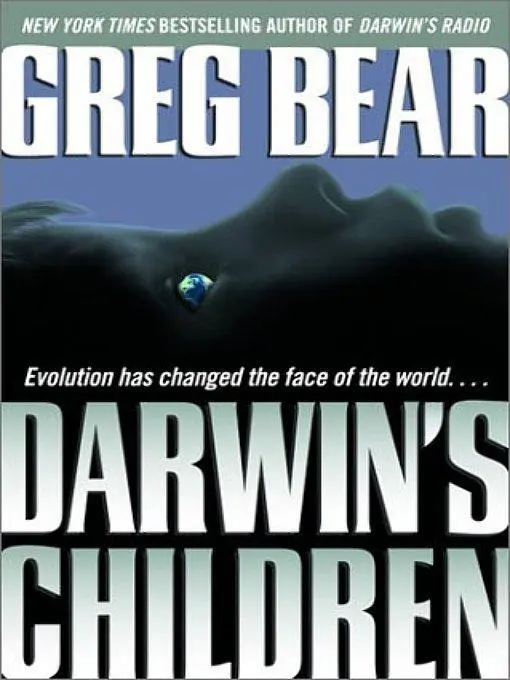
- Название:Darwin's Children
- Автор:
- Издательство:Del Rey Books
- Жанр:
- Год:2010
- Город:New York
- ISBN:9780345448361
- Рейтинг книги:3 / 5. Голосов: 1
-
Избранное:Добавить в избранное
- Отзывы:
-
Ваша оценка:
Darwin's Children: краткое содержание, описание и аннотация
Предлагаем к чтению аннотацию, описание, краткое содержание или предисловие (зависит от того, что написал сам автор книги «Darwin's Children»). Если вы не нашли необходимую информацию о книге — напишите в комментариях, мы постараемся отыскать её.
, painted a chilling portrait of humankind on the threshold of a radical leap in evolution—one that would alter our species forever. Now Bear continues his provocative tale of the human race confronted by an uncertain future, where “survival of the fittest” takes on astonishing and controversial new dimensions.
Eleven years have passed since SHEVA, an ancient retrovirus, was discovered in human DNA—a retrovirus that caused mutations in the human genome and heralded the arrival of a new wave of genetically enhanced humans. Now these changed children have reached adolescence… and face a world that is outraged about their very existence. For these special youths, possessed of remarkable, advanced traits that mark a major turning point in human development, are also ticking time bombs harboring hosts of viruses that could exterminate the “old” human race.
Fear and hatred of the virus children have made them a persecuted underclass, quarantined by the government in special “schools,” targeted by federally sanctioned bounty hunters, and demonized by hysterical segments of the population. But pockets of resistance have sprung up among those opposed to treating the children like dangerous diseases—and who fear the worst if the government’s draconian measures are carried to their extreme.
Scientists Kaye Lang and Mitch Rafelson are part of this small but determined minority. Once at the forefront of the discovery and study of the SHEVA outbreak, they now live as virtual exiles in the Virginia suburbs with their daughter, Stella—a bright, inquisitive virus child who is quickly maturing, straining to break free of the protective world her parents have built around her, and eager to seek out others of her kind.
But for all their precautions, Kaye, Mitch, and Stella have not slipped below the government’s radar. The agencies fanatically devoted to segregating and controlling the new-breed children monitor their every move—watching and waiting for the opportunity to strike the next blow in their escalating war to preserve “humankind” at any cost. DARWIN’S CHILDREN
Darwin's Children — читать онлайн ознакомительный отрывок
Ниже представлен текст книги, разбитый по страницам. Система сохранения места последней прочитанной страницы, позволяет с удобством читать онлайн бесплатно книгу «Darwin's Children», без необходимости каждый раз заново искать на чём Вы остановились. Поставьте закладку, и сможете в любой момент перейти на страницу, на которой закончили чтение.
Интервал:
Закладка:
Kaye dragged a wooden box stacked high with the computer and the most important of their books and papers out to the Dodge. Mitch burned documents in a rusty oil drum in the backyard.
Kaye tersely told Stella to throw the clothes she really wanted into a single small suitcase and anything else into a plastic garbage bag, which they would take if there was room left in the car.
“I didn’t mean to do this,” Stella said softly. Kaye did not hear or, more likely, did not think it best to listen to her daughter now. Louder, Stella added, “I like this house.”
“So do I, honey. So do I,” Kaye said, her face stony.
In the kitchen, Mitch smashed the cell phone and pulled out the little plastic circuit boards, then jammed them in his pocket. He would throw them out the window or drop them in a garbage can in another state. He then smashed the answering machine.
“Don’t bother,” Kaye said as she lugged the plastic bag full of clothes down the hall. “We’re probably the most listened-to family in America.”
“Old habit,” Mitch said. “Leave me to my illusions.”
“I’ve made trouble and I’m putting you in danger,” Stella said. “I should just go away. I should just go into a camp.”
“Us, in danger?” Kaye stopped and spun around at the end of the hall. “Are you testing me?” she demanded. “We are not worried for ourselves , Stella. We have never been worried about ourselves. ” Her hands moved in small arcs from hips to shoulders, and then she crossed her arms.
“I don’t understand why this has to happen,” Stella said. “Please, let’s stay here and if they come, they come, all right?”
Kaye’s face turned white.
Stella could not stop talking. “You say you’re afraid for me, but are you really afraid for yourselves , for how you’ll feel if—”
“Shut up, Stella,” Kaye said, shaking, then regretted the sharp words. “Please. We have to get out of here quickly.”
“I’d know others like me. I could find out what we really need to do. They have to accept us someday.”
“They could just as easily kill you all,” Mitch said, standing behind Kaye.
“That’s crazy,” Stella said. “Their own children?”
Mitch and Kaye faced off against their daughter down the length of the hall. Kaye seemed to recognize this symbolism and turned halfway, not looking directly at Stella, but at the plasterboard, the cornice, the paint, her eyes searching these blank things as if they might be sacred texts.
“I don’t think they would,” Stella said.
“That is not your concern,” Mitch said.
Stella desperately wrinkled her face in what she hoped was a smile. Her tears started to flow. “If it isn’t my concern, whose is it?”
“Not yours, alone, not yet,” Mitch said, his voice many degrees softer, and so full of painful, angry love that Stella’s throat itched. She scratched her neck with her fingers.
Kaye looked up. “Damn,” she said, reminded of something. She stared at her fingers and her nails and rushed into the bathroom. There, she lathered and rinsed her hands for several minutes.
Steam billowed from the sink as Stella stood by the door.
“Fred stuff?” Stella asked.
“Fred,” Kaye confirmed grimly.
“You took a good swipe,” Stella said.
“Mom cat,” Kaye said. She scrubbed back and forth with a stiff little bristle brush, then looked up at the ceiling through the steam and the lavender of the soap. “I’m going to wash that man right off of my hands,” she sang. This was so close to the edge, so fraught, that Stella forgot her guilt and frustration and reached out for her mother.
Kaye knocked aside her daughter’s long arms.
“Mother,” Stella said, shocked. “I’m sorry!” She reached out again. Kaye let out a wail, slapping at Stella’s hands until Stella caught her around her chest. As mother and daughter slumped to the ragged throw rug on the bathroom floor, too exhausted to do anything but shake and clutch, Mitch sucked in his breath and finished the work. He loaded a second suitcase with clothes, zipped it shut, and tossed it into the trunk of the Dodge along with the garbage bag. He imagined himself a rugged frontier father getting ready to pull out of the sod house and hightail it into the woods because Indians were coming.
But it wasn’t Indians. They had spent time with Indians—Stella had been born in a reservation hospital in Washington state. Mitch had studied and admired Indians for decades. He had also dug up ancient North American bones. That had been a long time ago. He didn’t think he would do that now.
Mitch was no longer a white man. He wanted little or nothing to do with his own race, his own species.
It was the cavalry that he feared.
They took the Dodge and left the old gray Toyota truck in the dirt driveway. Kaye did not look back at the house, but Stella, sitting beside her mother in the backseat, swung around.
“We buried Shamus there,” she said. Shamus had come into their lives three years ago, an old, battered tomcat with a rope looped around his neck. Kaye had cut off the rope, sewn up a slashed ear, and put in a shunt to drain a pus-filled wound behind one eye. To keep the orange tabby from scratching out the stitches, Mitch had wrapped his head in a ridiculous plastic shield that had made him look, Stella said, like Frankenpuss.
For a half-wild old tom, he had been a remarkably sweet and affectionate cat.
One evening last winter, Shamus had not shown up for table scraps or his usual siesta on Kaye’s lap. The tom had wandered off into the far corner of the backyard, well away from Stella’s sense of smell. He had pushed his way under a swelling lobe of kudzu, hidden from crows, and curled up.
Two days later, acting on a hunch, Mitch had found him there, head down, eyes closed, feet tucked under as if asleep. They had buried him a few yards away wrapped in a scrap of knitted afghan he had favored as a bed.
Mitch had said that cats did that, wandered off when they knew the end was near so their bodies would not attract predators or bring disease to the family, the pride.
“Poor Shamus,” Stella said, peering out the rear window. “He has no family now.”
26
They drove. Stella remembered many such trips. She lay in the backseat, nose burning, arms folded tightly, fingers and toes itching, her head in Kaye’s lap and when Kaye drove, in Mitch’s.
Mitch stroked her hair and looked down on her. Sometimes she slept. For a time, the clouds and then the sun through the car windows filled her up. Thoughts ran around in her head like mice. Even with her parents, she hated to admit, she was alone. She hated those thoughts. She thought instead of Will and Kevin and Mabel or Maybelle and how they had suffered because their parents were stupid or mean or both.
The car stopped at a service station. Late afternoon sun reflected from a shiny steel sign and hurt Stella’s eyes as she pushed through the hollow metal door into the restroom. The restroom was small and empty and forbidding, the walls covered with chipped, dirty tile. She threw up in the toilet and wiped her face and mouth.
Now the backs of her ears stung as if little bees were poking her. In the mirror, she saw that her cheeks would not make colors. They were as pale as Kaye’s. Stella wondered if she was changing, becoming more like her mother. Maybe being a virus child was something you got over, like a birthmark that faded away.
Kaye felt her daughter’s forehead as Mitch drove.
The sun had set and the storm had passed.
Stella lay in Kaye’s lap, face almost buried. She was breathing heavily. “Roll over, sweetie,” Kaye said. Stella rolled over. “Your face is hot.”
Читать дальшеИнтервал:
Закладка:
Похожие книги на «Darwin's Children»
Представляем Вашему вниманию похожие книги на «Darwin's Children» списком для выбора. Мы отобрали схожую по названию и смыслу литературу в надежде предоставить читателям больше вариантов отыскать новые, интересные, ещё непрочитанные произведения.





Обсуждение, отзывы о книге «Darwin's Children» и просто собственные мнения читателей. Оставьте ваши комментарии, напишите, что Вы думаете о произведении, его смысле или главных героях. Укажите что конкретно понравилось, а что нет, и почему Вы так считаете.