Alex Bobl - Memoria
Здесь есть возможность читать онлайн «Alex Bobl - Memoria» весь текст электронной книги совершенно бесплатно (целиком полную версию без сокращений). В некоторых случаях можно слушать аудио, скачать через торрент в формате fb2 и присутствует краткое содержание. Год выпуска: 2012, Издательство: Sky Bridge, Жанр: Фантастика и фэнтези, на английском языке. Описание произведения, (предисловие) а так же отзывы посетителей доступны на портале библиотеки ЛибКат.
- Название:Memoria
- Автор:
- Издательство:Sky Bridge
- Жанр:
- Год:2012
- ISBN:нет данных
- Рейтинг книги:4 / 5. Голосов: 1
-
Избранное:Добавить в избранное
- Отзывы:
-
Ваша оценка:
Memoria: краткое содержание, описание и аннотация
Предлагаем к чтению аннотацию, описание, краткое содержание или предисловие (зависит от того, что написал сам автор книги «Memoria»). Если вы не нашли необходимую информацию о книге — напишите в комментариях, мы постараемся отыскать её.
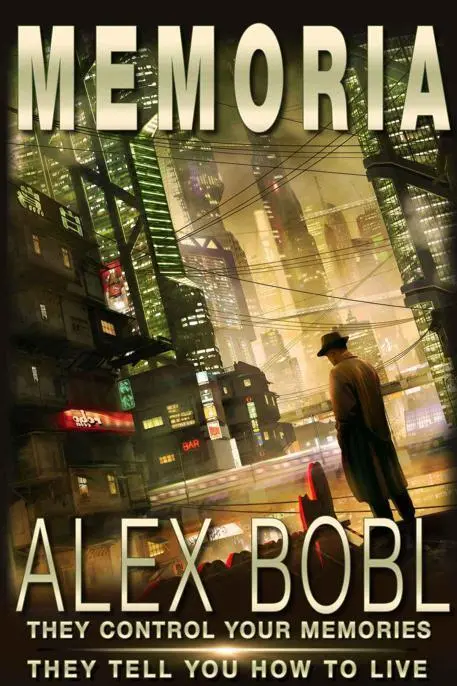
They tell you how to live…
In the bombed-out streets of New York, the corrupt bosses of Memoria Corporation make billions by erasing people’s traumatic memories. But their bubble bursts when a humble citizen Frank Shelby becomes a murder suspect on the run. Betrayed by his friends and hunted down by mysterious killers, Frank has to penetrate Memoria and find evidence of their real plans before it’s too late for all of us.
Memoria — читать онлайн бесплатно полную книгу (весь текст) целиком
Ниже представлен текст книги, разбитый по страницам. Система сохранения места последней прочитанной страницы, позволяет с удобством читать онлайн бесплатно книгу «Memoria», без необходимости каждый раз заново искать на чём Вы остановились. Поставьте закладку, и сможете в любой момент перейти на страницу, на которой закончили чтение.
Интервал:
Закладка:
Maggie was the first to come to her senses.
“You don’t need to be afraid of us,” she said. “We won’t hurt you. All we need is a wash and a place to clean ourselves up a bit.”
She stepped forward. Frank squinted at the coach. The gun in his hands was gone. He definitely knew how to handle firearms.
“My name is Maggie, Maggie Douggan. I’m from Brooklyn. We are looking for the camp- eh, the Bronx leaders. Your administration. You think you can take us there?”
The boy still stared at them, fear in his eyes. The girl gave them an analyzing adult look.
“You got to go to Fordham,” she waived her hand pointing in the direction of the north east. “Over there, see? The Council House.” She hugged the boy’s shoulders.
“What’s your name?” Maggie stepped closer.
“I’m Lynda. Lynda Nelson.”
“Oh! You have the same name as the street!” Maggie nodded at the signpost.
“I do,” the girl said, pride in her voice. “This is our custom. We’re all Nelsons here on this street. We’re one big family.”
Frank and Max looked at each other. The coach murmured, “I wonder what kind of names they have on the numbered streets!”
“And your friend? What’s his name?” A step closer, and Maggie was crouching in front of the kids.
“He’s my little brother,” Lynda smiled and ruffled the boy’s curly hair. “Tom Nelson.”
“Nice to meet you two,” Maggie stood up. “And these are my friends. This is Frank and that’s Uncle Max.”
“He’s not an uncle,” Tom babbled bravely. “He’s too old.”
Everybody smiled at the boy’s artless insight.
“You’re a good judge of character, man,” the coach said.
“Why are you so dirty?” the boy said. “You stink like… like…” he looked up searching for a word. Lynda shook his shoulder reproachfully and whispered in his ear.
“We,” Maggie looked back at the men, “we managed to fall into the cesspit by the wall. Maybe you could tell us where we could clean ourselves up? Or if you call an adult, they could probably direct us, too.”
A middle-aged, broad-faced black woman looked out of a window over the front door. Her large head was tied with a scarf above a thick neck. Under a white apron she wore a dress with a faded pink print.
“Lynda, Tom! Lunch time!” she yelled. Then she noticed the strangers and hung out of the window, clutching a flour-covered rolling pin in her plump hand. “Now who would you be?” She glanced over the street and looked back at them.
“Gran, they fell in the shit hole!” Tom shouted, beating everyone to it. “They’re going to Fordham!”
Later they found out the woman’s name was Oprah. She sent the kids back in the house for their lunch and allowed Maggie to follow them inside, leaving Frank and Max waiting by the door. Shortly, she reappeared, carrying an empty washbasin, a couple of towels and some soap and told them to use the garden hose in the back yard.
They promptly found it lying on a garden patch next to a scarecrow. Frank hung the towels around the scarecrow’s neck, pulled off his clothes, turned the water on and splashed some on his head and chest, snorting happily. He then directed a jet of water onto the disrobed coach and, as he lathered himself, stood under the cold shower enjoying its clean freshness. After a few minutes, he washed the lather off Max, handed him the hose and reached for the soap.
“I had no idea I’d enjoy a cold shower so much,” the coach said as he hosed Frank up and down. “Life’s little pleasures.”
“Pardon?”
“Nothing,” Max gave an indifferent wave with his free hand. “Just remembering the war. The missions we went on. The trenches. Never mind.”
To get the coach’s mind off it, Frank said,
“Did you know that, apart from water supplies, the Bronx is also known for its cell networks?”
Max raised a surprised eyebrow.
“Yes, it’s — ouch!” Frank had disturbed the deep scratch on his side. He’d completely forgotten about it.
“Wait, let me clean it,” Max took the remaining soap and started washing the wound. “In the meantime, tell me what else is interesting here.”
Wincing from the stinging in his side, Frank drew in some air through his teeth and continued,
“Where the Zoo used to be,” he turned his head to get his bearings, then waved his hand to the North, “they have a farm where they raise cattle. A bit further on, by Van Cortlandt Lake, they work the land and saw oats, corn and wheat.”
“You said you didn’t know much,” the coach pointed out.
“Thanks. But this is only general knowledge,” Frank pulled the towels off the scarecrow’s neck, handed one to the coach and started rubbing himself with the other. “You know as well as I do that the migrants provide New York with its running water and much of its food supply, too. Remember you spoke about it when we were in your apartment? You mentioned the electricity, too. They have wind turbines working all along the East Coast, and a tidal power station on the East River Split.”
Frank threw the towel round his neck, smoothed his wet hair and added, “Nothing prevents them from selling the excess energy as far as New Jersey.”
“Do they have enough?”
“They do, and Gautier suggested that the Mayor spoke to their administration. It didn’t go through for some reason. Most likely, the Mayor backpedalled thinking New York could use all the energy it could get.”
“Someone could suggest he did,” Max mumbled.
“Do you suspect our Mayor of corruption?”
“Not at all. Just thinking aloud.”
They wrapped the towels around their waists, washed their shoes, then filled the washbasin with water and started washing their clothes. Frank’s shirt fell apart in his hands, and he discarded it, but at least his trousers were still serviceable.
A few minutes later, Oprah came out. She gave Max a funny look, took their wet clothes and went back in with a promise to iron them.
Max and Frank watched her go. They sat down on the ground by the scarecrow sensing a slight change in the woman. Frank opened his mouth to speak but Max motioned him to stop and pointed at an open window. Its curtain moved out of synch with the rest. It could be Tom or Lynda, but it could also be an adult who had a reason not to let the strangers know he was there. After all, they hadn’t asked Oprah if there was somebody else in the house.
Maggie came out with their clothes. Her eyes sparkled. She looked fresh and rested. Frank smiled back, unable to take his eyes off her. Maggie handed him his trousers and a large checkered shirt.
“Whose is this?” he asked as he unfolded it.
“No idea,” Maggie shrugged. “Oprah gave it to me for you. Don’t forget to thank her.”
“I won’t,” Frank looked down. “Are these her sandals you’re wearing?”
“They are,” the girl turned away. The two men hurried to put their clothes on.
Then all three came over to the front door where Oprah was waiting for them. Lynda and Tom looked out of the first-floor window. Maggie waived to them, and they returned her farewell.
“Thanks a lot for the shirt,” Frank said.
“You’ve been a great help,” Max nodded at the children in the window. “Lynda said the Council was in Fordham. Is that correct?”
“That’s right,” Oprah took one step down.
“It’s that way, isn’t it?” Frank motioned in the direction of North Nelson Avenue.
“I shouldn’t hurry if I were you,” Oprah grabbed the banisters and glared at the coach, her corpulent body filling the stairway.
Max didn’t move. A car was approaching along 167th. Maggie cowered behind the men’s backs.
A few seconds later, an off-road pickup truck pulled up at the house: light gray with deep-treaded wide wheels. Three fit young men jumped out of the back. Two more men emerged from the cab.
Читать дальшеИнтервал:
Закладка:
Похожие книги на «Memoria»
Представляем Вашему вниманию похожие книги на «Memoria» списком для выбора. Мы отобрали схожую по названию и смыслу литературу в надежде предоставить читателям больше вариантов отыскать новые, интересные, ещё непрочитанные произведения.






Обсуждение, отзывы о книге «Memoria» и просто собственные мнения читателей. Оставьте ваши комментарии, напишите, что Вы думаете о произведении, его смысле или главных героях. Укажите что конкретно понравилось, а что нет, и почему Вы так считаете.