Pfitzinger Pete - Advanced Marathoning
Здесь есть возможность читать онлайн «Pfitzinger Pete - Advanced Marathoning» весь текст электронной книги совершенно бесплатно (целиком полную версию без сокращений). В некоторых случаях можно слушать аудио, скачать через торрент в формате fb2 и присутствует краткое содержание. Год выпуска: 2008, Издательство: Human Kinetics - A, Жанр: Спорт, на английском языке. Описание произведения, (предисловие) а так же отзывы посетителей доступны на портале библиотеки ЛибКат.
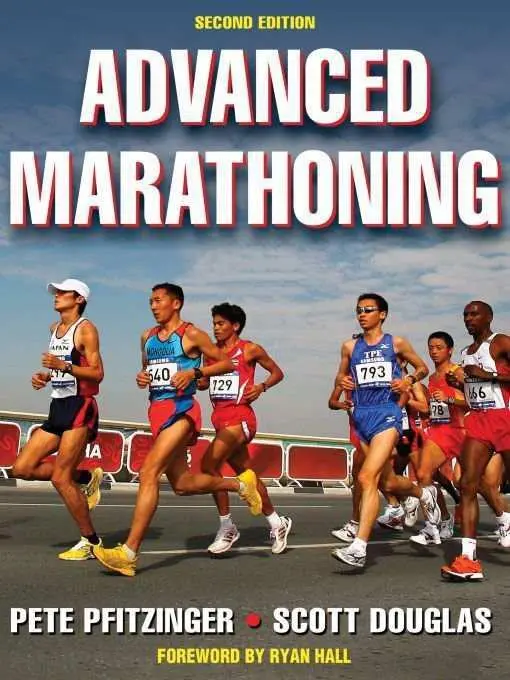
- Название:Advanced Marathoning
- Автор:
- Издательство:Human Kinetics - A
- Жанр:
- Год:2008
- ISBN:нет данных
- Рейтинг книги:5 / 5. Голосов: 1
-
Избранное:Добавить в избранное
- Отзывы:
-
Ваша оценка:
Advanced Marathoning: краткое содержание, описание и аннотация
Предлагаем к чтению аннотацию, описание, краткое содержание или предисловие (зависит от того, что написал сам автор книги «Advanced Marathoning»). Если вы не нашли необходимую информацию о книге — напишите в комментариях, мы постараемся отыскать её.
Advanced Marathoning — читать онлайн бесплатно полную книгу (весь текст) целиком
Ниже представлен текст книги, разбитый по страницам. Система сохранения места последней прочитанной страницы, позволяет с удобством читать онлайн бесплатно книгу «Advanced Marathoning», без необходимости каждый раз заново искать на чём Вы остановились. Поставьте закладку, и сможете в любой момент перейти на страницу, на которой закончили чтение.
Интервал:
Закладка:
When the marathon approaches, however, you need to cut back your training for a more-prolonged period so that you’re optimally rested for the marathon. Tapering your training is critical for reaching the starting line in peak fitness and with maximal energy reserves. The challenge during the last several weeks leading up to the marathon is to find the best balance between continued training to get into the best possible racing shape and resting to eliminate the fatigue of training. In this chapter, we’ll look at the best way to strike that crucial balance.
Benefits of Tapering
Put simply, tapering corrects the accumulated wear and tear of training. More specifically, it appears that tapering leads to improvements in running economy (how much oxygen you need to run at a given pace) and muscle strength. As you saw in chapter 1, improvements in running economy have a direct relationship to improvements in marathon race pace, so tapering is money in the bank in improving your marathon performance. In Lore of Running, Fourth Edition , renowned exercise physiologist Tim Noakes, MD, emphasizes that recovery of the shock-absorbing function of the muscles is an important benefit of tapering for marathon runners, which may explain the improvements in running economy. Interestingly, Noakes also suggests that “Perhaps the brain must also be adequately rested to ensure that it can continue to recruit the muscles appropriately once the pain of the marathon becomes increasingly severe” (page 621). Tapering also allows repair of the ongoing microcellular muscle damage from training and full replenishment of the glycogen stores in your muscles and liver, as well as bolstering your immune system.
A review in the International Journal of Sports Medicine of more than 50 scientific studies on tapering (Mujika 1998) concluded there’s no question that tapering works. Various studies have found improvements in performance or physiological measures of up to 16 percent when athletes taper their training before competition, with most studies finding performance improvements of 3 to 5 percent. In studies with runners, the benefit is generally around 2 to 4 percent, which equates to 3.5 to 7 minutes for a 3-hour marathoner.
So the potential gains from tapering are substantial. What’s the most effective way to cut back your training before the marathon?
Key Principles for Marathon Tapering
• Begin tapering 3 weeks before your marathon.
• Maintain training intensity.
• Reduce mileage.
• Make recovery days easy, or take days off.
• Optimize recovery strategies with proper diet and hydration.
• Eliminate muscle tightness with stretching, physical therapy, massage, and rest.
How Long Should You Taper?
Several studies investigating the relationship between racing performance at various distances and taper duration concluded that the optimal length of a taper is from 7 days to 3 weeks. For the marathon, the general consensus is to taper for a minimum of 2 weeks, with 3 weeks being optimal. Too short a taper will leave you tired on marathon day, whereas tapering for too long will lead to a loss of fitness. When you consider that any one workout will give you less than a 1 percent improvement in fitness, but that a well-designed taper can provide an improvement in race performance of several percent, it’s wise to err on the side of tapering too much rather than not enough. For the marathon, a well-designed 3-week taper will leave you optimally prepared and recovered for the race.
Paula Radcliffe
Fastest Marathon: 2:15:25
(world record)
Marathon Highlights:
First place, 2005 World
Championships;
2002, 2003, 2005 London;
2003 Chicago;
2004, 2007, 2008 New York City
It goes without saying that any world-record holder in the marathon is a supreme athlete. But that doesn’t mean that they’re all perfect, nor does it mean that they don’t make mistakes we can learn from. Although Paula Radcliffe’s career includes some very public misfortune, it also includes many positive lessons.
As noted in chapter 6, her two world records in the marathon have been models of optimal pacing; in both performances, she ran first and second halves that were within a minute of each other and ran her fastest miles at the end.
It’s also important to note that Radcliffe set her current shorter-distance PRs, such as 30:01 for 10,000 meters, only after becoming a marathoner. This is despite having been a serious runner for more than a decade before running her first marathon in 2002. For many runners, the great aerobic fitness they develop during a marathon buildup can continue to be cashed in after marathon season is over and they’ve returned to regular road races.

And who wouldn’t be inspired by Radcliffe’s victory at the 2007 New York City Marathon just nine months after giving birth? Like many women, Radcliffe claims that she felt physically stronger running after pregnancy.
Despite her world records and big-city victories, Radcliffe will also always be known for dropping out of the 2004 Olympic Marathon and sobbing on the curb. Soon after the race, she explained that taking anti-inflammatories for a leg injury had upset her stomach, rendering her unable to fuel properly. Subsequently, she noted that the stress of the event – expectations placed on her by the British press and by herself – had gotten to her. More than any other race, the marathon has the power to overwhelm. Try to remember that you’re doing it because you want to (at least we hope you are!) and that your performance in the race has no bearing on whether you’re a contributing member of society or all-around decent person.
There’s also a cautionary note in Radcliffe’s recent history. After winning New York City soon after giving birth, she was continually beset by injury. Trying to rush back to fitness to get to the start line of a given marathon compounded her bodily woes. In early 2008, a toe injury prevented her from starting April’s London Marathon. She then suffered a stress fracture in her thigh while trying to make up for lost time before the Beijing Olympics. She was able to resume running on land only in the month before the marathon there; despite daily cross-training, she simply lacked the running-specific fitness to race for 26.2 miles, and she finished twentythird. After the race, Radcliffe said that if it had been any race but the Olympics, she wouldn’t have started. Most of us can be much more flexible in planning our races, so if your training suffers a setback owing to injury or significant illness, be open to the idea of refocusing on another, later marathon.
How Should You Reduce Your Training to Improve Racing Performance?
The scientific evidence indicates that the key to effective tapering is to substantially reduce your mileage while maintaining the intensity of your training. Reducing the amount you run reduces accumulated fatigue to improve your marathon performance, while interspersing efforts that you have been doing throughout your buildup, including  O 2max intervals and strides, maintains the adaptations that you have worked hard to gain over the past several months. (During your taper, you should do shorter sessions at those paces, so while you’re maintaining the intensity of training, you’re still reducing the quantity of higher-intensity training.) A tune-up race 2 weeks before the marathon is also a key session for advancing your fitness (and, ideally, providing psychological reinforcement that you’re almost ready to roll).
Интервал:
Закладка:
Похожие книги на «Advanced Marathoning»
Представляем Вашему вниманию похожие книги на «Advanced Marathoning» списком для выбора. Мы отобрали схожую по названию и смыслу литературу в надежде предоставить читателям больше вариантов отыскать новые, интересные, ещё непрочитанные произведения.







Обсуждение, отзывы о книге «Advanced Marathoning» и просто собственные мнения читателей. Оставьте ваши комментарии, напишите, что Вы думаете о произведении, его смысле или главных героях. Укажите что конкретно понравилось, а что нет, и почему Вы так считаете.