Pfitzinger Pete - Advanced Marathoning
Здесь есть возможность читать онлайн «Pfitzinger Pete - Advanced Marathoning» весь текст электронной книги совершенно бесплатно (целиком полную версию без сокращений). В некоторых случаях можно слушать аудио, скачать через торрент в формате fb2 и присутствует краткое содержание. Год выпуска: 2008, Издательство: Human Kinetics - A, Жанр: Спорт, на английском языке. Описание произведения, (предисловие) а так же отзывы посетителей доступны на портале библиотеки ЛибКат.
- Название:Advanced Marathoning
- Автор:
- Издательство:Human Kinetics - A
- Жанр:
- Год:2008
- ISBN:нет данных
- Рейтинг книги:5 / 5. Голосов: 1
-
Избранное:Добавить в избранное
- Отзывы:
-
Ваша оценка:
Advanced Marathoning: краткое содержание, описание и аннотация
Предлагаем к чтению аннотацию, описание, краткое содержание или предисловие (зависит от того, что написал сам автор книги «Advanced Marathoning»). Если вы не нашли необходимую информацию о книге — напишите в комментариях, мы постараемся отыскать её.
Advanced Marathoning — читать онлайн бесплатно полную книгу (весь текст) целиком
Ниже представлен текст книги, разбитый по страницам. Система сохранения места последней прочитанной страницы, позволяет с удобством читать онлайн бесплатно книгу «Advanced Marathoning», без необходимости каждый раз заново искать на чём Вы остановились. Поставьте закладку, и сможете в любой момент перейти на страницу, на которой закончили чтение.
Интервал:
Закладка:
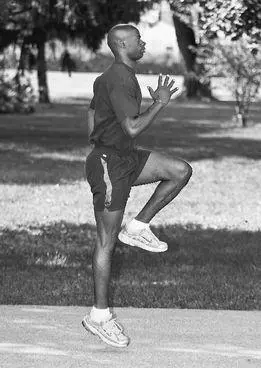
But there’s something else you can do to improve your form and, therefore, how efficiently you run. You’ve probably seen sprinters doing various combinations of high-knee running, butt kicks, skipping, and so on. Well, several of these drills are great for distance runners too. First, these exercises can improve your coordination and running form. Second, they lead to gains in strength endurance that can allow you to maintain your stride length throughout a race. Drills up a moderate slope provide even greater resistance. By concentrating on a high knee lift; a complete toe-off; good arm drive; a relaxed neck with the head positioned over the body; relaxed shoulders, arms, and hands; minimal vertical movement (not bouncing with each stride); and an upright posture (not leaning too far forward), you will improve your ability to hold good running form and maximize your running efficiency. When you consider how even a slight flaw in your form will be magnified over the course of a marathon, and when you add the likely scenario of your form, no matter how good, faltering in the last few miles of a marathon, it should be obvious why working to streamline your running technique will help you be a faster marathoner.
When doing drills, the key is to exaggerate various aspects of the running stride and to concentrate on maintaining your form as you begin to fatigue. This attention to various aspects of the running gait will, over time, become ingrained, and pay dividends late in your marathon.
There are endless drills you could do; we’ve selected four that will significantly help your marathoning. They’ll help you maintain your stride length and lessen your ground-contact time, two aspects of running form that can deteriorate with lots of relatively slow marathon training.
You should do drills when you are warmed up but still fresh – there is no use trying to improve your coordination and technique when you are already tired. You’ll notice benefits if you do them regularly, at least once, and preferably twice, per week. A good way to easily incorporate drills into your routine is to do them before a session of striders and before harder workouts such as tempo runs and  O 2max sessions.
Perform the drills as a circuit; that is, do one repetition of each, and then repeat the sequence. Do one repetition of each drill for 15 to 20 meters, and rest before the next one by walking back to the starting point. Visualize yourself completing the drill perfectly.
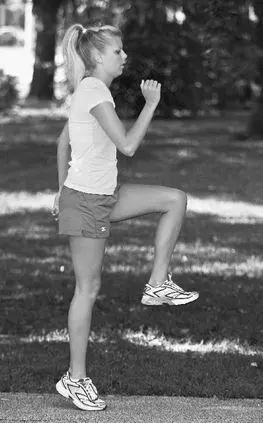
SKIP MARCH WALK
How to do it:
Begin by walking slowly forward on the balls of your feet using small steps.
Raise one knee to hip level so that your thigh is parallel to the ground.
Rise on the toes of the other foot, straightening your back leg.
Your trunk should be held upright, with your chest out and shoulders back.
Keep your head still and neck relaxed.
Swing your arms forward and back in an exaggerated running motion.
Keep your shoulders, arms, and hands relaxed.
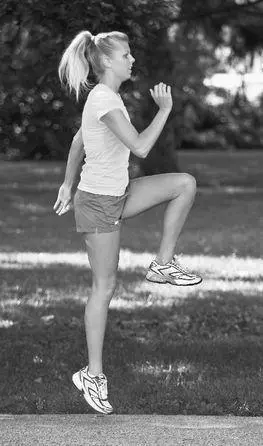
SKIP MARCH RUN
How to do it:
Adopt the same start posture as for skip march walk. Follow the same movements as for skip march walk, but increase your leg and arm drive to a more-exaggerated skipping motion.
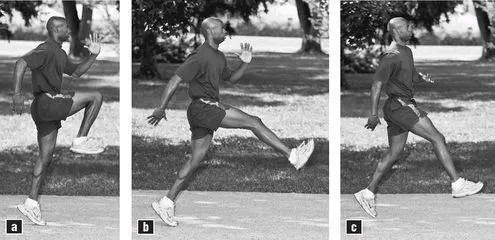
KICKOUT
How to do it:
Walk forward slowly on the balls of your feet.
Raise one knee (photo a ), and as the knee approaches hip level, straighten the knee to nearly full extension. (Your leg will end up nearly horizontal.)
Allow your momentum to carry your body forward (photo b ), and hop on your back leg before stepping forward (photo c ) to repeat with the other leg.
Hold your trunk upright, with your head still and your arms swinging forward in a normal running motion.
As you become more adept at the movement over time, progress from walking to jogging while performing the kickouts.
FAST FEET
How to do it:
In this drill, you run by taking short steps as quickly as possible.
Stay on the balls of your feet at all times, and use a rapid arm movement.
Don’t lean too far forward. Try to keep your trunk upright and your head still.
Aerobic Cross-Training
Predictable training errors, such as increasing mileage or adding speed work too quickly, lead to the majority of running injuries. Just as the risk of coronary artery disease can be reduced through regular exercise, so can the risk of running injuries be reduced through modifying risk factors. One way to do this is to reduce pounding on your legs and back by substituting cross-training for a portion of your running.
The primary reason to cross-train is to provide additional cardiovascular fitness without increasing the repetitive wear and tear associated with running. Cross-training indoors can also be useful when the weather or pollution levels prevent you from running outside. Unfortunately, many runners cross-train only when injured and then return exclusively to running as soon as the injury recovers. Sure, cross-training is highly effective for maintaining fitness during times of injury, but that shouldn’t be the only time that most runners do it. If you’re careful about increases in mileage and intensity, the surfaces you run on, and the like, and you still can’t consistently reach the level of weekly mileage you’d like, then you should incorporate cross-training into your training program year-round.
No form of cross-training is a perfect substitute for running because your body adapts very specifically to training. Though you will gain cardiovascular benefits from cross-training, your neuromuscular system will not make similar gains because the movement patterns are different in cross-training activities. That’s okay, however, because cross-training should be viewed as a supplement to, not a replacement for, your running. Use cross-training in place of recovery runs and, if necessary, in place of a portion of your general aerobic conditioning. The advantage of using it for recovery training is that the increased blood flow improves your recovery without increasing the cumulative impact forces on your body.
But won’t your racing performances suffer if you replace some of your running with cross-training? The specificity-of-training principle states that your body adapts very specifically to the type of training you do. That’s why you won’t have much success as a runner by doing all your training on the bike or in the pool. But if the majority of your training is running, you can enhance your running performance by doing other types of aerobic workouts.
Scientific evidence suggests that reasonably well-trained runners can improve their running performance through cross-training, but the improvement is likely to be less than through increased running.
Cross-training activities that work the large muscle groups of the legs (such as cycling, stair climbing, in-line skating, rowing, deep-water running, and cross-country skiing) are most similar to running and should lead to the greatest improvements in performance, whereas activities less similar to running (such as swimming) would likely lead to smaller improvements in running performance.
Читать дальшеИнтервал:
Закладка:
Похожие книги на «Advanced Marathoning»
Представляем Вашему вниманию похожие книги на «Advanced Marathoning» списком для выбора. Мы отобрали схожую по названию и смыслу литературу в надежде предоставить читателям больше вариантов отыскать новые, интересные, ещё непрочитанные произведения.







Обсуждение, отзывы о книге «Advanced Marathoning» и просто собственные мнения читателей. Оставьте ваши комментарии, напишите, что Вы думаете о произведении, его смысле или главных героях. Укажите что конкретно понравилось, а что нет, и почему Вы так считаете.