Pfitzinger Pete - Advanced Marathoning
Здесь есть возможность читать онлайн «Pfitzinger Pete - Advanced Marathoning» весь текст электронной книги совершенно бесплатно (целиком полную версию без сокращений). В некоторых случаях можно слушать аудио, скачать через торрент в формате fb2 и присутствует краткое содержание. Год выпуска: 2008, Издательство: Human Kinetics - A, Жанр: Спорт, на английском языке. Описание произведения, (предисловие) а так же отзывы посетителей доступны на портале библиотеки ЛибКат.
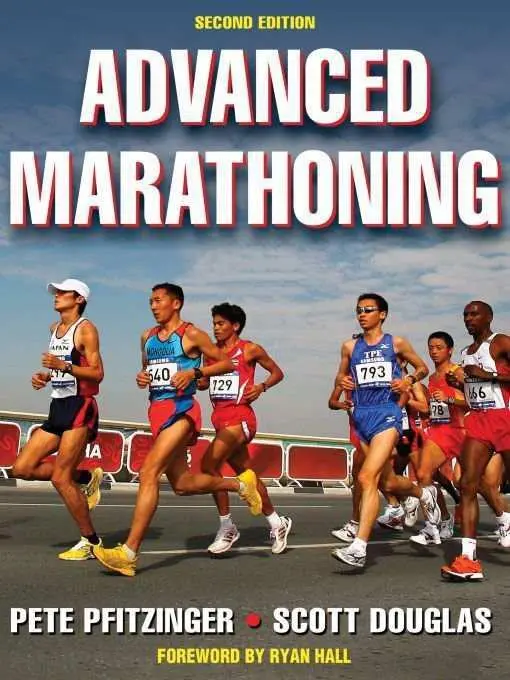
- Название:Advanced Marathoning
- Автор:
- Издательство:Human Kinetics - A
- Жанр:
- Год:2008
- ISBN:нет данных
- Рейтинг книги:5 / 5. Голосов: 1
-
Избранное:Добавить в избранное
- Отзывы:
-
Ваша оценка:
Advanced Marathoning: краткое содержание, описание и аннотация
Предлагаем к чтению аннотацию, описание, краткое содержание или предисловие (зависит от того, что написал сам автор книги «Advanced Marathoning»). Если вы не нашли необходимую информацию о книге — напишите в комментариях, мы постараемся отыскать её.
Advanced Marathoning — читать онлайн бесплатно полную книгу (весь текст) целиком
Ниже представлен текст книги, разбитый по страницам. Система сохранения места последней прочитанной страницы, позволяет с удобством читать онлайн бесплатно книгу «Advanced Marathoning», без необходимости каждый раз заново искать на чём Вы остановились. Поставьте закладку, и сможете в любой момент перейти на страницу, на которой закончили чтение.
Интервал:
Закладка:
Although the evidence suggests that cross-training can lead to improved performance in moderately trained or even well-trained runners, no scientific evidence exists concerning cross-training for elite runners, and the specificity-of-training principle likely becomes more critical the higher the level of performance.
For all but the elite, then, it appears that if you increase your training volume by cross-training, you can improve your running performance. The improvement, however, won’t be as large as if you had increased your mileage. This point goes right to the heart of the mileage versus injury trade-off. Sure, you would improve more by increasing your running, but you would also increase your risk of injury. The challenge for marathoners is to manage that trade-off by running as much as you can handle before the risk of injury shoots up.
There are many ways to cross-train, including cycling, water running, in-line skating, rowing or kayaking, cross-country skiing, stair climbing, and swimming. Let’s look at the pluses and minuses for marathon runners of the various types of cross-training.
Cycling offers many options in that you can ride a bike outdoors, use your bike on a wind trainer indoors, or use an exercise bike at home or at a gym. An advantage of cycling is that it works the cardiovascular system while eliminating the impact forces that cause most running injuries. You can therefore add cycling to your training program with little risk of bringing on typical running injuries. An advantage of cycling compared with other cross-training options is that you get to cover ground and feel the wind in your hair, just as in running.
The downsides of cycling are the risk of getting squashed by a car, the large amount of time required compared with running, and the risk of developing a short running stride. The first downside is all too possible, particularly for runners with good cardiovascular fitness but poor bike-handling skills; to keep your heart rate up, you’ll likely have to maintain speeds that could put you in danger. In a low-traffic area, cycling outdoors is a great option, but if you’re limited to cycling in an urban area without bike paths, then you may want to stay with the more-boring indoor options.
Riding indoors can be a surprisingly satisfying experience because you can concentrate on your workout without distractions or dangers such as traffic lights and cars. Although the maximum time a sane person should sit on a bike indoors is about an hour and a half, when injured, Scott laid claim to the dubious achievement of a 3-hour, 40-minute ride in his garage. (This is what iPods were invented for, right?) During times of injury, an indoor bike can also be used for lactate-threshold training.
Haile Gebrselassie
Fastest Marathon: 2:03:59
(world record)
Marathon Highlights:
First place, 2006-2008 Berlin,
2005 Amsterdam;
Three fastest marathons in history
Even if he had never run the marathon, Haile Gebrselassie could have been considered the greatest distance runner in history. But once he moved up to the longest Olympic running event and conquered it as well, all doubt was gone – there has never been another runner in the modern era like Gebrselassie. No one can match his range (from a world indoor 1,500 meters title to a world record in the marathon), his accomplishments (nearly 30 world records, from 3,000 meters indoors to the marathon) and his longevity (his marathon world record in 2007 came an astounding 14 years after his first senior world title).
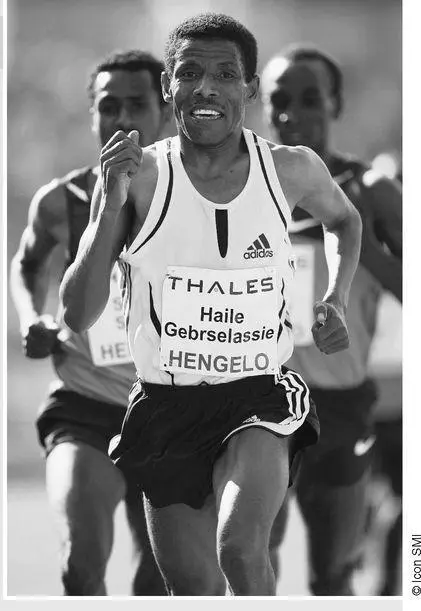
Yet Gebrselassie didn’t immediately master the marathon. In his first one as an adult, at London in 2002, he faded over the last few miles to finish a well-beaten third behind Khalid Khannouchi and Paul Tergat. (Debuting in 2:06:35 is hardly a cause for shame, but Gebrselassie was unaccustomed to losing.) “I have to change a lot of things before I can become a good marathon runner,” he said at the time. One change he made was to become less of a forefoot runner. Gebrselassie believed that the springy stride resembling a sprinter’s that had served him so well on the track was costing him energy over the course of a marathon. He also put greater emphasis on finishing his long runs at marathon race pace.
Gebrselassie returned to the marathon in 2005 with a win at Amsterdam. Starting that year, he ran the fastest time in the world for four years straight, including his 2:03:59 world record at Berlin in 2008.
After all this time, he remains as motivated as ever to train three or more hours a day at altitude. Why? “It’s not for money,” he says, “because I have enough, and I am making even more with my investments and my businesses. It’s simply the thrill of racing.” Finding meaningful goals – in Gebrselassie’s case, an Olympic gold medal in the marathon and a sub-2:04 clocking – are key to any long career in the marathon.
Gebrselassie is steeped in the Ethiopian tradition of near-daily form drills and calisthenics. No doubt his long career and beautiful stride reflect his dedication to them. But even the man whose biography is simply titled “The Greatest” has chinks in his armor. Gebrselassie has been bothered by Achilles tendon problems for much of his career. If he slacks off on doing calf raises and shin-muscle-strengthening exercises, his aches resume. All of us can have healthier, longer running careers if we’re diligent about addressing our inherent weak spots with the right stretching and strengthening exercises.
To get a similar workout to running requires about three times as long on a bike. But because the main rationale for recovery runs is simply to increase blood flow through the muscles, you can replace a 30-minute recovery run with about 45 minutes on the bike.
Because cycling is highly repetitive and uses a limited range of motion, it presents a danger of shortening your stride. You can minimize this concern by walking and then running slowly for several minutes after cycling and then stretching your hamstrings, quadriceps, and hip flexors. Also, be sure to keep the bike in an easy-enough gear, with RPMs of at least 90, so that cycling doesn’t detract from your running turnover.
Unfortunately, a number of running injuries are aggravated by some types of cross-training. Fortunately, with most running injuries, you can safely run in the water. Deep-water running with a flotation vest provides an excellent training stimulus and simulates land running more closely than most other cross-training options. Running in the water is a total-body exercise that works your legs, trunk, and arms and positively stresses your cardiovascular system.
Several studies have verified that runners can use deep-water running to maintain aerobic fitness, lactate threshold, running economy, and time-trial performance for at least 6 weeks. There’s little question, then, that water running is an effective method for runners to stay fit.
Water-running technique is an area of some debate. Some coaches insist that you should try to simulate land-running form as closely as possible. Though that’s a nice ideal, the most important consideration is to maintain your training intensity to the highest degree possible; if your form needs improvement, so be it.
Regardless of your running form, your stride rate will be slower during water running because of the increased resistance of moving your legs through water. If you try to simulate land running too closely, your stride rate will be even slower. For that reason, don’t worry if you don’t bring your leg behind your body to the same degree as in land running; just find a happy compromise with decent form and a reasonable rate of leg turnover.
Читать дальшеИнтервал:
Закладка:
Похожие книги на «Advanced Marathoning»
Представляем Вашему вниманию похожие книги на «Advanced Marathoning» списком для выбора. Мы отобрали схожую по названию и смыслу литературу в надежде предоставить читателям больше вариантов отыскать новые, интересные, ещё непрочитанные произведения.







Обсуждение, отзывы о книге «Advanced Marathoning» и просто собственные мнения читателей. Оставьте ваши комментарии, напишите, что Вы думаете о произведении, его смысле или главных героях. Укажите что конкретно понравилось, а что нет, и почему Вы так считаете.