Pfitzinger Pete - Advanced Marathoning
Здесь есть возможность читать онлайн «Pfitzinger Pete - Advanced Marathoning» весь текст электронной книги совершенно бесплатно (целиком полную версию без сокращений). В некоторых случаях можно слушать аудио, скачать через торрент в формате fb2 и присутствует краткое содержание. Год выпуска: 2008, Издательство: Human Kinetics - A, Жанр: Спорт, на английском языке. Описание произведения, (предисловие) а так же отзывы посетителей доступны на портале библиотеки ЛибКат.
- Название:Advanced Marathoning
- Автор:
- Издательство:Human Kinetics - A
- Жанр:
- Год:2008
- ISBN:нет данных
- Рейтинг книги:5 / 5. Голосов: 1
-
Избранное:Добавить в избранное
- Отзывы:
-
Ваша оценка:
Advanced Marathoning: краткое содержание, описание и аннотация
Предлагаем к чтению аннотацию, описание, краткое содержание или предисловие (зависит от того, что написал сам автор книги «Advanced Marathoning»). Если вы не нашли необходимую информацию о книге — напишите в комментариях, мы постараемся отыскать её.
Advanced Marathoning — читать онлайн бесплатно полную книгу (весь текст) целиком
Ниже представлен текст книги, разбитый по страницам. Система сохранения места последней прочитанной страницы, позволяет с удобством читать онлайн бесплатно книгу «Advanced Marathoning», без необходимости каждый раз заново искать на чём Вы остановились. Поставьте закладку, и сможете в любой момент перейти на страницу, на которой закончили чтение.
Интервал:
Закладка:
• Reduced Muscle Stiffness.Cooling down also improves recovery by reducing muscle stiffness. A relaxing cool-down makes the muscles more resilient, which can reduce the risk of injury after a race or hard workout.
Your cool-down should start with easy running for 10 to 20 minutes. (If you’re too tired to run, then walk for an equivalent amount of time, or try some easy cross-training.) The optimal clearance of lactate, adrenaline, and so on occurs if you start your cool-down run at about 60 to 75 percent of your maximum heart rate and slow down to a slow jog or walk for the last 5 minutes. After running, your muscles are warm and have very good blood flow, which increases their ability to stretch without injury, so this is the perfect time to gently stretch your muscles.
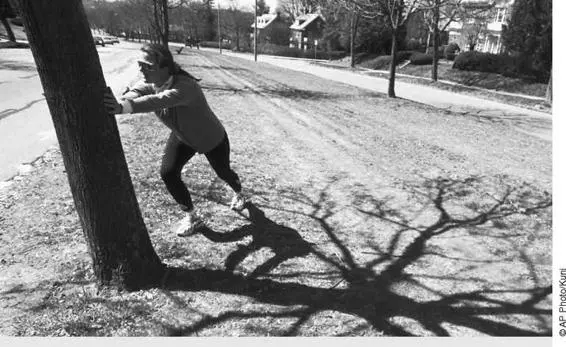
Because muscles are warm and therefore less susceptible to injury, after a run is a great time to gently stretch.
In this chapter, we look at how ensuring adequate recovery allows you to ©get the most from your long runs and hard workouts. Successful marathoning, however, often involves more than just running. Just as true recovery days can mean the difference between adequate and optimal progress in your training, supplemental training, such as flexibility work and strength training, can help you get the biggest bang for your marathon-training buck.
Chapter 4
Supplementary Training
This chapter focuses on several important aspects of training that can make the difference between mediocrity and marathoning excellence. The chapter discusses five types of supplementary training that often get lumped into the category of cross-training but that really deserve to be treated separately.
First we look at the importance of flexibility for marathon performance and how to improve it. Next we examine core stability training, which is a vitally important but often overlooked aspect of training, particularly for marathoners. Third, we look at whether strength training is beneficial for marathoners and how to incorporate it into your overall training program. Then we describe a few technique drills that can improve your running form. Finally we discuss various forms of aerobic cross-training that will enhance your cardiovascular fitness and reduce your likelihood of incurring injuries.
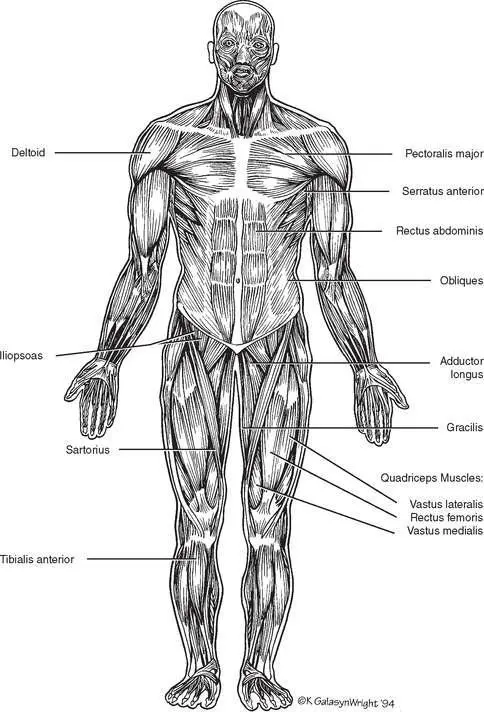
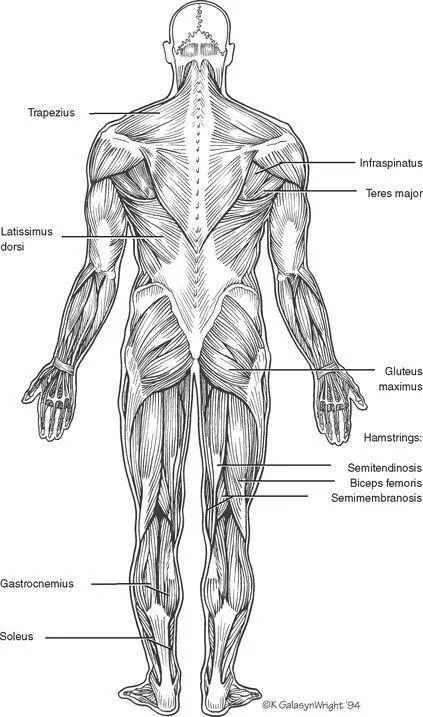
For the flexibility, core, resistance, and form exercises, we’ve given a brief explanation of how the exercise in question benefits marathoners. If you have an especially hard time with any of the exercises, you’re most likely weak or tight – or both! – in that area. Addressing your most troublesome areas will lead to faster, more enjoyable training and racing. Figure 4.1 provides a diagram of the muscles of the body to use a reference when performing the stretches and exercises in this chapter.
Supplementary work, especially core stability training, form drills, and flexibility exercises, is easy to skip when you’re tired and your main training goal is getting in your long runs and tempo runs. These extra sessions, however, will provide refreshing variety to your training. Even more important, by correcting imbalances and weaknesses in your body, they can contribute to better running form. With that improved form, you can train harder and longer at a lower risk of injury, and you will be able to maintain a more-effective running technique throughout the marathon. When scheduling your training, count time for these sessions as an integral part of your marathon preparation.
Flexibility Training
Marathon training takes a toll on the body. One of the greatest costs of all that mileage is a loss of flexibility. Improving your natural range of motion can improve your running technique and increase your stride length while reducing your risk of injury.
Tight muscles provide resistance that limits your ability to stride out. Stretching not only increases your muscle length but also improves the length of the connective tissue surrounding the muscle fibers. Your regular stretching routine before and after running helps maintain your flexibility but is unlikely to improve it. To achieve gains in flexibility, include one or two training sessions of at least 30 minutes per week devoted to flexibility exercises or yoga.
Always do your stretching when your muscles are warmed up. A warm muscle stretches more easily and greatly reduces the likelihood of injury while stretching. If you’re doing a specific flexibility training session, then walk, jog, or cycle for 5 minutes or so to improve the blood flow in your muscles. If you’re doing a normal training run, then warm up for 5 minutes and stretch before starting the run. We know you’ve probably heard this advice before, and you probably know some good runners in your area who pride themselves on never stretching, but there’s no getting around the facts: Even a small amount of stretching before running will improve the flow of your running and help improve your running form. After running, try to allow a minimum of 10 minutes for stretching your major muscle groups.
Stretching should be firm enough to create adequate tension in the muscle, but gentle enough that your muscles can relax. If you stretch aggressively, your muscles will tighten in a protective reflex to prevent straining or tearing of muscle fibers. You need to stretch gently and consistently to obtain improved length in the muscle and surrounding connective tissue.
There are several schools of thought on how long to stretch and how many times to repeat a stretch. The traditional recommendation is to hold a stretch for at least 30 seconds and to do each stretch once or twice. To strike an optimal balance between effectiveness and time-efficiency, we recommend holding stretches for 20 to 30 seconds and repeating each stretch twice.
Be sure to breathe while you stretch. Some runners inadvertently hold their breath while stretching, thereby reducing stretching’s effectiveness.
Two important areas for marathoners to focus on are the hip flexors and hamstrings. Your hip flexors (primarily iliopsoas and rectus femoris) are the muscles that lift your thigh relative to your hip. These are some of the strongest muscles in the body, and they tend to become short and inflexible in runners. Improving the flexibility of your hip flexors increases your thigh’s ability to move back relative to your pelvis, thereby allowing your stride length to increase.
Tight hamstrings restrict your stride length by preventing your thigh from swinging forward completely. The combination of tight hip flexors and tight hamstrings causes the familiar marathoners’ shuffle. Stretching your hamstrings consistently (a slow but steady process) will allow your stride to increase to its natural length.
The following program provides total-body stretches and is recommended if you’re serious about improving your flexibility. It’s ideal for after your run, or you can do it as a stand-alone session after a few minutes of walking, jogging, or cycling to warm your muscles.
Do each stretch twice. Perform the first repetition with a gentle intensity and the second stretch with a moderate intensity. Don’t stretch forcefully. If you don’t have time to do the entire program, then select the exercises that work your tightest muscles.
Читать дальшеИнтервал:
Закладка:
Похожие книги на «Advanced Marathoning»
Представляем Вашему вниманию похожие книги на «Advanced Marathoning» списком для выбора. Мы отобрали схожую по названию и смыслу литературу в надежде предоставить читателям больше вариантов отыскать новые, интересные, ещё непрочитанные произведения.






Обсуждение, отзывы о книге «Advanced Marathoning» и просто собственные мнения читателей. Оставьте ваши комментарии, напишите, что Вы думаете о произведении, его смысле или главных героях. Укажите что конкретно понравилось, а что нет, и почему Вы так считаете.