Гилберт Честертон - All Things Considered
Здесь есть возможность читать онлайн «Гилберт Честертон - All Things Considered» весь текст электронной книги совершенно бесплатно (целиком полную версию без сокращений). В некоторых случаях можно слушать аудио, скачать через торрент в формате fb2 и присутствует краткое содержание. Год выпуска: 2014, Издательство: epubBooks Classics, Жанр: Публицистика, Критика, на английском языке. Описание произведения, (предисловие) а так же отзывы посетителей доступны на портале библиотеки ЛибКат.
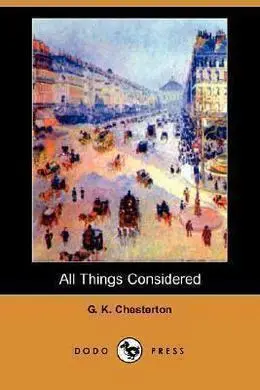
- Название:All Things Considered
- Автор:
- Издательство:epubBooks Classics
- Жанр:
- Год:2014
- ISBN:нет данных
- Рейтинг книги:3 / 5. Голосов: 1
-
Избранное:Добавить в избранное
- Отзывы:
-
Ваша оценка:
All Things Considered: краткое содержание, описание и аннотация
Предлагаем к чтению аннотацию, описание, краткое содержание или предисловие (зависит от того, что написал сам автор книги «All Things Considered»). Если вы не нашли необходимую информацию о книге — напишите в комментариях, мы постараемся отыскать её.
All Things Considered — читать онлайн бесплатно полную книгу (весь текст) целиком
Ниже представлен текст книги, разбитый по страницам. Система сохранения места последней прочитанной страницы, позволяет с удобством читать онлайн бесплатно книгу «All Things Considered», без необходимости каждый раз заново искать на чём Вы остановились. Поставьте закладку, и сможете в любой момент перейти на страницу, на которой закончили чтение.
Интервал:
Закладка:
Let me be considered therefore to have made quite clear that I believe with a quite special intensity in the independent consideration of Scotland and Ireland as apart from England. I believe that, in the proper sense of the words, Scotland is an independent nation, even if Edward VII. is the King of Scotland. I believe that, in the proper sense of words, Ireland is an independent nation, even if Edward VII. is King of Ireland. But the fact is that I have an even bolder and wilder belief than either of these. I believe that England is an independent nation. I believe that England also has its independent colour and history, and meaning. I believe that England could produce costumes quite as queer as the kilt; I believe that England has heroes fully as untranslateable as Brian Boru, and consequently I believe that Edward VII. is, among his innumerable other functions, really King of England. If my Scotch friends insist, let us call it one of his quite obscure, unpopular, and minor titles; one of his relaxations. A little while ago he was Duke of Cornwall; but for a family accident he might still have been King of Hanover. Nor do I think that we should blame the simple Cornishmen if they spoke of him in a rhetorical moment by his Cornish title, nor the well–meaning Hanoverians if they classed him with Hanoverian Princes.
Now it so happens that in the passage complained of I said the King of England merely because I meant the King of England. I was speaking strictly and especially of English Kings, of Kings in the tradition of the old Kings of England. I wrote as an English nationalist keenly conscious of the sacred boundary of the Tweed that keeps (or used to keep) our ancient enemies at bay. I wrote as an English nationalist resolved for one wild moment to throw off the tyranny of the Scotch and Irish who govern and oppress my country. I felt that England was at least spiritually guarded against these surrounding nationalities. I dreamed that the Tweed was guarded by the ghosts of Scropes and Percys; I dreamed that St. George's Channel was guarded by St. George. And in this insular security I spoke deliberately and specifically of the King of England, of the representative of the Tudors and Plantagenets. It is true that the two Kings of England, of whom I especially spoke, Charles II. and George III., had both an alien origin, not very recent and not very remote. Charles II. came of a family originally Scotch. George III. came of a family originally German. But the same, so far as that goes, could be said of the English royal houses when England stood quite alone. The Plantagenets were originally a French family. The Tudors were originally a Welsh family. But I was not talking of the amount of English sentiment in the English Kings. I was talking of the amount of English sentiment in the English treatment and popularity of the English Kings. With that Ireland and Scotland have nothing whatever to do.
Charles II. may, for all I know, have not only been King of Scotland; he may, by virtue of his temper and ancestry, have been a Scotch King of Scotland. There was something Scotch about his combination of clear–headedness with sensuality. There was something Scotch about his combination of doing what he liked with knowing what he was doing. But I was not talking of the personality of Charles, which may have been Scotch. I was talking of the popularity of Charles, which was certainly English. One thing is quite certain: whether or no he ever ceased to be a Scotch man, he ceased as soon as he conveniently could to be a Scotch King. He had actually tried the experiment of being a national ruler north of the Tweed, and his people liked him as little as he liked them. Of Presbyterianism, of the Scottish religion, he left on record the exquisitely English judgment that it was "no religion for a gentleman." His popularity then was purely English; his royalty was purely English; and I was using the words with the utmost narrowness and deliberation when I spoke of this particular popularity and royalty as the popularity and royalty of a King of England. I said of the English people specially that they like to pick up the King's crown when he has dropped it. I do not feel at all sure that this does apply to the Scotch or the Irish. I think that the Irish would knock his crown off for him. I think that the Scotch would keep it for him after they had picked it up.
For my part, I should be inclined to adopt quite the opposite method of asserting nationality. Why should good Scotch nationalists call Edward VII. the King of Britain? They ought to call him King Edward I. of Scotland. What is Britain? Where is Britain? There is no such place. There never was a nation of Britain; there never was a King of Britain; unless perhaps Vortigern or Uther Pendragon had a taste for the title. If we are to develop our Monarchy, I should be altogether in favour of developing it along the line of local patriotism and of local proprietorship in the King. I think that the Londoners ought to call him the King of London, and the Liverpudlians ought to call him the King of Liverpool. I do not go so far as to say that the people of Birmingham ought to call Edward VII. the King of Birmingham; for that would be high treason to a holier and more established power. But I think we might read in the papers: "The King of Brighton left Brighton at half–past two this afternoon," and then immediately afterwards, "The King of Worthing entered Worthing at ten minutes past three." Or, "The people of Margate bade a reluctant farewell to the popular King of Margate this morning," and then, "His Majesty the King of Ramsgate returned to his country and capital this afternoon after his long sojourn in strange lands." It might be pointed out that by a curious coincidence the departure of the King of Oxford occurred a very short time before the triumphal arrival of the King of Reading. I cannot imagine any method which would more increase the kindly and normal relations between the Sovereign and his people. Nor do I think that such a method would be in any sense a depreciation of the royal dignity; for, as a matter of fact, it would put the King upon the same platform with the gods. The saints, the most exalted of human figures, were also the most local. It was exactly the men whom we most easily connected with heaven whom we also most easily connected with earth.
Thoughts Around Koepenick
A famous and epigrammatic author said that life copied literature; it seems clear that life really caricatures it. I suggested recently that the Germans submitted to, and even admired, a solemn and theatrical assertion of authority. A few hours after I had sent up my "copy," I saw the first announcement of the affair of the comic Captain at Koepenick. The most absurd part of this absurd fraud (at least, to English eyes) is one which, oddly enough, has received comparatively little comment. I mean the point at which the Mayor asked for a warrant, and the Captain pointed to the bayonets of his soldiery and said. "These are my authority." One would have thought any one would have known that no soldier would talk like that. The dupes were blamed for not knowing that the man wore the wrong cap or the wrong sash, or had his sword buckled on the wrong way; but these are technicalities which they might surely be excused for not knowing. I certainly should not know if a soldier's sash were on inside out or his cap on behind before. But I should know uncommonly well that genuine professional soldiers do not talk like Adelphi villains and utter theatrical epigrams in praise of abstract violence.
We can see this more clearly, perhaps, if we suppose it to be the case of any other dignified and clearly distinguishable profession. Suppose a Bishop called upon me. My great modesty and my rather distant reverence for the higher clergy might lead me certainly to a strong suspicion that any Bishop who called on me was a bogus Bishop. But if I wished to test his genuineness I should not dream of attempting to do so by examining the shape of his apron or the way his gaiters were done up. I have not the remotest idea of the way his gaiters ought to be done up. A very vague approximation to an apron would probably take me in; and if he behaved like an approximately Christian gentleman he would be safe enough from my detection. But suppose the Bishop, the moment he entered the room, fell on his knees on the mat, clasped his hands, and poured out a flood of passionate and somewhat hysterical extempore prayer, I should say at once and without the smallest hesitation, "Whatever else this man is, he is not an elderly and wealthy cleric of the Church of England. They don't do such things." Or suppose a man came to me pretending to be a qualified doctor, and flourished a stethoscope, or what he said was a stethoscope. I am glad to say that I have not even the remotest notion of what a stethoscope looks like; so that if he flourished a musical–box or a coffee–mill it would be all one to me. But I do think that I am not exaggerating my own sagacity if I say that I should begin to suspect the doctor if on entering my room he flung his legs and arms about, crying wildly, "Health! Health! priceless gift of Nature! I possess it! I overflow with it! I yearn to impart it! Oh, the sacred rapture of imparting health!" In that case I should suspect him of being rather in a position to receive than to offer medical superintendence.
Читать дальшеИнтервал:
Закладка:
Похожие книги на «All Things Considered»
Представляем Вашему вниманию похожие книги на «All Things Considered» списком для выбора. Мы отобрали схожую по названию и смыслу литературу в надежде предоставить читателям больше вариантов отыскать новые, интересные, ещё непрочитанные произведения.

Обсуждение, отзывы о книге «All Things Considered» и просто собственные мнения читателей. Оставьте ваши комментарии, напишите, что Вы думаете о произведении, его смысле или главных героях. Укажите что конкретно понравилось, а что нет, и почему Вы так считаете.