Гилберт Честертон - All Things Considered
Здесь есть возможность читать онлайн «Гилберт Честертон - All Things Considered» весь текст электронной книги совершенно бесплатно (целиком полную версию без сокращений). В некоторых случаях можно слушать аудио, скачать через торрент в формате fb2 и присутствует краткое содержание. Год выпуска: 2014, Издательство: epubBooks Classics, Жанр: Публицистика, Критика, на английском языке. Описание произведения, (предисловие) а так же отзывы посетителей доступны на портале библиотеки ЛибКат.
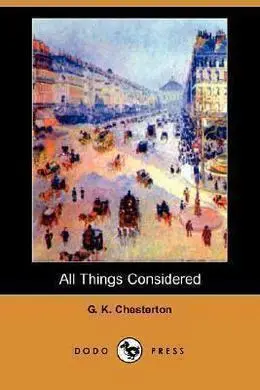
- Название:All Things Considered
- Автор:
- Издательство:epubBooks Classics
- Жанр:
- Год:2014
- ISBN:нет данных
- Рейтинг книги:3 / 5. Голосов: 1
-
Избранное:Добавить в избранное
- Отзывы:
-
Ваша оценка:
All Things Considered: краткое содержание, описание и аннотация
Предлагаем к чтению аннотацию, описание, краткое содержание или предисловие (зависит от того, что написал сам автор книги «All Things Considered»). Если вы не нашли необходимую информацию о книге — напишите в комментариях, мы постараемся отыскать её.
All Things Considered — читать онлайн бесплатно полную книгу (весь текст) целиком
Ниже представлен текст книги, разбитый по страницам. Система сохранения места последней прочитанной страницы, позволяет с удобством читать онлайн бесплатно книгу «All Things Considered», без необходимости каждый раз заново искать на чём Вы остановились. Поставьте закладку, и сможете в любой момент перейти на страницу, на которой закончили чтение.
Интервал:
Закладка:
No; if you were setting women free for something else, I might be more melted. If you can assure me, privately and gravely, that you are setting women free to dance on the mountains like mænads, or to worship some monstrous goddess, I will make a note of your request. If you are quite sure that the ladies in Brixton, the moment they give up cooking, will beat great gongs and blow horns to Mumbo–Jumbo, then I will agree that the occupation is at least human and is more or less entertaining. Women have been set free to be Bacchantes; they have been set free to be Virgin Martyrs; they have been set free to be Witches. Do not ask them now to sink so low as the higher culture.
I have my own little notions of the possible emancipation of women; but I suppose I should not be taken very seriously if I propounded them. I should favour anything that would increase the present enormous authority of women and their creative action in their own homes. The average woman, as I have said, is a despot; the average man is a serf. I am for any scheme that any one can suggest that will make the average woman more of a despot. So far from wishing her to get her cooked meals from outside, I should like her to cook more wildly and at her own will than she does. So far from getting always the same meals from the same place, let her invent, if she likes, a new dish every day of her life. Let woman be more of a maker, not less. We are right to talk about "Woman;" only blackguards talk about women. Yet all men talk about men, and that is the whole difference. Men represent the deliberative and democratic element in life. Woman represents the despotic.
The Modern Martyr
The incident of the Suffragettes who chained themselves with iron chains to the railings of Downing Street is a good ironical allegory of most modern martyrdom. It generally consists of a man chaining himself up and then complaining that he is not free. Some say that such larks retard the cause of female suffrage, others say that such larks alone can advance it; as a matter of fact, I do not believe that they have the smallest effect one way or the other.
The modern notion of impressing the public by a mere demonstration of unpopularity, by being thrown out of meetings or thrown into jail is largely a mistake. It rests on a fallacy touching the true popular value of martyrdom. People look at human history and see that it has often happened that persecutions have not only advertised but even advanced a persecuted creed, and given to its validity the public and dreadful witness of dying men. The paradox was pictorially expressed in Christian art, in which saints were shown brandishing as weapons the very tools that had slain them. And because his martyrdom is thus a power to the martyr, modern people think that any one who makes himself slightly uncomfortable in public will immediately be uproariously popular. This element of inadequate martyrdom is not true only of the Suffragettes; it is true of many movements I respect and some that I agree with. It was true, for instance, of the Passive Resisters, who had pieces of their furniture sold up. The assumption is that if you show your ordinary sincerity (or even your political ambition) by being a nuisance to yourself as well as to other people, you will have the strength of the great saints who passed through the fire. Any one who can be hustled in a hall for five minutes, or put in a cell for five days, has achieved what was meant by martyrdom, and has a halo in the Christian art of the future. Miss Pankhurst will be represented holding a policeman in each hand—the instruments of her martyrdom. The Passive Resister will be shown symbolically carrying the teapot that was torn from him by tyrannical auctioneers.
But there is a fallacy in this analogy of martyrdom. The truth is that the special impressiveness which does come from being persecuted only happens in the case of extreme persecution. For the fact that the modern enthusiast will undergo some inconvenience for the creed he holds only proves that he does hold it, which no one ever doubted. No one doubts that the Nonconformist minister cares more for Nonconformity than he does for his teapot. No one doubts that Miss Pankhurst wants a vote more than she wants a quiet afternoon and an armchair. All our ordinary intellectual opinions are worth a bit of a row: I remember during the Boer War fighting an Imperialist clerk outside the Queen's Hall, and giving and receiving a bloody nose; but I did not think it one of the incidents that produce the psychological effect of the Roman amphitheatre or the stake at Smithfield. For in that impression there is something more than the mere fact that a man is sincere enough to give his time or his comfort. Pagans were not impressed by the torture of Christians merely because it showed that they honestly held their opinion; they knew that millions of people honestly held all sorts of opinions. The point of such extreme martyrdom is much more subtle. It is that it gives an appearance of a man having something quite specially strong to back him up, of his drawing upon some power. And this can only be proved when all his physical contentment is destroyed; when all the current of his bodily being is reversed and turned to pain. If a man is seen to be roaring with laughter all the time that he is skinned alive, it would not be unreasonable to deduce that somewhere in the recesses of his mind he had thought of a rather good joke. Similarly, if men smiled and sang (as they did) while they were being boiled or torn in pieces, the spectators felt the presence of something more than mere mental honesty: they felt the presence of some new and unintelligible kind of pleasure, which, presumably, came from somewhere. It might be a strength of madness, or a lying spirit from Hell; but it was something quite positive and extraordinary; as positive as brandy and as extraordinary as conjuring. The Pagan said to himself: "If Christianity makes a man happy while his legs are being eaten by a lion, might it not make me happy while my legs are still attached to me and walking down the street?" The Secularists laboriously explain that martyrdoms do not prove a faith to be true, as if anybody was ever such a fool as to suppose that they did. What they did prove, or, rather, strongly suggest, was that something had entered human psychology which was stronger than strong pain. If a young girl, scourged and bleeding to death, saw nothing but a crown descending on her from God, the first mental step was not that her philosophy was correct, but that she was certainly feeding on something. But this particular point of psychology does not arise at all in the modern cases of mere public discomfort or inconvenience. The causes of Miss Pankhurst's cheerfulness require no mystical explanations. If she were being burned alive as a witch, if she then looked up in unmixed rapture and saw a ballot–box descending out of heaven, then I should say that the incident, though not conclusive, was frightfully impressive. It would not prove logically that she ought to have the vote, or that anybody ought to have the vote. But it would prove this: that there was, for some reason, a sacramental reality in the vote, that the soul could take the vote and feed on it; that it was in itself a positive and overpowering pleasure, capable of being pitted against positive and overpowering pain.
I should advise modern agitators, therefore, to give up this particular method: the method of making very big efforts to get a very small punishment. It does not really go down at all; the punishment is too small, and the efforts are too obvious. It has not any of the effectiveness of the old savage martyrdom, because it does not leave the victim absolutely alone with his cause, so that his cause alone can support him. At the same time it has about it that element of the pantomimic and the absurd, which was the cruellest part of the slaying and the mocking of the real prophets. St. Peter was crucified upside down as a huge inhuman joke; but his human seriousness survived the inhuman joke, because, in whatever posture, he had died for his faith. The modern martyr of the Pankhurst type courts the absurdity without making the suffering strong enough to eclipse the absurdity. She is like a St. Peter who should deliberately stand on his head for ten seconds and then expect to be canonised for it.
Читать дальшеИнтервал:
Закладка:
Похожие книги на «All Things Considered»
Представляем Вашему вниманию похожие книги на «All Things Considered» списком для выбора. Мы отобрали схожую по названию и смыслу литературу в надежде предоставить читателям больше вариантов отыскать новые, интересные, ещё непрочитанные произведения.


Обсуждение, отзывы о книге «All Things Considered» и просто собственные мнения читателей. Оставьте ваши комментарии, напишите, что Вы думаете о произведении, его смысле или главных героях. Укажите что конкретно понравилось, а что нет, и почему Вы так считаете.