Гилберт Честертон - All Things Considered
Здесь есть возможность читать онлайн «Гилберт Честертон - All Things Considered» весь текст электронной книги совершенно бесплатно (целиком полную версию без сокращений). В некоторых случаях можно слушать аудио, скачать через торрент в формате fb2 и присутствует краткое содержание. Год выпуска: 2014, Издательство: epubBooks Classics, Жанр: Публицистика, Критика, на английском языке. Описание произведения, (предисловие) а так же отзывы посетителей доступны на портале библиотеки ЛибКат.
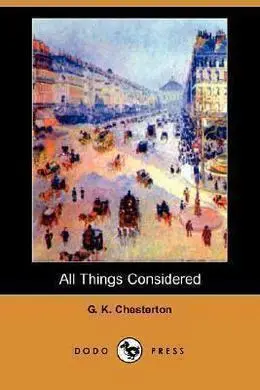
- Название:All Things Considered
- Автор:
- Издательство:epubBooks Classics
- Жанр:
- Год:2014
- ISBN:нет данных
- Рейтинг книги:3 / 5. Голосов: 1
-
Избранное:Добавить в избранное
- Отзывы:
-
Ваша оценка:
All Things Considered: краткое содержание, описание и аннотация
Предлагаем к чтению аннотацию, описание, краткое содержание или предисловие (зависит от того, что написал сам автор книги «All Things Considered»). Если вы не нашли необходимую информацию о книге — напишите в комментариях, мы постараемся отыскать её.
All Things Considered — читать онлайн бесплатно полную книгу (весь текст) целиком
Ниже представлен текст книги, разбитый по страницам. Система сохранения места последней прочитанной страницы, позволяет с удобством читать онлайн бесплатно книгу «All Things Considered», без необходимости каждый раз заново искать на чём Вы остановились. Поставьте закладку, и сможете в любой момент перейти на страницу, на которой закончили чтение.
Интервал:
Закладка:
Now the question is whether this political secrecy is of any of the kinds that can be called legitimate. We have roughly divided legitimate secrets into three classes. First comes the secret that is only kept in order to be revealed, as in the detective stories; secondly, the secret which is kept because everybody knows it, as in sex; and third, the secret which is kept because it is too delicate and vague to be explained at all, as in the choice of a country walk. Do any of these broad human divisions cover such a case as that of secrecy of the political and party finances? It would be absurd, and even delightfully absurd, to pretend that any of them did. It would be a wild and charming fancy to suggest that our politicians keep political secrets only that they may make political revelations. A modern peer only pretends that he has earned his peerage in order that he may more dramatically declare, with a scream of scorn and joy, that he really bought it. The Baronet pretends that he deserved his title only in order to make more exquisite and startling the grand historical fact that he did not deserve it. Surely this sounds improbable. Surely all our statesmen cannot be saving themselves up for the excitement of a death–bed repentance. The writer of detective tales makes a man a duke solely in order to blast him with a charge of burglary. But surely the Prime Minister does not make a man a duke solely in order to blast him with a charge of bribery. No; the detective–tale theory of the secrecy of political funds must (with a sigh) be given up.
Neither can we say that the thing is explained by that second case of human secrecy which is so secret that it is hard to discuss it in public. A decency is preserved about certain primary human matters precisely because every one knows all about them. But the decency touching contributions, purchases, and peerages is not kept up because most ordinary men know what is happening; it is kept up precisely because most ordinary men do not know what is happening. The ordinary curtain of decorum covers normal proceedings. But no one will say that being bribed is a normal proceeding.
And if we apply the third test to this problem of political secrecy, the case is even clearer and even more funny. Surely no one will say that the purchase of peerages and such things are kept secret because they are so light and impulsive and unimportant that they must be matters of individual fancy. A child sees a flower and for the first time feels inclined to pick it. But surely no one will say that a brewer sees a coronet and for the first time suddenly thinks that he would like to be a peer. The child's impulse need not be explained to the police, for the simple reason that it could not be explained to anybody. But does any one believe that the laborious political ambitions of modern commercial men ever have this airy and incommunicable character? A man lying on the beach may throw stones into the sea without any particular reason. But does any one believe that the brewer throws bags of gold into the party funds without any particular reason? This theory of the secrecy of political money must also be regretfully abandoned; and with it the two other possible excuses as well. This secrecy is one which cannot be justified as a sensational joke nor as a common human freemasonry, nor as an indescribable personal whim. Strangely enough, indeed, it violates all three conditions and classes at once. It is not hidden in order to be revealed: it is hidden in order to be hidden. It is not kept secret because it is a common secret of mankind, but because mankind must not get hold of it. And it is not kept secret because it is too unimportant to be told, but because it is much too important to bear telling. In short, the thing we have is the real and perhaps rare political phenomenon of an occult government. We have an exoteric and an esoteric doctrine. England is really ruled by priestcraft, but not by priests. We have in this country all that has ever been alleged against the evil side of religion; the peculiar class with privileges, the sacred words that are unpronounceable; the important things known only to the few. In fact we lack nothing except the religion.
EDWARD VII. AND SCOTLAND
I have received a serious, and to me, at any rate, an impressive remonstrance from the Scottish Patriotic Association. It appears that I recently referred to Edward VII. of Great Britain and Ireland, King, Defender of the Faith, under the horrible description of the King of England. The Scottish Patriotic Association draws my attention to the fact that by the provisions of the Act of Union, and the tradition of nationality, the monarch should be referred to as the King of Britain. The blow thus struck at me is particularly wounding because it is particularly unjust. I believe in the reality of the independent nationalities under the British Crown much more passionately and positively than any other educated Englishman of my acquaintance believes in it. I am quite certain that Scotland is a nation; I am quite certain that nationality is the key of Scotland; I am quite certain that all our success with Scotland has been due to the fact that we have in spirit treated it as a nation. I am quite certain that Ireland is a nation; I am quite certain that nationality is the key to Ireland; I am quite certain that all our failure in Ireland arose from the fact that we would not in spirit treat it as a nation. It would be difficult to find, even among the innumerable examples that exist, a stronger example of the immensely superior importance of sentiment to what is called practicality than this case of the two sister nations. It is not that we have encouraged a Scotchman to be rich; it is not that we have encouraged a Scotchman to be active; it is not that we have encouraged a Scotchman to be free. It is that we have quite definitely encouraged a Scotchman to be Scotch.
A vague, but vivid impression was received from all our writers of history, philosophy, and rhetoric that the Scottish element was something really valuable in itself, was something which even Englishmen were forced to recognise and respect. If we ever admitted the beauty of Ireland, it was as something which might be loved by an Englishman but which could hardly be respected even by an Irishman. A Scotchman might be proud of Scotland; it was enough for an Irishman that he could be fond of Ireland. Our success with the two nations has been exactly proportioned to our encouragement of their independent national emotion; the one that we would not treat nationally has alone produced Nationalists. The one nation that we would not recognise as a nation in theory is the one that we have been forced to recognise as a nation in arms. The Scottish Patriotic Association has no need to draw my attention to the importance of the separate national sentiment or the need of keeping the Border as a sacred line. The case is quite sufficiently proved by the positive history of Scotland. The place of Scottish loyalty to England has been taken by English admiration of Scotland. They do not need to envy us our titular leadership, when we seem to envy them their separation.
I wish to make very clear my entire sympathy with the national sentiment of the Scottish Patriotic Association. But I wish also to make clear this very enlightening comparison between the fate of Scotch and of Irish patriotism. In life it is always the little facts that express the large emotions, and if the English once respected Ireland as they respect Scotland, it would come out in a hundred small ways. For instance, there are crack regiments in the British Army which wear the kilt—the kilt which, as Macaulay says with perfect truth, was regarded by nine Scotchmen out of ten as the dress of a thief. The Highland officers carry a silver–hilted version of the old barbarous Gaelic broadsword with a basket–hilt, which split the skulls of so many English soldiers at Killiecrankie and Prestonpans. When you have a regiment of men in the British Army carrying ornamental silver shillelaghs you will have done the same thing for Ireland, and not before—or when you mention Brian Boru with the same intonation as Bruce.
Читать дальшеИнтервал:
Закладка:
Похожие книги на «All Things Considered»
Представляем Вашему вниманию похожие книги на «All Things Considered» списком для выбора. Мы отобрали схожую по названию и смыслу литературу в надежде предоставить читателям больше вариантов отыскать новые, интересные, ещё непрочитанные произведения.


Обсуждение, отзывы о книге «All Things Considered» и просто собственные мнения читателей. Оставьте ваши комментарии, напишите, что Вы думаете о произведении, его смысле или главных героях. Укажите что конкретно понравилось, а что нет, и почему Вы так считаете.