Гилберт Честертон - All Things Considered
Здесь есть возможность читать онлайн «Гилберт Честертон - All Things Considered» весь текст электронной книги совершенно бесплатно (целиком полную версию без сокращений). В некоторых случаях можно слушать аудио, скачать через торрент в формате fb2 и присутствует краткое содержание. Год выпуска: 2014, Издательство: epubBooks Classics, Жанр: Публицистика, Критика, на английском языке. Описание произведения, (предисловие) а так же отзывы посетителей доступны на портале библиотеки ЛибКат.
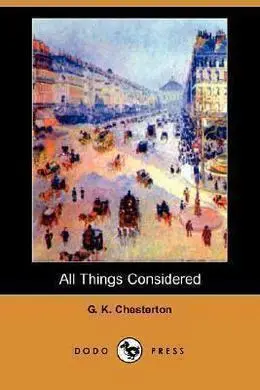
- Название:All Things Considered
- Автор:
- Издательство:epubBooks Classics
- Жанр:
- Год:2014
- ISBN:нет данных
- Рейтинг книги:3 / 5. Голосов: 1
-
Избранное:Добавить в избранное
- Отзывы:
-
Ваша оценка:
All Things Considered: краткое содержание, описание и аннотация
Предлагаем к чтению аннотацию, описание, краткое содержание или предисловие (зависит от того, что написал сам автор книги «All Things Considered»). Если вы не нашли необходимую информацию о книге — напишите в комментариях, мы постараемся отыскать её.
All Things Considered — читать онлайн бесплатно полную книгу (весь текст) целиком
Ниже представлен текст книги, разбитый по страницам. Система сохранения места последней прочитанной страницы, позволяет с удобством читать онлайн бесплатно книгу «All Things Considered», без необходимости каждый раз заново искать на чём Вы остановились. Поставьте закладку, и сможете в любой момент перейти на страницу, на которой закончили чтение.
Интервал:
Закладка:
Sometimes I see small fragments of information in the newspapers which make my heart leap with an irrational patriotic sympathy. I have had the misfortune to be left comparatively cold by many of the enterprises and proclamations of my country in recent times. But the other day I found in the Tribune the following paragraph, which I may be permitted to set down as an example of the kind of international outrage with which I have by far the most instinctive sympathy. There is something attractive, too, in the austere simplicity with which the affair is set forth—
"Geneva, Oct. 31.
"The English schoolboy Allen, who was arrested at Lausanne railway station on Saturday, for having painted red the statue of General Jomini of Payerne, was liberated yesterday, after paying a fine of £24. Allen has proceeded to Germany, where he will continue his studies. The people of Payerne are indignant, and clamoured for his detention in prison."
Now I have no doubt that ethics and social necessity require a contrary attitude, but I will freely confess that my first emotions on reading of this exploit were those of profound and elemental pleasure. There is something so large and simple about the operation of painting a whole stone General a bright red. Of course I can understand that the people of Payerne were indignant. They had passed to their homes at twilight through the streets of that beautiful city (or is it a province?), and they had seen against the silver ending of the sunset the grand grey figure of the hero of that land remaining to guard the town under the stars. It certainly must have been a shock to come out in the broad white morning and find a large vermilion General staring under the staring sun. I do not blame them at all for clamouring for the schoolboy's detention in prison; I dare say a little detention in prison would do him no harm. Still, I think the immense act has something about it human and excusable; and when I endeavour to analyse the reason of this feeling I find it to lie, not in the fact that the thing was big or bold or successful, but in the fact that the thing was perfectly useless to everybody, including the person who did it. The raid ends in itself; and so Master Allen is sucked back again, having accomplished nothing but an epic.
There is one thing which, in the presence of average modern journalism, is perhaps worth saying in connection with such an idle matter as this. The morals of a matter like this are exactly like the morals of anything else; they are concerned with mutual contract, or with the rights of independent human lives. But the whole modern world, or at any rate the whole modern Press, has a perpetual and consuming terror of plain morals. Men always attempt to avoid condemning a thing upon merely moral grounds. If I beat my grandmother to death to–morrow in the middle of Battersea Park, you may be perfectly certain that people will say everything about it except the simple and fairly obvious fact that it is wrong. Some will call it insane; that is, will accuse it of a deficiency of intelligence. This is not necessarily true at all. You could not tell whether the act was unintelligent or not unless you knew my grandmother. Some will call it vulgar, disgusting, and the rest of it; that is, they will accuse it of a lack of manners. Perhaps it does show a lack of manners; but this is scarcely its most serious disadvantage. Others will talk about the loathsome spectacle and the revolting scene; that is, they will accuse it of a deficiency of art, or æsthetic beauty. This again depends on the circumstances: in order to be quite certain that the appearance of the old lady has definitely deteriorated under the process of being beaten to death, it is necessary for the philosophical critic to be quite certain how ugly she was before. Another school of thinkers will say that the action is lacking in efficiency: that it is an uneconomic waste of a good grandmother. But that could only depend on the value, which is again an individual matter. The only real point that is worth mentioning is that the action is wicked, because your grandmother has a right not to be beaten to death. But of this simple moral explanation modern journalism has, as I say, a standing fear. It will call the action anything else—mad, bestial, vulgar, idiotic, rather than call it sinful.
One example can be found in such cases as that of the prank of the boy and the statue. When some trick of this sort is played, the newspapers opposed to it always describe it as "a senseless joke." What is the good of saying that? Every joke is a senseless joke. A joke is by its nature a protest against sense. It is no good attacking nonsense for being successfully nonsensical. Of course it is nonsensical to paint a celebrated Italian General a bright red; it is as nonsensical as "Alice in Wonderland." It is also, in my opinion, very nearly as funny. But the real answer to the affair is not to say that it is nonsensical or even to say that it is not funny, but to point out that it is wrong to spoil statues which belong to other people. If the modern world will not insist on having some sharp and definite moral law, capable of resisting the counter–attractions of art and humour, the modern world will simply be given over as a spoil to anybody who can manage to do a nasty thing in a nice way. Every murderer who can murder entertainingly will be allowed to murder. Every burglar who burgles in really humorous attitudes will burgle as much as he likes.
There is another case of the thing that I mean. Why on earth do the newspapers, in describing a dynamite outrage or any other political assassination, call it a "dastardly outrage" or a cowardly outrage? It is perfectly evident that it is not dastardly in the least. It is perfectly evident that it is about as cowardly as the Christians going to the lions. The man who does it exposes himself to the chance of being torn in pieces by two thousand people. What the thing is, is not cowardly, but profoundly and detestably wicked. The man who does it is very infamous and very brave. But, again, the explanation is that our modern Press would rather appeal to physical arrogance, or to anything, rather than appeal to right and wrong.
In most of the matters of modern England, the real difficulty is that there is a negative revolution without a positive revolution. Positive aristocracy is breaking up without any particular appearance of positive democracy taking its place. The polished class is becoming less polished without becoming less of a class; the nobleman who becomes a guinea–pig keeps all his privileges but loses some of his tradition; he becomes less of a gentleman without becoming less of a nobleman. In the same way (until some recent and happy revivals) it seemed highly probable that the Church of England would cease to be a religion long before it had ceased to be a Church. And in the same way, the vulgarisation of the old, simple middle class does not even have the advantage of doing away with class distinctions; the vulgar man is always the most distinguished, for the very desire to be distinguished is vulgar.
At the same time, it must be remembered that when a class has a morality it does not follow that it is an adequate morality. The middle–class ethic was inadequate for some purposes; so is the public–school ethic, the ethic of the upper classes. On this last matter of the public schools Dr. Spenser, the Head Master of University College School, has lately made some valuable observations. But even he, I think, overstates the claim of the public schools. "The strong point of the English public schools," he says, "has always lain in their efficiency as agencies for the formation of character and for the inculcation of the great notion of obligation which distinguishes a gentleman. On the physical and moral sides the public–school men of England are, I believe, unequalled." And he goes on to say that it is on the mental side that they are defective. But, as a matter of fact, the public–school training is in the strict sense defective upon the moral side also; it leaves out about half of morality. Its just claim is that, like the old middle class (and the Zulus), it trains some virtues and therefore suits some people for some situations. Put an old English merchant to serve in an army and he would have been irritated and clumsy. Put the men from English public schools to rule Ireland, and they make the greatest hash in human history.
Читать дальшеИнтервал:
Закладка:
Похожие книги на «All Things Considered»
Представляем Вашему вниманию похожие книги на «All Things Considered» списком для выбора. Мы отобрали схожую по названию и смыслу литературу в надежде предоставить читателям больше вариантов отыскать новые, интересные, ещё непрочитанные произведения.


Обсуждение, отзывы о книге «All Things Considered» и просто собственные мнения читателей. Оставьте ваши комментарии, напишите, что Вы думаете о произведении, его смысле или главных героях. Укажите что конкретно понравилось, а что нет, и почему Вы так считаете.